 StudyDesk
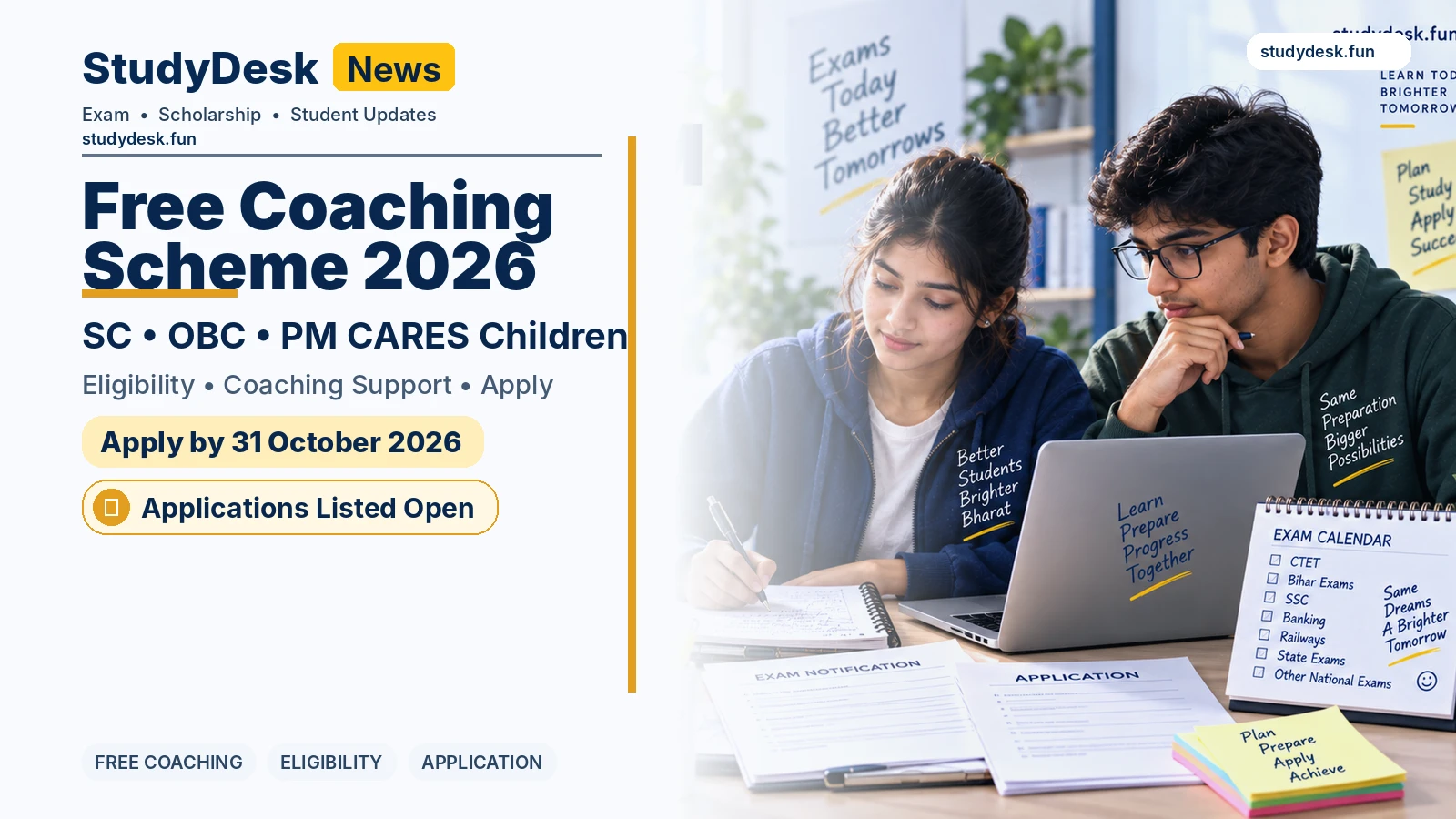
Free Coaching for SC/OBC & PM CARES Children: what this scheme actually does
This is one of the few central government schemes that does not hand you cash for college — it pays for your preparation. If you belong to the Scheduled Castes or Other Backward Classes and want to crack UPSC, SSC, banking exams, JEE, NEET, CAT, CLAT, GATE or even GRE and TOEFL, the Ministry of Social Justice & Empowerment will cover your coaching fee up to a prescribed cap and pay you a monthly stipend while you prepare. Since 2024-25, children covered under the PM CARES Children Scheme are included as well.
The scheme is implemented by the Dr. Ambedkar Foundation through coaching centres — Dr. Ambedkar Centres of Excellence (DACE) — at empanelled Central Universities. You choose a coaching institute of your choice and attend in physical mode; online-only coaching is not supported.
Who is eligible
There are three doors into this scheme, and they are not the same.
SC and OBC students. Your family's total annual income from all sources must be ₹8 lakh or less. There are also academic floors that trip up a lot of applicants: if the exam you are preparing for requires Class XII as the qualifying examination, you need at least 50% marks in Class X; if the exam requires a graduation-level qualification, you need at least 50% in Class XII. You must have passed Class XII or be studying in Class XII at the time you get the benefit (for XII-level exams), or have completed graduation or be in the final year of graduation (for graduate-level exams).
PM CARES Children Scheme beneficiaries. If you hold the central certificate (with beneficiary ID) confirming your status, you are eligible with no income ceiling, no caste condition and no merit shortlist — the Central University must admit you over and above its normal seat allocation.
Two hard exclusions. You can take the benefit at most twice in your lifetime, no matter how many attempts your target exam allows. And you cannot simultaneously hold another similar coaching assistance scheme of the Centre or a State/UT — you sign a declaration to that effect, and the beneficiary list is published and shared with States to prevent double-dipping.
How much the government pays
The support has three parts, all paid through Direct Benefit Transfer into your Aadhaar-seeded bank account.
Coaching fee. The government pays the actual course fee you were charged or the prescribed maximum for that course, whichever is lower. The caps are worth knowing before you pick an institute: civil services (UPSC/State PSCs) ₹75,000 for up to 12 months; SSC and RRB ₹40,000; banking, insurance, PSU and CLAT ₹50,000; JEE and NEET ₹75,000; engineering services (IES) ₹75,000; CAT and CMAT ₹50,000; GRE, GMAT, SAT, IELTS and TOEFL ₹35,000; CA-CPT and GATE ₹75,000; CPL courses ₹30,000; NDA and CDS ₹20,000. If your institute charges more than the cap, you arrange the difference yourself. The fee is released in two instalments of 50% each — the first at the start of the course, the second after 75% of the course duration is complete — and you must remit the university's portion to the Central University within 15 days.
Stipend. ₹4,000 per month for the actual months of coaching, up to 12 months. A minimum of 16 hours of physical coaching per week is mandatory, and attendance is recorded through Aadhaar-based biometric systems, reported monthly to the Dr. Ambedkar Foundation.
Interview incentive. Students who clear the mains stage of Central or State Civil Services examinations for Class 1 and Class 2 posts get an additional ₹15,000 for interview-stage coaching.
Which exams are covered
The course list is broad: Group A and B examinations of the UPSC, SSC and Railway Recruitment Boards; Group A and B exams of State Public Service Commissions; officers'-grade exams of banks, insurance companies and PSUs; premier entrance examinations for engineering (IIT-JEE), medical (NEET), management (CAT) and law (CLAT); eligibility tests like SAT, GRE, GMAT, IELTS and TOEFL; and entrance tests for CPL courses, the National Defence Academy and the Combined Defence Services.
Seats and selection
The scheme selects 3,500 students every year. Each empanelled Central University gets up to 100 slots (excluding PM CARES beneficiaries, who are admitted over and above). Within those slots, at least 70% go to SC students and 30% to OBC students — the SC share can never drop below 50% even when candidates are unavailable — and 30% of the slots in each category are reserved for women. A university may offer at most four courses and must take at least 25 students per course and at least 50 students overall to keep the centre viable.
For SC and OBC students, selection is merit-based: the empanelled Central University screens eligible applicants on the merit of marks in Class X or XII and prepares a shortlist. Only online applications are entertained, incomplete applications are summarily rejected (you can reapply in a later year), and PM CARES beneficiaries skip the entire selection procedure.
How to apply
Applications for the scheme are listed on the National Scholarship Portal (scholarships.gov.in) — the current listing shows the 2026 cycle open with student applications shown till 31 October 2026. Separately, empanelled Central Universities issue their own advertisements inviting eligible students to apply for the courses allocated to them. In practice you should watch both channels: the NSP listing and the advertisements from Central Universities running DACE centres. Keep your Aadhaar number (or EID at the time of application), Aadhaar-seeded bank account, income certificate from a Tehsildar-rank revenue officer (or your employer's certificate consolidated by the revenue officer for salaried families), and Class X/XII marks ready.
Common mistakes
The 50% marks floor knocks out more applicants than anything else — read the guidelines before assuming your board scores qualify. The income declaration must come from the correct authority; a random employer letter is not enough. Do not apply if you already hold a similar state coaching scholarship — false information invites recovery of the money with 15% compound interest. And absence matters: staying away for more than four days in a month without an acceptable reason like a medical or household emergency can get your candidature cancelled.
Current status, honestly stated
The guidelines in force were issued for 2024-25. On the NSP, the 2026 cycle shows open from 3 August 2026 with student applications listed till 31 October 2026 — treat that as the working deadline, but verify it on the live listing: one secondary report described a separate May 2026 window on the coaching.dosje.gov.in portal, and the two channels need reconciling before you act on a date.
Sources & verification
Checked against Department of Social Justice & Empowerment / NSP's official source on 6 September 2026. Closed, renewal-only, expected and open statuses are kept separate.
Frequently asked questions
Who is eligible for the Free Coaching Scheme?
SC and OBC students whose family income from all sources is ₹8 lakh or less, subject to marks floors — at least 50% in Class X for exams requiring Class XII, or at least 50% in Class XII for graduate-level exams. PM CARES Children Scheme beneficiaries holding the central certificate are eligible with no income ceiling, no caste condition and no merit shortlist.
How much coaching fee and stipend does the scheme pay?
The government pays the actual course fee or the prescribed cap, whichever is lower — for example ₹75,000 for civil services and for JEE and NEET, and ₹50,000 for banking, insurance, PSU and CLAT — plus a stipend of ₹4,000 per month for the actual months of coaching, up to 12 months, paid by DBT into your Aadhaar-seeded bank account.
Which exams does the Free Coaching Scheme cover?
Group A and B examinations of the UPSC, SSC and Railway Recruitment Boards and State PSCs; officers'-grade exams of banks, insurance companies and PSUs; entrance examinations for engineering (IIT-JEE), medical (NEET), management (CAT) and law (CLAT); tests like SAT, GRE, GMAT, IELTS and TOEFL; and entrance tests for CPL courses, NDA and CDS.
How many students are selected each year?
The scheme selects 3,500 students every year, with each empanelled Central University getting up to 100 slots (excluding PM CARES beneficiaries, who are admitted over and above). At least 70% of slots go to SC students and 30% to OBC students, and 30% of slots in each category are reserved for women.
How many times can I take this benefit?
At most twice in your lifetime, and you cannot simultaneously hold another similar coaching assistance scheme of the Centre or a State/UT — you sign a declaration to that effect.
What is the application deadline for 2026?
The scheme is listed on the National Scholarship Portal with the 2026 cycle open from 3 August 2026 and student applications shown till 31 October 2026 — treat that as the working deadline but verify it on the live listing, and also watch advertisements from Central Universities running DACE centres.
NSP 2026–27 guide covering the open Academic Year 2026–27 portal, mandatory OTR, scheme-specific deadlines, fresh/renewal applications and verification stages.
Top Class Education Scholarship for ST Students 2026–27 current scholarship status, eligibility, benefits, application process, deadline and official-source verification.
Top Class Education Scholarship for SC Students 2026–27 current scholarship status, eligibility, benefits, application process, deadline and official-source verification.
PM-USP CSSS Scholarship 2026–27 current scholarship status, eligibility, benefits, application process, deadline and official-source verification.
PM Scholarship for Wards of State/UT Police Personnel 2026–27 current scholarship status, eligibility, benefits, application process, deadline and official-source verification.