 StudyDesk

UPSC ESE 2027: the application window has closed — 31 January is the fixed target
The Engineering Services Examination is the Union Public Service Commission's route into the Government of India's engineering services — Group A and Group B posts across ministries, railways, CPWD, defence, power, telecommunications and related departments. UPSC issued Examination Notice No. 02/2027-ENGG on 16 September 2026 for approximately 480 vacancies, including 19 reserved for Persons with Benchmark Disabilities. The online application window closed on 6 October 2026 at 6 PM, and the notice permits no withdrawal or correction of a submitted application. The next two milestones on the official annual calendar are the Preliminary (Stage-I) examination on 31 January 2027 and the Main (Stage-II) examination on 18 June 2027.
Who can apply: the eligibility structure
ESE 2027 is open only to four engineering disciplines, and you apply under exactly one of them: Civil Engineering (Category I), Mechanical Engineering (Category II), Electrical Engineering (Category III), and Electronics & Telecommunication Engineering (Category IV). There is no mixing — your discipline determines your Paper-II subject, your service allocations and your Main papers.
Educational qualification: a degree in engineering from a recognised university or institution, or equivalent qualifications such as passing Sections A and B of the Institution of Engineers (India) examinations. For specific posts — notably IRRS (Group A) and INAS (Electronics Engineering posts) — an M.Sc. with Wireless Communication, Electronics, Radio Physics or Radio Engineering is also accepted. Final-year candidates could apply provisionally, subject to meeting the qualification conditions by the date specified in the notice. The notification also contains detailed eligibility notes for candidates admitted to qualifications after 31 May 2013 — an ESE-specific provision that past aspirants know to check rather than assume.
Age: a candidate must have attained 21 years and must not have attained 30 years as on 1 January 2027 — in practice, born between 2 January 1997 and 1 January 2006. Upper-age relaxation is up to 5 years for SC/ST, 3 years for OBC, and up to 10 years for PwBD candidates, with additional relaxations for departmental candidates and certain other categories as per the notice. The application fee was ₹200, with Female, SC, ST and PwBD candidates exempted from payment.
The three-stage pattern
Stage-I is the Preliminary Examination: objective papers totalling 500 marks — Paper I on General Studies and Engineering Aptitude (200 marks) and Paper II on the discipline-specific paper (300 marks), with a penalty of one-third of the marks assigned for each wrong answer in objective papers. Stage-II is the Main Examination: two conventional (descriptive) engineering papers, 300 marks and three hours each, totalling 600 marks, set and answered in English. Stage-III is the Personality Test, 200 marks. The final ranking is on 1,300 marks, and — unlike the Civil Services Examination — the Preliminary marks count toward the final ranking. That single fact changes strategy: Paper I's General Studies and Engineering Aptitude section cannot be treated as a mere qualifier, because every mark feeds your final position.
What applicants should do now
If you applied, the immediate job is verification: confirm your registration number and application acknowledgement from upsconline.nic.in (the new OTR-based application portal), and check that the photograph, signature and ID details in your application are clean — the notice allowed no post-submission correction. Then track the Commission's website for the e-admit card, which typically appears a few weeks before the exam; no paper admit card is issued. Note the exam-day discipline ESE demands: conventional Main papers require sustained three-hour descriptive writing practice in English, and the Personality Test is a structured assessment of engineering temperament, not a viva on textbook definitions.
A note on vacancies and service allocation
The figure of approximately 480 vacancies — including 19 for PwBD candidates — is the Commission's estimate at notification, and UPSC states it is liable to change. Vacancies are distributed across the four engineering categories and across services within each category, and final allocation depends on your rank, your category, the preferences you recorded, and medical fitness for the specific service. A high rank in a low-vacancy category can therefore produce a narrower choice of services than the headline number suggests, which is another reason the discipline choice at application mattered more than any later preference list can repair.
Two traps specific to ESE: first, applying under the wrong engineering category — your discipline choice is locked to your paper and services, so a mismatch with your degree closes the options you actually wanted. Second, the birth-date window is computed against 1 January 2027, and the notice's relaxations apply to specific defined categories; verify your category claim against the notification's own language rather than a summary. With the application window closed, the preparation window is now fixed: Prelims on 31 January 2027, Main on 18 June 2027 — plan backwards from those dates.
Sources & verification
Opened UPSC's active-examinations list today: the Engineering Services (Preliminary) Examination, 2027 is no longer listed, consistent with the 6 October 2026 6:00 PM cut-off passing. Current reporting of the official notification confirms the link was disabled after the cut-off, ~480 vacancies, prelims 31 Jan 2027 and Main 18 Jun 2027.
Frequently asked questions
When is the UPSC ESE 2027 Prelims and Main exam?
The Preliminary (Stage-I) examination is on 31 January 2027 and the Main (Stage-II) examination is on 18 June 2027. The application window closed on 6 October 2026 at 6 PM, and the notice permits no withdrawal or correction of a submitted application.
How many vacancies are there in ESE 2027?
Approximately 480 vacancies, including 19 reserved for Persons with Benchmark Disabilities. The figure is the Commission's estimate at notification and UPSC states it is liable to change.
Which engineering disciplines can apply for ESE 2027?
Four only, and you apply under exactly one: Civil Engineering (Category I), Mechanical Engineering (Category II), Electrical Engineering (Category III), and Electronics & Telecommunication Engineering (Category IV).
What is the age limit for ESE 2027?
You must have attained 21 years and must not have attained 30 years as on 1 January 2027 — born between 2 January 1997 and 1 January 2006. Relaxation is up to 5 years for SC/ST, 3 years for OBC, and up to 10 years for PwBD candidates.
What was the ESE 2027 application fee?
₹200. Female, SC, ST and PwBD candidates were exempted from payment.
Do ESE Prelims marks count in the final result?
Yes. Unlike the Civil Services Examination, Preliminary marks count toward the final ranking in ESE. The final ranking is on 1,300 marks — Prelims 500, Main 600 and Personality Test 200.

UPSC Combined Geo-Scientist Preliminary Examination 2027 application closure, prelims date and stage tracker.

Coast Guard Enrolled Persons Test (CGEPT) batches 01/2027 and 02/2027: 365 vacancies, applications 6-21 October 2026, eligibility and selection process.

Track UPSC CSE 2027 registration, exam date, eligibility, fees, syllabus, admit card and result notices in one place. Current status: 2027 annual calendar released. Confirm time-sensitive details on the linked official source before acting.
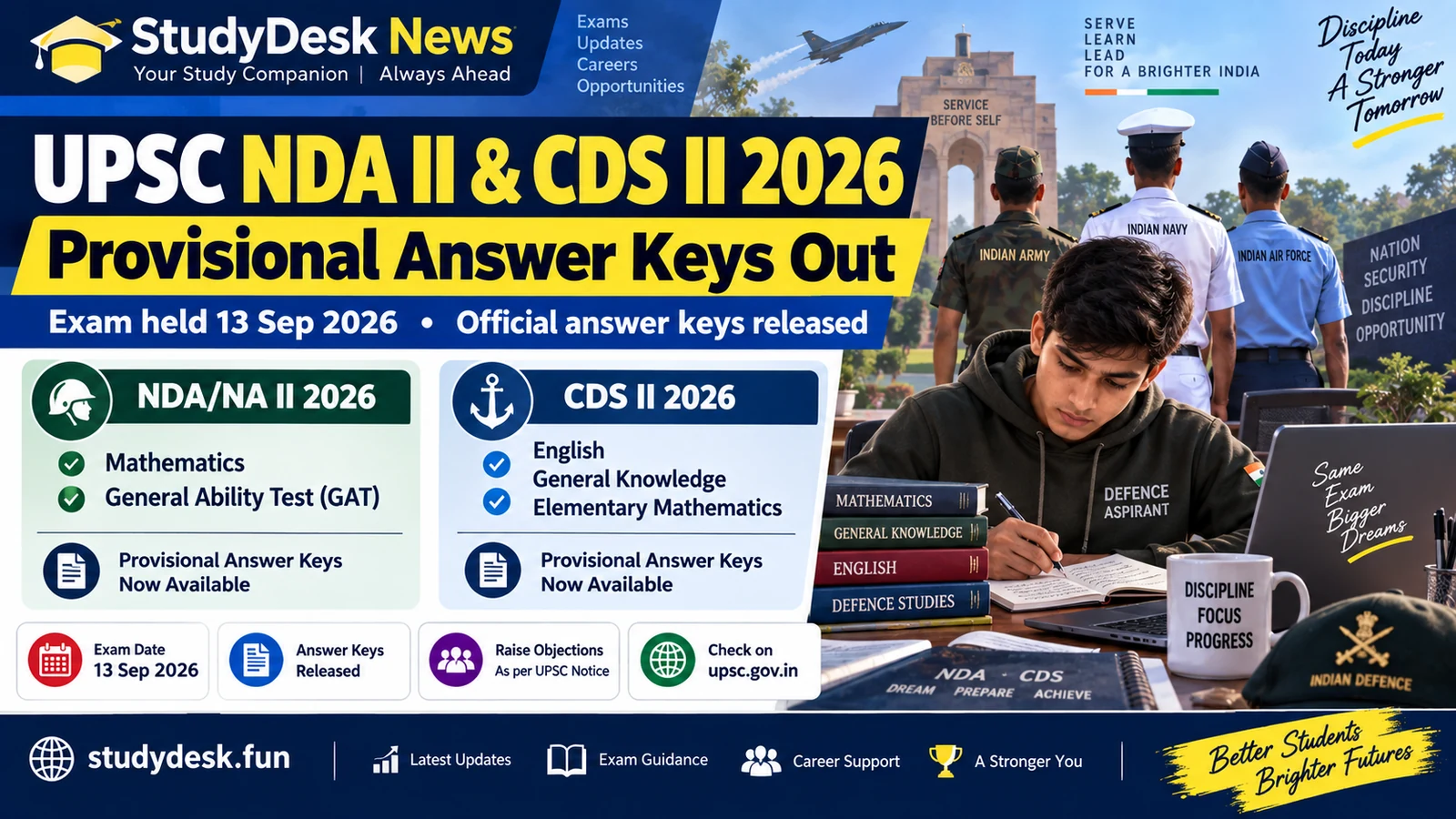
UPSC has published provisional answer keys for the 13 September 2026 NDA/NA II and CDS II examinations. Candidates can download the subject-wise keys from UPSC.

Track NDA 2027 registration, exam date, eligibility, fees, syllabus, admit card and result notices in one place. Current status: 2027 annual calendar released. Confirm time-sensitive details on the linked official source before acting.