 StudyDesk

What this examination recruits for
The Combined Geo-Scientist Examination is UPSC's single entry route into two scientific services. Category-I posts sit in the Geological Survey of India under the Ministry of Mines: Geologist, Geophysicist and Chemist (Group A), and Assistant Geologist, Assistant Geophysicist and Assistant Chemist (Group B). Category-II posts sit in the Central Ground Water Board under the Ministry of Jal Shakti: Scientist 'B' in Hydrogeology, Chemical and Geophysics (Group A), and Assistant Hydrogeologist, Assistant Chemist and Assistant Geophysicist (Group B). This cycle carries 127 tentative vacancies across the two categories. The work is field-and-lab science — geological mapping and mineral exploration at GSI, groundwater assessment at CGWB — not desk administration, which is why the eligibility is built around postgraduate science degrees rather than a general graduate pool.
Who was eligible to apply
Candidates had to be between 21 and 32 years of age on 1 January 2027 — born not earlier than 2 January 1995 and not later than 1 January 2006. The upper limit relaxes by five years for SC and ST candidates, three years for OBC, and ten years for persons with benchmark disability, alongside the standard relaxations for government servants, ex-servicemen and defence personnel disabled in operations, as set out in the notice.
The educational bar is a Master's degree in the discipline matching the post: Geology, Applied Geology or allied subjects (including Mineral Exploration, Marine Geology, Earth Science and Geochemistry) for the Geologist line and for Scientist 'B' (Hydrogeology)/Assistant Hydrogeologist, where Hydrogeology itself also qualifies; M.Sc. in Physics, Applied Physics or Geophysics (including Exploration, Applied and Marine Geophysics) for the Geophysicist line; and M.Sc. in Chemistry, Applied Chemistry or Analytical Chemistry for the Chemist line. Final-year postgraduate students could apply, but eligibility is verified against original documents only after a candidate qualifies for the Personality Test — an e-admit card is not proof that UPSC has cleared your candidature.
The application fee was ₹200, payable by card, net banking or UPI, and non-refundable. Female candidates and SC, ST and PwBD candidates were exempt.
How the selection runs
Selection has three stages, and — unlike a pure screening model — marks from every stage count toward the final merit list of 1,200 marks.
Stage-I, the Preliminary Examination (10 January 2027, 400 marks) is a one-day, objective, OMR-based screening held across 21 centres, from Ahmedabad and Bengaluru to Shillong and Thiruvananthapuram. Every candidate writes Paper-I, General Studies (100 marks, two hours, pitched at the level of a science graduate), and Paper-II in their stream — Geology/Hydrogeology, Geophysics or Chemistry (300 marks, two hours). Wrong answers attract a penalty of one-third of the marks assigned to the question; unanswered questions carry none. Calculators are not permitted, answers must be marked in black ball pen only, and entry to the venue closes 30 minutes before each session, with mandatory face authentication at the door.
Stage-II, the Main Examination (19–20 June 2027, 600 marks) is conventional and descriptive: three papers in your stream, written in English. Only candidates who clear the prelims cutoff are admitted, through a separate application stage that UPSC opens after the prelims result.
Stage-III, the Personality Test (200 marks), follows for mains qualifiers, with document verification against age, degree, community, EWS and PwBD claims, and a medical-fitness check under the examination rules.
What applicants should be doing now
First, protect your paperwork. Keep the final submitted application, the URN (your lifetime Universal Registration Number on the new UPSC portal) and this exam's Application Number safe — the portal's four-module structure (account creation, Universal Registration, Common Application Form, and the exam-specific module) means future correspondence runs off those identifiers, and no correction or withdrawal is possible after submission.
Second, watch for the e-admit card. UPSC issues it on the last working day of the week preceding the examination — so expect it in the first week of January 2027, downloadable from upsconline.nic.in. Nothing arrives by post. Check the name, photograph, centre and session timings the day it appears, not the night before the exam; centres were allotted first-apply-first-allot with capacity ceilings, so your allotted centre may not be your first preference.
Third, know the answer-key drill in advance. After the prelims, UPSC opens an online representation window against the questions and the provisional answer keys of the objective papers: five days, running from the third day after the examination to 6:00 PM on the seventh day, through the 'Examinations > Representations on Question Paper & Provisional Answer Keys' section at upsconline.nic.in. Representations by email, post or hand are not accepted, and nothing is entertained after the window closes. If you believe a question or key is wrong, that short window is your only remedy.
Common mistakes at this stage
Losing the URN or Application Number and being unable to download the admit card; assuming a change of exam centre can be requested later — the notice states plainly that no such request will be granted; carrying a phone or smartwatch into the venue, which is prohibited even switched off and can draw a ban from future examinations; and arriving after the 30-minute entry closure, for which there is no exception. Application-stage queries were handled during the window on the helpline (011-24041001 / 011-40303444, [email protected]); for the examination phase, the admit-card instructions and the notice itself are the operative documents.
Sources & verification
Opened the official UPSC Combined Geo-Scientist (Preliminary) Examination, 2027 page today: last date for receipt of applications was 22/09/2026 6:00 PM (passed, no extension notice); prelims 10/01/2027, one day. The exam no longer appears in UPSC's active-examinations list. Main 19–20 June 2027 per the official schedule as currently reported.
Frequently asked questions
When is the UPSC Combined Geo-Scientist Prelims 2027?
The Preliminary Examination is on 10 January 2027. The Main Examination follows on 19–20 June 2027, and the Personality Test carries 200 marks after that.
How many vacancies are there in the Geo-Scientist 2027 cycle?
This cycle carries 127 tentative vacancies across Category-I posts in the Geological Survey of India and Category-II posts in the Central Ground Water Board.
What was the application fee, and who was exempt?
The fee was ₹200, payable by card, net banking or UPI, and non-refundable. Female candidates and SC, ST and PwBD candidates were exempt.
What is the age limit for Geo-Scientist 2027?
Candidates had to be between 21 and 32 years of age on 1 January 2027 — born not earlier than 2 January 1995 and not later than 1 January 2006. The upper limit relaxes by five years for SC and ST candidates, three years for OBC, and ten years for persons with benchmark disability.
When will the e-admit card be available?
UPSC issues it on the last working day of the week preceding the examination, so expect it in the first week of January 2027, downloadable from upsconline.nic.in. Nothing arrives by post.
Is there negative marking in the prelims?
Yes. A wrong answer attracts a penalty of one-third of the marks assigned to the question, while unanswered questions carry no penalty. The prelims total 400 marks: Paper-I General Studies (100 marks) and Paper-II in your stream (300 marks).

Coast Guard Enrolled Persons Test (CGEPT) batches 01/2027 and 02/2027: 365 vacancies, applications 6-21 October 2026, eligibility and selection process.
Track UPSC CSE 2027 registration, exam date, eligibility, fees, syllabus, admit card and result notices in one place. Current status: 2027 annual calendar released. Confirm time-sensitive details on the linked official source before acting.
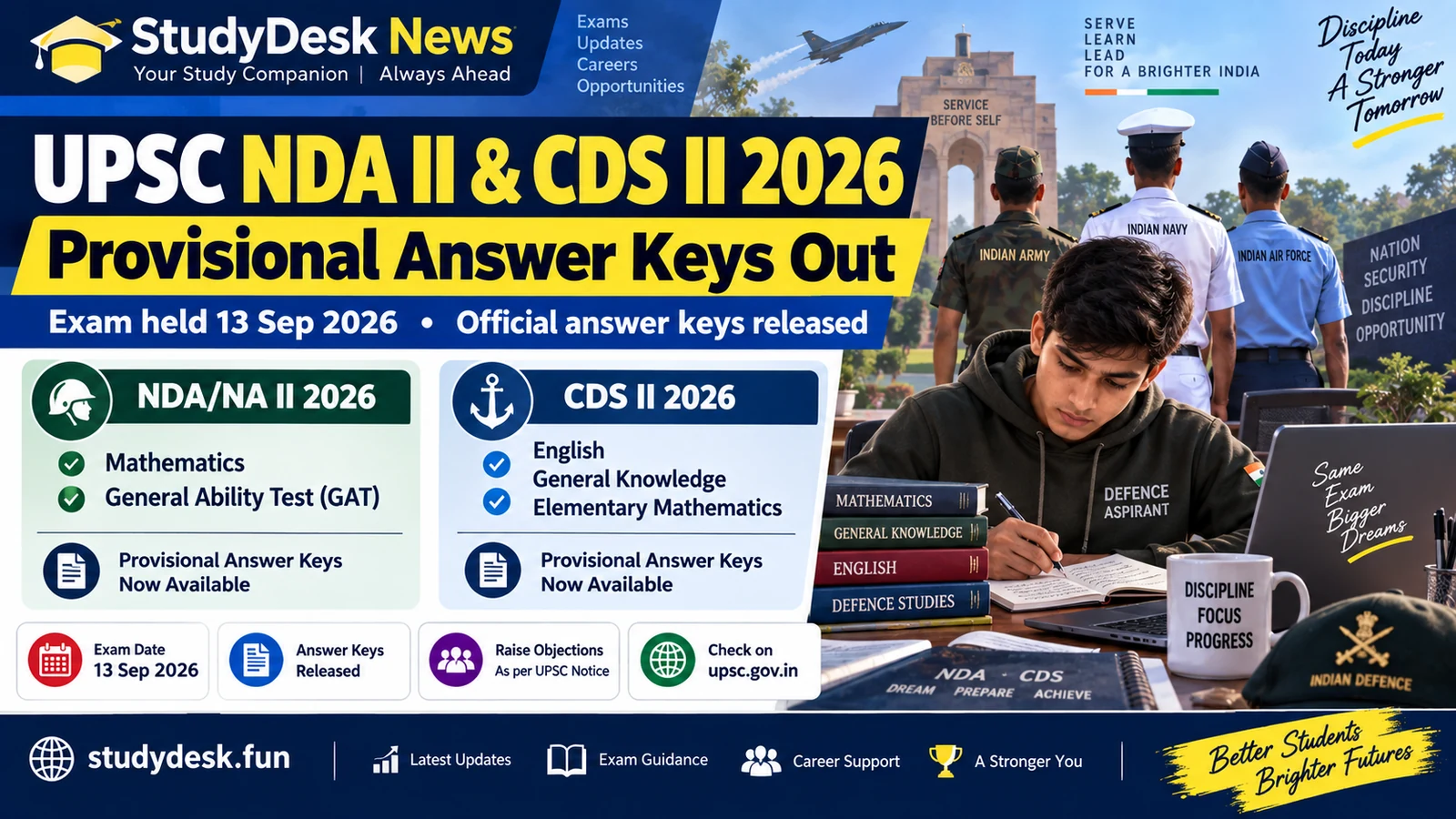
UPSC has published provisional answer keys for the 13 September 2026 NDA/NA II and CDS II examinations. Candidates can download the subject-wise keys from UPSC.
Track NDA 2027 registration, exam date, eligibility, fees, syllabus, admit card and result notices in one place. Current status: 2027 annual calendar released. Confirm time-sensitive details on the linked official source before acting.

Track CDS 2027 registration, exam date, eligibility, fees, syllabus, admit card and result notices in one place. Current status: 2027 annual calendar released. Confirm time-sensitive details on the linked official source before acting.