 StudyDesk

Rhodes Scholarship India 2027: five places, one closed door — and how the next one opens
The Rhodes Scholarship is the oldest international scholarship in the world and still one of the hardest to win: for the October 2027 entry, India had exactly five places. The application window for this cycle has already closed — applications ran from 1 June 2026 to 23:59 IST on 23 July 2026, with referees given until 6 August 2026 to submit references — and the selection process is now under way. If you missed it, this page is still worth reading carefully: the eligibility rules are strict, unusual, and worth checking a full year before the next window opens, because two of them cannot be fixed at the last minute.
What the scholarship is
The Rhodes Scholarship, established in 1902 and administered by the Rhodes Trust at Rhodes House, Oxford, funds full-time postgraduate study at the University of Oxford. It is awarded country by country — each country or region is a "constituency" with its own places, deadlines and selection committee; India is one such constituency. The Trust looks for more than marks: its founding criteria combine academic excellence with energy of character, leadership, integrity and commitment to service — the "fighting the world's fight" idea that still shapes the interview room.
The award is fully funded. It covers Oxford course fees in full, and pays an annual stipend to cover living costs — for 2026–27 the stipend was £21,060 for the year (£1,755 a month), from which scholars pay their own rent and living expenses. It also covers the costs around the degree itself, such as the visa and health surcharge and travel to and from Oxford, per the Trust's terms. The scholarship normally runs for two years, extending to three where the chosen course (such as a DPhil) requires it. One crucial condition: selection is not admission. A Rhodes Scholar-elect must still apply to and be offered a place by Oxford for their chosen course; the scholarship is confirmed only once that offer is in hand.
Who can apply from India — the four hard rules
The Rhodes Trust's official India eligibility conditions for the 2027 scholarship (entry October 2027) are:
- Citizenship.You must be a citizen of India, holding an Indian passport or equivalent proof of citizenship. PIO and OCI card holders do not satisfy this requirement. Applications from refugees and asylum seekers in India are also considered.
- Education and residency.You must have undertaken formal study at an educational institution in India for a minimum of four of the last ten years, and you must either have completed a school-leaving examination (Class 10 or 12 or equivalent) at a school in India, or be in the final year of — or have completed — an undergraduate degree at a university in India.
- Age.On 1 October 2026 you must be aged 18 to 23 — born after 1 October 2002 and before 2 October 2008. There is one exception for late starters: if you began your degree later than usual, you may apply while under 27 on 1 October 2026 (born after 1 October 1999), provided you completed the academic requirements for your first undergraduate degree on or after 1 October 2025. These cut-offs are applied exactly; a day outside them is outside.
- Academic standing.You must have completed your undergraduate degree by July 2027, with a record that at minimum meets the entry requirements of your chosen full-time Oxford course. The Trust notes that a First Class Honours degree or equivalent materially improves your chance of Oxford admission.
If you have a genuine connection to two constituencies but fail the India citizenship or education tests, the Trust offers an Inter-Jurisdictional route — a narrow exception, not a workaround. You may apply for the Rhodes a maximum of twice in your lifetime, through the same constituency.
How the 2027 cycle ran — and what happens next
Applications for India opened on the Rhodes online portal on 1 June 2026 and closed on 23 July 2026. There is no application fee. The application itself asks for your academic record and transcripts, a CV, a personal statement, your proposed Oxford course, and references — your referees submit separately, which is why they had their own deadline of 6 August 2026. Shortlisted candidates go through interview rounds with the national selection committee in the autumn (first rounds in September–October, final interviews in person in November, on the pattern reported for this cycle), and all applicants are informed of the outcome by email, with the scholars-elect then applying to Oxford for their courses ahead of an October 2027 start.
For the next cycle — scholarships for October 2028 entry — expect the same shape: an early-June opening and a late-July closing for India, announced on rhodeshouse.ox.ac.uk. That window is short and India's is among the earliest of all constituencies, which is precisely why preparation starts now.
If you are aiming at the next cycle
- Check the age and education rules first, today. If you will be over 23 on 1 October of the application year and do not fit the late-starter exception, no statement can rescue the application.
- Choose referees early. Four referees who know your work and character well, briefed months ahead, matter more than a famous name who writes two lines. Their deadline is separate from yours and just as absolute.
- Pick the Oxford course before you write. The personal statement and the course choice are read together; a vague "any master's at Oxford" application reads as exactly that.
- Treat the personal statement as the centre of the file. It must be your own story — specific work, specific commitments, specific reasons for Oxford — within the Trust's rules that it be written by you, unaided.
- Do not bet everything on five places. Apply in parallel to other fully funded routes for the same Oxford course where eligible.
Common mistakes
- Assuming OCI status qualifies. It does not, for the India constituency — this ends more applications than any academic factor.
- Missing that India closes in July while other constituencies close in the autumn. Rhodes deadlines are constituency-specific.
- Leaving references to the last week. A missing reference on 6 August makes a complete application incomplete.
- Confusing selection with Oxford admission. Budget time after selection for the Oxford graduate application and its own course deadlines.
The 2027 India round is closed and its five scholars will be named through the selection process this autumn. For everyone else, the work that decides the next round — grades, referees, a real record of service, and a settled course choice — is done in the year before the portal opens, not in the seven weeks it stays open.
Sources & verification
Checked against Rhodes Trust's official source on 6 September 2026. Closed, renewal-only, expected and open statuses are kept separate.
Frequently asked questions
How many Rhodes Scholarships are there for India?
India had exactly five places for the October 2027 entry.
When did applications for the Rhodes Scholarship India 2027 close?
Applications ran from 1 June 2026 to 23:59 IST on 23 July 2026, with referees given until 6 August 2026 to submit references. There is no application fee.
Can OCI or PIO card holders apply through the India constituency?
No. You must be a citizen of India, holding an Indian passport or equivalent proof of citizenship; PIO and OCI card holders do not satisfy this requirement. Applications from refugees and asylum seekers in India are also considered.
What is the education requirement for Indian applicants?
You must have undertaken formal study at an educational institution in India for a minimum of four of the last ten years, and either have completed a school-leaving examination (Class 10 or 12 or equivalent) at a school in India, or be in the final year of — or have completed — an undergraduate degree at a university in India.
What is the age limit?
On 1 October 2026 you must be aged 18 to 23 — born after 1 October 2002 and before 2 October 2008. Late starters may apply while under 27 on 1 October 2026, provided they completed the academic requirements for their first undergraduate degree on or after 1 October 2025.
What does the Rhodes Scholarship cover?
Oxford course fees in full, and an annual stipend to cover living costs — for 2026–27 the stipend was £21,060 for the year (£1,755 a month) — as well as the costs around the degree itself, such as the visa and health surcharge and travel to and from Oxford, per the Trust's terms. It normally runs for two years, extending to three where the chosen course requires it.
Chevening India 2027–28 current scholarship status, eligibility, benefits, application process, deadline and official-source verification.
The Narotam Sekhsaria Foundation says the 2026 application process is closed; its published deadline was 23 March 2026. This page explains the interest-free support model, eligibility and what to watch for in the next annual call.
The Inlaks Foundation states that applications for 2026 are closed and shortlisted candidates have been informed. This guide explains the current closed status, eligibility and funding structure while you monitor the official page for the next cycle.
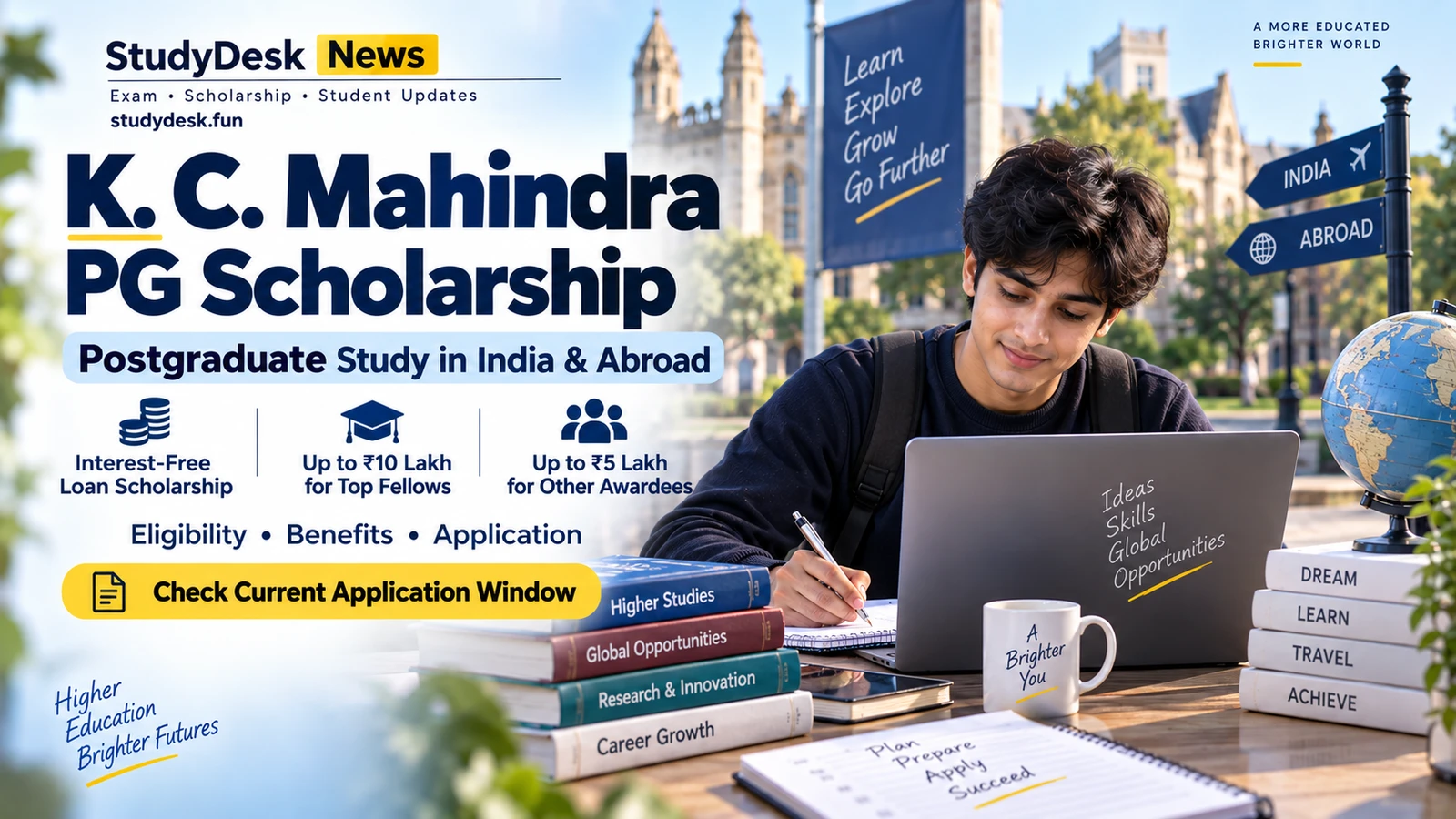
K. C. Mahindra PG Scholarship current scholarship status, eligibility, benefits, application process, deadline and official-source verification.
Fulbright-Nehru 2027–28 current scholarship status, eligibility, benefits, application process, deadline and official-source verification.