 StudyDesk
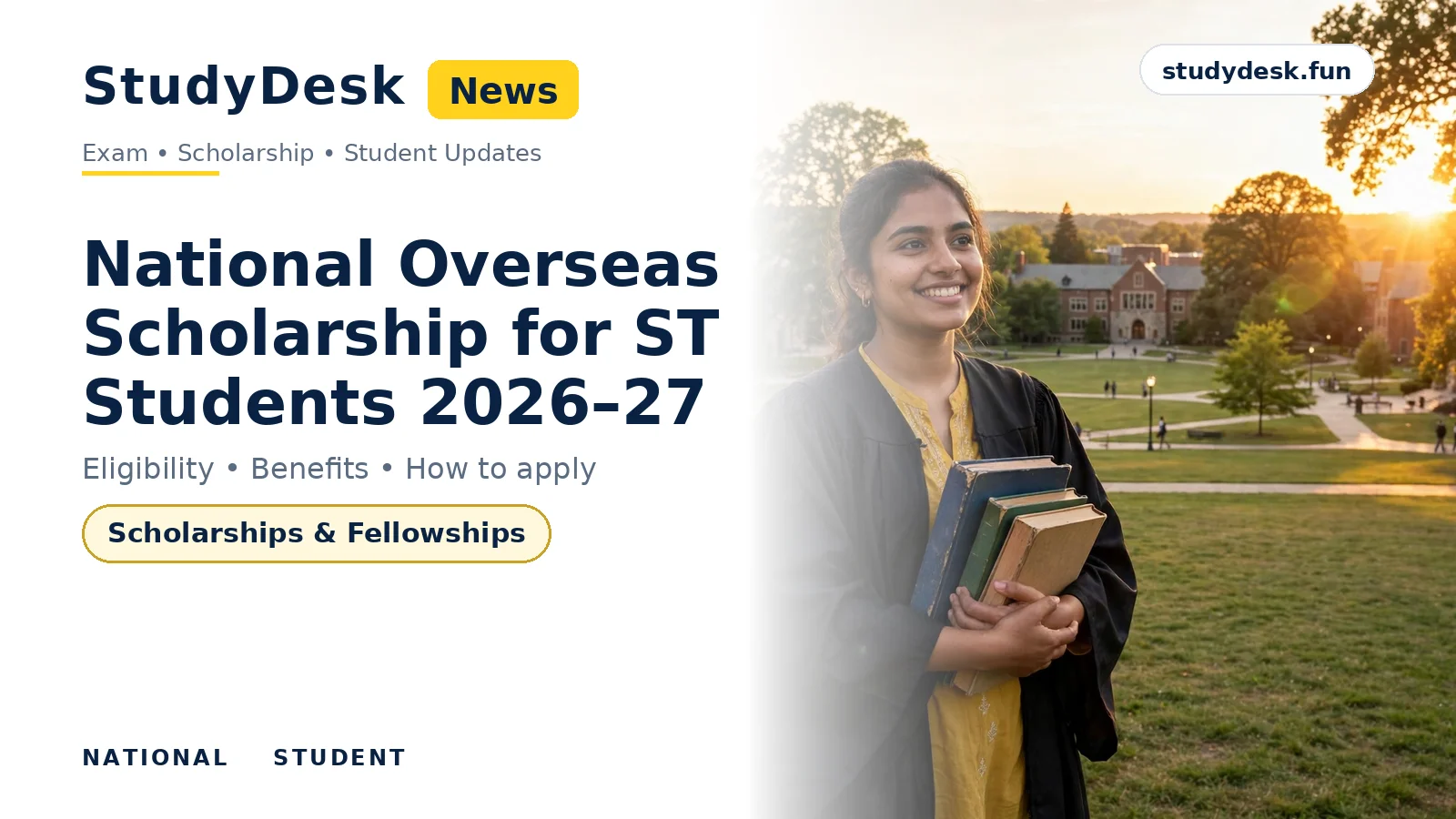
The National Overseas Scholarship for ST students: what it actually is
This is the Ministry of Tribal Affairs' central-sector scheme that pays for meritorious Scheduled Tribe students to do higher education abroad — at universities ranked in the top 1,000 of the latest QS World Rankings. It covers Master's degrees, PhDs and post-doctoral research. Bachelor's courses are explicitly excluded.
It is a small, highly competitive scheme — 20 awards a year — run through the Indian Embassies/Missions abroad (under the Ministry of External Affairs), which disburse the money to the university and the student. Applications go through the Ministry's dedicated portal, overseas.tribal.gov.in — not the National Scholarship Portal, and not the parallel NOS run by the Ministry of Social Justice and Empowerment (the SC/DNT scheme: 125 slots, different portal, different income limit). Applying to the wrong ministry's portal wastes the entire window — get the scheme right first.
The 20 slots, broken down
The standing guidelines split the 20 annual awards as follows:
- 17 slots for ST candidates
- 3 slots earmarked for Particularly Vulnerable Tribal Groups (PVTGs) — if not enough eligible PVTG candidates are found in a year, those slots open to other ST candidates, and vice versa
- 30% of all awards (6 of 20) earmarked for women candidates; unfilled women's slots go to eligible male candidates
The slots are also divided by field of study:
| Field | Slots |
|---|---|
| STEM (Pure/Applied Science, Engineering, Technology, Mathematics) | 10 |
| Management, Economics, Finance, Law | 4 |
| Agriculture, Medicine | 4 |
| Humanities, Social Science, Fine Arts | 2 |
Merit lists are drawn separately for each field.
Who is eligible
All of this is from the official guidelines (with 2026-27 age reckoning as on 1 July of the selection year):
Community. You must belong to a Scheduled Tribe, with a valid ST certificate from a competent authority. PVTG candidates need the PVTG certificate as well.
Education and age.
| Level | Qualification | Max age (as on 1 July of selection year) |
|---|---|---|
| Post-doctoral research | 55% in a relevant Master's + awarded PhD | 38 |
| PhD | 55% in a relevant Master's | 35 |
| Master's | 55% in a relevant Bachelor's | 32 |
One useful waiver: the 55% marks requirement does not apply to candidates who have already secured admission in a top-1,000 QS-ranked university.
Family income. Not more than ₹6,00,000 per year from all sources. The income is computed on parents' combined income (both parents if both work; the single surviving parent's if only one is alive); income of other earning family members is excluded. For an orphan supported by a guardian, the income criterion does not apply. Income means gross income without exemptions or deductions; the certificate is taken once, at admission, and stays valid for the course.
One child, one award. Not more than one child of the same parents can hold the scholarship, and a person can receive the award only once.
Other conditions. You cannot receive another Central or State government scholarship for the same study, and you cannot change your course or university after the award. If you return to India without completing the course, the Ministry can cancel the award and recover the money already paid (genuine ill-health is the exception, with a nominated medical officer's certificate).
What the scholarship pays
The benefit package per the official guidelines:
- Annual maintenance allowance: USD 15,400 per year (US and most countries); £9,900 per year in the United Kingdom.
- Annual contingency and equipment allowance: USD 1,532 (US); £1,116 (UK) — for books, apparatus, study tours, thesis typing and binding.
- Tuition and compulsory university fees: actuals, in full.
- Medical insurance premium: actuals. Air passage: economy class, shortest route, to and from India, at the best available price.
- Visa fees: actuals in Indian rupees. Poll tax: actuals where applicable. Incidental journey expenses: up to USD 20 equivalent.
Duration of support: up to 2 years for post-doctoral research, 4 years for a PhD, 1–2 years for a Master's. Stay longer and the money stops — only your air ticket home is still covered.
How selection actually works
This is the part most applicants misunderstand. There are three priority tiers, in order:
- First priority:candidates already studying in a top-1,000 QS-ranked foreign university. Merit runs on the university's QS ranking first; ties break on your qualifying-exam marks.
- Second:candidates holding a firm offer from a top-1,000 QS university who haven't joined yet — ranked the same way.
- Third:remaining eligible candidates, selected through a personal interview by an expert committee; candidates with GRE/GMAT/TOEFL scores get preference here.
A few practical points: the scholarship is prospective — it runs from the date of the award letter, and no fees you already paid are reimbursed. If you are selected from the offer-holders or interview pool, you must secure admission and join a top-1,000 QS university within two years of the award, or the award is cancelled and the slot carries to the next year. The provisional merit list goes up on the Ministry's website; verification happens through the Indian Embassy/Mission abroad (or the State/UT for offer-holders).
To apply: register on overseas.tribal.gov.in and on DigiLocker (Aadhaar is mandatory for portal registration). Upload your documents through DigiLocker: photograph, ST certificate (and PVTG certificate if applicable), Class 10 certificate for date of birth, degree marksheets with aggregate percentage (plus the CGPA conversion sheet; PhD completion certificate for postdocs), your offer of admission, and the income certificate.
The 2026–27 cycle: current status
The 2026–27 application window is closed. The window opened in mid-2026 and, per StudyDesk's earlier checks, carried an initial deadline of 30 June 2026 that was extended to 15 July 2026; the portal has been shut since. Missed it? There is no late mechanism — you wait for the next selection year's advertisement.
What to do now if you are aiming at the next cycle:
- Line up your admission first. The scheme rewards candidates who already hold offers from top-1,000 QS universities — the strongest position you can be in when the window opens.
- Get your documents right early: ST certificate, income certificate, CGPA-to-percentage conversion letter from your university, and DigiLocker-linked Aadhaar. Applications are rejected outright for missing eligibility proof.
- Watch overseas.tribal.gov.in and the Employment News from around May–June 2027 for the advertisement; the portal's opening and closing are announced there and in major dailies.
- Keep an eye on the EFC decision on the income ceiling and slot count — if the ₹6 lakh cap moves, it changes who can apply.
Sources & verification
Checked against Ministry of Tribal Affairs / primary published information on 7 September 2026.
Frequently asked questions
How many National Overseas Scholarship ST awards are given each year?
The scheme gives 20 awards a year: 17 slots for ST candidates and 3 earmarked for Particularly Vulnerable Tribal Groups (PVTGs), with 30% of all awards (6 of 20) earmarked for women candidates.
What marks and age do I need for NOS ST?
You need 55% in the relevant qualifying degree — a Bachelor's for a Master's, a Master's for a PhD — with maximum ages of 32 for a Master's, 35 for a PhD and 38 for post-doctoral research, as on 1 July of the selection year. The 55% marks requirement does not apply if you have already secured admission in a top-1,000 QS-ranked university.
What is the family income limit for NOS ST?
Family income must not be more than ₹6,00,000 per year from all sources, computed on parents' combined income. For an orphan supported by a guardian, the income criterion does not apply.
How much does the NOS ST scholarship pay?
It pays an annual maintenance allowance of USD 15,400 (£9,900 in the UK), an annual contingency and equipment allowance of USD 1,532 (£1,116 in the UK), tuition and compulsory university fees in full, medical insurance and visa fees at actuals, and economy-class air passage.
Where do I apply for the National Overseas Scholarship for ST students?
Applications go through the Ministry of Tribal Affairs' dedicated portal, overseas.tribal.gov.in — not the National Scholarship Portal. Aadhaar is mandatory for portal registration, and documents are uploaded through DigiLocker.
Is the 2026-27 application window still open?
No. The window carried an initial deadline of 30 June 2026 that was extended to 15 July 2026, and the portal has been shut since. There is no late mechanism — you wait for the next selection year's advertisement.
J N Tata Endowment 2026–27 verified current status, eligibility, benefits, deadline, application route and official-source guidance.
National Overseas Scholarship (SC etc.) 2026–27 verified current status, eligibility, benefits, deadline, application route and official-source guidance.
Lady Meherbai D Tata Scholarship 2026–27 verified current status, eligibility, benefits, deadline, application route and official-source guidance.
Check who the Shraman Foundation scholarship supports, the published benefit structure, participating-institute route and what to verify before relying on a last date. Institute-specific timelines can vary.
TATA AIG scholarship for girl students: current application status, eligibility conditions and official portal tracker.