 StudyDesk
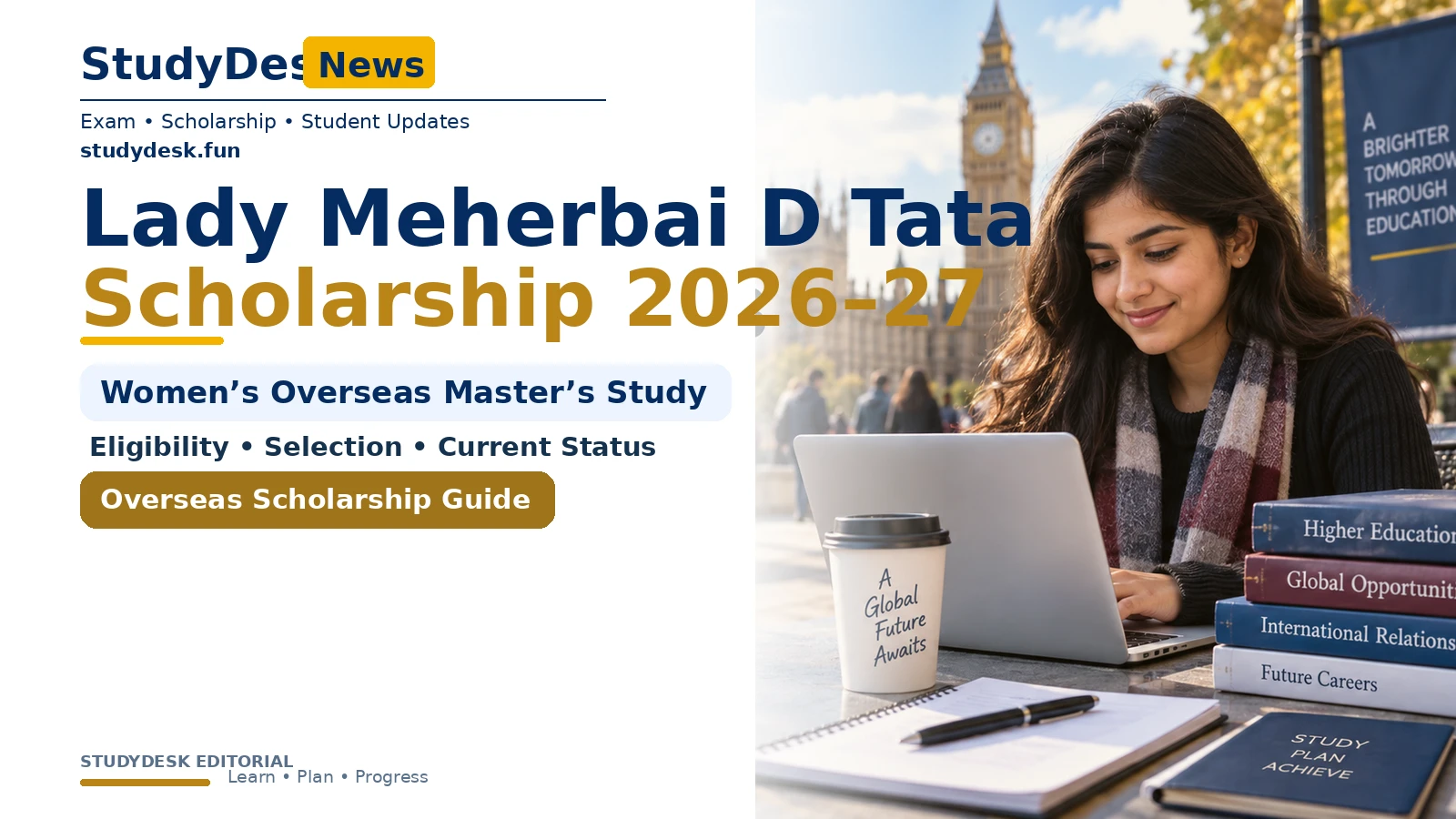
Lady Meherbai D Tata Scholarship: what it is, and its current status
This is one of India's oldest study-abroad scholarships, and one of its most narrowly targeted. Established in 1933 in memory of Lady Meherbai D Tata — sportswoman and advocate for women's advancement — the Lady Meherbai D Tata Education Trust Scholarship sits inside the Tata Trusts' Individual Grants Programme. Each year, up to ten Indian women graduates are selected, through a rigorous process in which the trustees themselves take a close interest, for a merit-based grant toward a full-time Master's degree overseas.
The 2026–27 cycle is closed. Tata Trusts' official grants page says so plainly: "This scholarship programme stands closed for the year 2026-2027." So the honest status for October 2026 is that there is nothing to apply for right now. This guide exists so you are ready — genuinely ready — when the 2027–28 call opens, because this is a scholarship where the field of study, the timing of the application-form request, and the interview all reward early preparation.
What it funds, and the fields it covers
Unlike the J N Tata Endowment's loan scholarship, this is a gift scholarship — a grant, not a loan, with nothing to repay. It is partial funding toward the tuition fee of the overseas Master's, not full-cost support: secondary guides consistently place the award band around ₹3–6 lakh, varying with the individual and the interview performance, against overseas Master's tuition that often runs into tens of lakhs. Plan from the start for the Trust's award to cover a meaningful slice of tuition, with the balance — the rest of tuition, plus living costs, airfare and visas — funded from elsewhere. Applicants who budget as though this closes their whole funding gap usually withdraw after the offer.
The eligible fields are specific and welfare-oriented. Tata Trusts describes them as social work and social welfare — explicitly including child welfare — education, and education for children with special needs, "to mention a few." Independent guides broaden that to the Trust's full brief: child health and nutrition, counselling, teacher training, special education, speech and language therapy, gender studies, mental health, women's health, human rights, legal issues affecting women and children, psychology, public health, community development, social policy and social work. If your Master's sits in one of these areas — an MPH, an M.Ed in special needs, an MSW, an MSc in gender or development studies — you are in the right territory. If it is an MBA or a general engineering Master's, you are not; the J N Tata Endowment or the Means Grant may be the better Tata route.
Who can apply
The official framing is compact: women graduates engaged in the eligible fields. Scholarship guides that track the Trust's announcements add the working detail:
- Indian women who already hold a Bachelor's or Master's degree from a recognised Indian university, with final marks in hand — applicants still awaiting results cannot apply.
- Admitted to, or applying for, a full-time Master's at a university in the USA, the UK or Europe for the relevant academic year. Part-time, distance-learning, exchange, short-term or certificate programmes do not qualify, and applicants who have already commenced their studies abroad are not eligible.
- Consistently strong academic record — selection is merit-based at its core.
- Two years of relevant paid work experience is desirable, per the Trust's own language. Note the word: desirable, not mandatory. It signals what the trustees value — grounded professional experience in the welfare space — without being a formal bar.
- An evident intent to return and contribute to India. This Trust was founded on the idea that its scholars bring their learning back; your application and interview should make that commitment concrete, not decorative.
How the application actually works
This is where many candidates stumble, because the process is deliberately old-fashioned. There is no open portal with a "click to apply" button. Applicants must request the application form directly from the Trust by email during the announced request window, and only then complete and return it. For 2026–27, secondary trackers report the request window as 23 February to 30 March — but that is last cycle's reporting, not this page's invention, and it is not confirmed on the official page today. When the next cycle opens, expect a similarly narrow window, an email-based form request, a written application, and then — for shortlisted candidates — the decisive stage: a personal interview with the Board of Trustees in Mumbai. The interview is repeatedly described as the heart of the selection, where the award level itself is set. Prepare for it like a fellowship interview, not a formality: know your field's problems in India, know your numbers, know why this degree and why now.
Documents to keep ready
Nothing is more wasteful than a scholarship you qualify for but cannot document in a three-week window. Keep ready: degree certificates and complete marksheets; admission offer or application proof from the overseas university; a CV that foregrounds welfare-sector work experience; references who can speak to your field commitment; income and financial documents for the need component; and a statement of purpose that ties your chosen programme to concrete work you intend to do in India afterward. Update your passport now if it is expiring within the next eighteen months.
Common mistakes
Applying for an ineligible field and hoping the Trust makes an exception — it does not. Starting the degree abroad before applying — disqualifying. Treating the two-year experience line as irrelevant because it says "desirable" — the trustees demonstrably weight it. Missing the form-request window because you were watching for a portal that never opens — this is the single most common way strong candidates lose a year. And budgeting the award as full funding — it is a partial grant; have the rest of your financing genuinely arranged.
Watching for 2027–28
The next call has not been announced. Tata Trusts' official Individual Grants page is the only source that matters; check it from January 2027 onward, and be ready to request the form the moment the window opens rather than discovering the announcement in its final week. Ten awards a year means the margin between the selected and the rejected is preparation, not luck.
Sources & verification
Checked against Tata Trusts / primary published information on 7 September 2026.
Frequently asked questions
Is the Lady Meherbai D Tata Scholarship open for 2026-27?
No. Tata Trusts' official grants page states that the programme stands closed for the year 2026-2027, and the next call has not been announced.
Is this a loan or a grant?
It is a gift scholarship — a grant, not a loan, with nothing to repay. It is partial funding toward the tuition fee of the overseas Master's, not full-cost support.
Who can apply for the Lady Meherbai D Tata Scholarship?
Indian women graduates with a degree from a recognised Indian university and final marks in hand, who are admitted to, or applying for, a full-time Master's at a university in the USA, the UK or Europe. Part-time, distance-learning, exchange, short-term and certificate programmes do not qualify.
Which fields of study are eligible?
The Trust's fields are welfare-oriented — social work and social welfare including child welfare, education, and education for children with special needs, among the areas described in this guide. An MBA or a general engineering Master's is not in this territory.
Is two years of work experience compulsory?
No. Two years of relevant paid work experience is described by the Trust as desirable, not mandatory, though it signals the grounded professional experience in the welfare space that the trustees value.
How do candidates apply?
There is no open portal; applicants must request the application form directly from the Trust by email during the announced request window, complete and return it, and shortlisted candidates then face a personal interview with the Board of Trustees in Mumbai.
J N Tata Endowment 2026–27 verified current status, eligibility, benefits, deadline, application route and official-source guidance.
National Overseas Scholarship for ST Students 2026–27 verified current status, eligibility, benefits, deadline, application route and official-source guidance.
National Overseas Scholarship (SC etc.) 2026–27 verified current status, eligibility, benefits, deadline, application route and official-source guidance.
TATA AIG scholarship for girl students: current application status, eligibility conditions and official portal tracker.
Check who the Shraman Foundation scholarship supports, the published benefit structure, participating-institute route and what to verify before relying on a last date. Institute-specific timelines can vary.