 StudyDesk
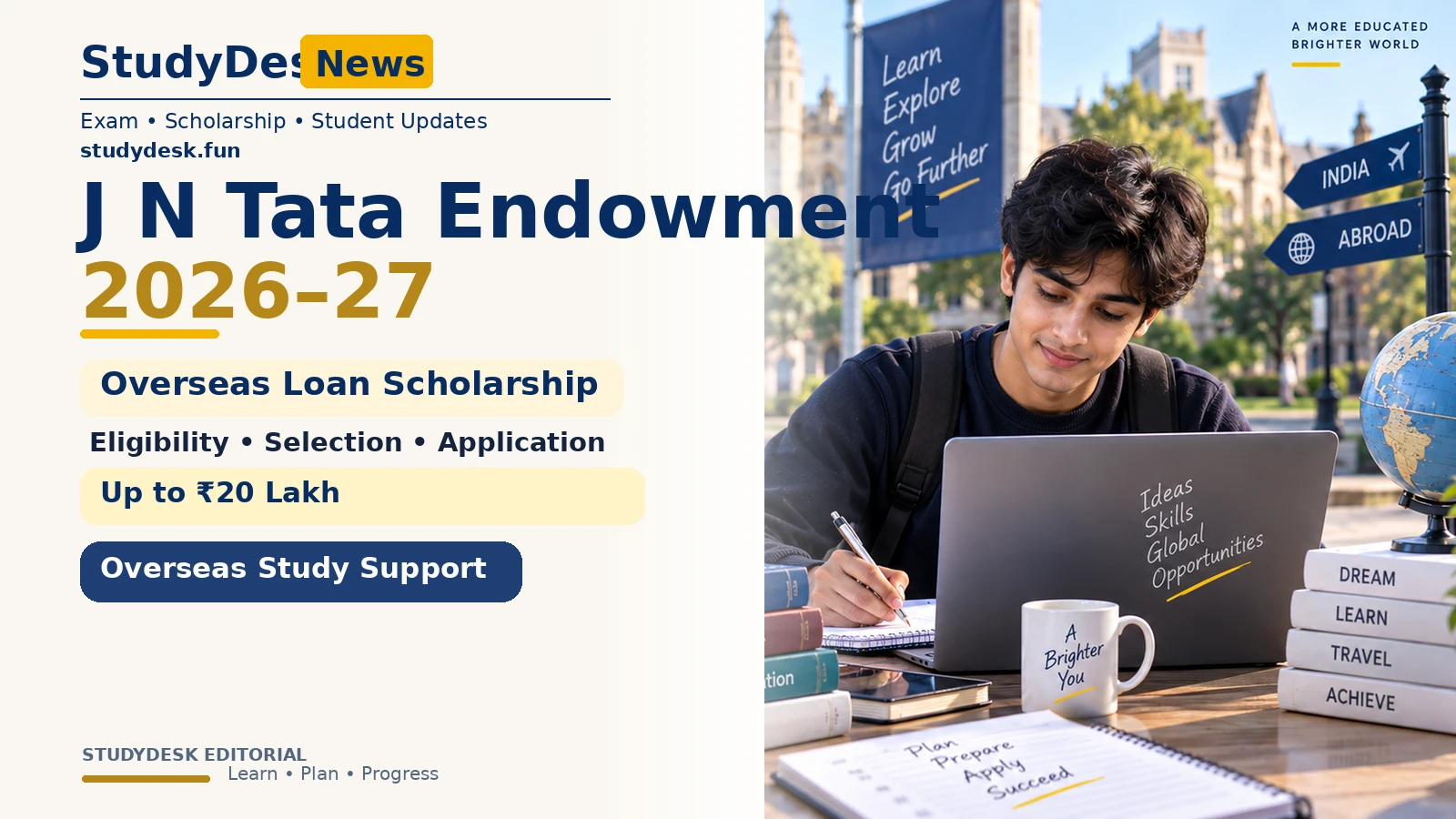
J N Tata Endowment: what this 134-year-old scholarship actually is
The Jamsetji Nusserwanjee Tata Endowment for the Higher Education of Indians was established in 1892 by Jamsetji Tata, the founder of the Tata group — making it older than most Indian universities. More than 5,800 Indian students have received its loan scholarship since, including names that later defined the country: former President K R Narayanan, astrophysicist Jayant Narlikar, Titan founder Xerxes Desai. The Endowment's founding charge still defines it: it rewards "the best and most gifted so as to make them of the greatest service to the country," and it does so strictly on merit.
Get the central fact right first, because many applicants do not: this is a loan scholarship, not a grant. The award is a loan of up to ₹20 lakh toward overseas study, repayable within seven years in five equal instalments starting from the end of the third year. Trackers of the Endowment's notices report interest at 2% simple per annum, with the trustees able to reduce or waive it at their discretion, and no collateral — but a guarantor (typically a parent or spouse) jointly liable with you. That interest figure and the guarantor mechanics are widely and consistently reported, but they do not appear on the Tata Trusts grants page itself, so verify them in the current application document rather than taking any single page's word for it.
The 2026–27 cycle — the Fall 2026 to Spring 2027 call — closed on 29 March 2026. There is no active window as of October 2026. What follows is the complete picture of how the Endowment works, so you can prepare for the next call like someone who intends to win it.
What it supports
The Endowment supports only overseas study — full-time Masters, PhD and postdoctoral fellowships abroad, in any educational stream. Sciences, engineering, management, law, humanities, fine arts: all disciplines are covered, which is what separates it from the Lady Meherbai D Tata scholarship's welfare-field focus. Part-time, online, distance-learning, exchange, seminar and Bachelor's programmes do not qualify. Selected scholars may additionally be recommended for a partial travel grant and, linked to their academic performance overseas, a gift award — both at the trustees' discretion.
Eligibility, in full
The eligibility notice reproduced for the 2026–27 cycle is unusually detailed, and worth reading clause by clause:
- Indian citizenship. PIO/OCI holders without Indian citizenship are not eligible.
- Age: not older than 45 years as of 30 June of the application year (30 June 2026 for the last cycle).
- Academic base: at least one undergraduate degree from a recognised Indian university, with at least 60% average marks in undergraduate or postgraduate studies. If your undergraduate degree is not from a recognised Indian university, you are not eligible — this rule is absolute.
- Overseas programme: you must intend to pursue a recognised full-time, on-campus postgraduate programme abroad — Master's, doctoral or postdoctoral. You may apply even before you hold an admission offer; if you secure one after applying, you update the Endowment by email quoting your application reference number.
- Already studying abroad: candidates in the first year of an overseas postgraduate programme may apply at the end of Year 1 or the start of Year 2, provided at least one full academic year (12 months) remains at the time of the award, typically July. Candidates on CPT/OPT training must have at least two full semesters or three quarters remaining.
- Final-year students awaiting results may apply.
- Re-application is allowed: candidates not selected in an earlier year, candidates selected earlier who could not avail the award, and former JN Tata scholars who have fully repaid their loans may all apply afresh.
How selection works
Trackers describe a four-phase selection: the written application, an online aptitude test, a subject-expert interview, and final selection by the trustees. The Endowment has always been interview-heavy — remember that the trustees "take keen interest in the selection process" is the Trust's own language, and the scholar list above is the standard you are implicitly measured against. Treat the interview as the main event: subject depth, clarity about why this programme and this university, and a credible account of what your work will give back to India.
How to apply when the window opens
- Watch jntataendowment.org from December onward.The last cycle's window ran 5 January to 29 March 2026; expect the next call on roughly the same calendar, but do not treat those dates as announced.
- Apply onlinethrough the Endowment's application portal within the window, even if your admission offers are still pending.
- Arrange your guarantor early— a parent or spouse willing to be jointly liable — since this is the step that most often stalls applications.
- Keep updating your application statuswith the Endowment as admission offers arrive, by email with your reference number.
- Prepare for the aptitude test and interviewalongside your university applications, not after them.
Documents to keep ready
Degree certificates and complete marksheets proving the 60% threshold; admission offers or application acknowledgements from overseas universities; a guarantor's identity and financial documents; a strong statement of purpose; references; and a CV that reads as the record of one of "the best and most gifted" — the Endowment's own standard. If you are already abroad, proof of remaining programme duration matters for the twelve-month rule.
Common mistakes
Treating the ₹20 lakh as a grant and discovering the repayment schedule after selection. Applying with an undergraduate degree from an unrecognised or foreign university — an automatic disqualification the notice states explicitly. Waiting for all admission offers before applying to the Endowment and missing the March deadline. Arranging the guarantor at the last minute. And the quietest failure: a generic statement of purpose for a scholarship whose trustees have interviewed 5,800 scholars and can spot one in minutes. Write yours around the specific problem your fieldwork will address in India.
Watching for the next cycle
Nothing is announced for Fall 2027–Spring 2028. The Endowment's own site, jntataendowment.org, and the Tata Trusts grants page are the only announcements that count. Start from December: documents ready, guarantor confirmed, statement drafted — so that when the window opens, you spend it on the application, not on assembling it.
Sources & verification
Checked against J N Tata Endowment / Tata Trusts / primary published information on 7 September 2026.
Frequently asked questions
Is the J N Tata Endowment award a grant or a loan?
It is a loan scholarship, not a grant: a loan of up to ₹20 lakh toward overseas study, repayable within seven years in five equal instalments starting from the end of the third year.
What study does the Endowment support?
It supports only overseas study — full-time Masters, PhD and postdoctoral fellowships abroad, in any educational stream; part-time, online, distance-learning, exchange, seminar and Bachelor's programmes do not qualify.
Who is eligible to apply?
Indian citizens not older than 45 years as of 30 June of the application year, with at least one undergraduate degree from a recognised Indian university and at least 60% average marks in undergraduate or postgraduate studies.
Can I apply before I have an admission offer?
Yes. You may apply even before you hold an admission offer; if you secure one after applying, you update the Endowment by email quoting your application reference number.
When did the 2026–27 cycle close?
The 2026–27 cycle — the Fall 2026 to Spring 2027 call — closed on 29 March 2026, and there is no active window as of October 2026.
Can I re-apply if I was not selected earlier?
Yes. Candidates not selected in an earlier year, candidates selected earlier who could not avail the award, and former JN Tata scholars who have fully repaid their loans may all apply afresh.
National Overseas Scholarship for ST Students 2026–27 verified current status, eligibility, benefits, deadline, application route and official-source guidance.
Lady Meherbai D Tata Scholarship 2026–27 verified current status, eligibility, benefits, deadline, application route and official-source guidance.
National Overseas Scholarship (SC etc.) 2026–27 verified current status, eligibility, benefits, deadline, application route and official-source guidance.
TATA AIG scholarship for girl students: current application status, eligibility conditions and official portal tracker.
Check who the Shraman Foundation scholarship supports, the published benefit structure, participating-institute route and what to verify before relying on a last date. Institute-specific timelines can vary.