 StudyDesk
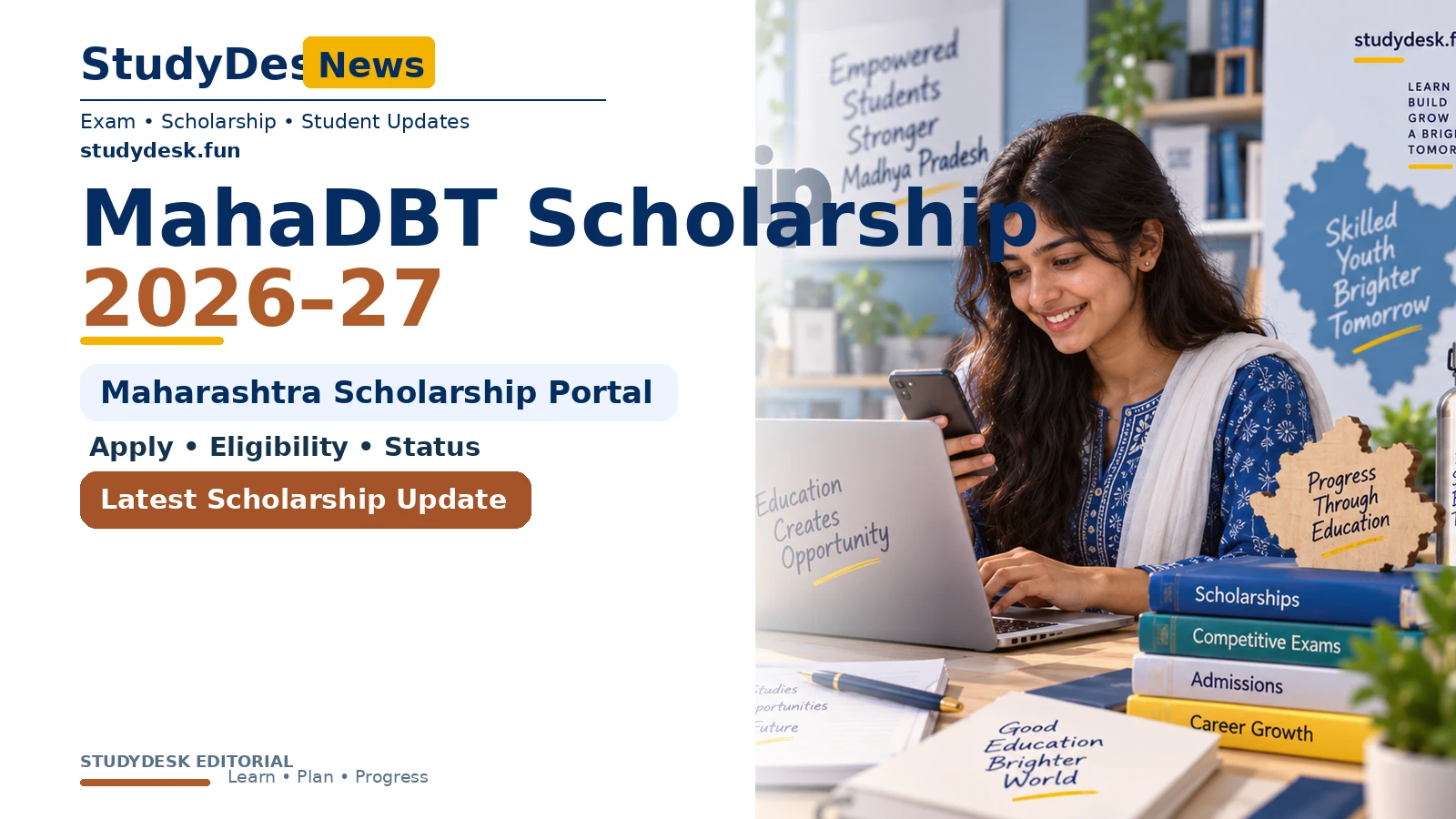
The schemes most students actually claim
Government of India Post-Matric Scholarship is the largest. For SC students it covers study from Class 11 to postgraduate level with family income up to ₹2,50,000 a year; parallel post-matric schemes run for ST, OBC, VJNT and SBC students under their own departments and income rules. The award has two parts: a maintenance allowance paid to the student for ten months of the academic year at rates that depend on the course group and on whether you are a hosteller or a day scholar, and reimbursement of tuition and examination fees at the approved rates for your course.
Freeship (Post-Matric Tuition Fee and Examination Fee) is the companion scheme students confuse with the scholarship. Where the post-matric scholarship is income-tested at the lower ceiling, the freeship reimburses tuition and exam fees for students in the higher income band — for OBC, VJNT and SBC students the freeship ceiling is ₹8,00,000 — but it carries no maintenance allowance. Picking the wrong one of the pair is a classic MahaDBT mistake: if your income fits the scholarship, the scholarship is worth more.
Rajarshi Chhatrapati Shahu Maharaj Shikshan Shulkh Shishyavrutti Yojna is the scheme open-category and EBC/SEBC students ask about. It is not caste-based. If you are a Maharashtra domicile, admitted through the Centralised Admission Process (CAP) to a professional or non-professional course in a government, aided or recognised unaided college — deemed and private universities are excluded — with family income up to ₹8,00,000, the state reimburses tuition and exam fees on a slab: for professional courses, 100% of tuition at incomes up to ₹2.5 lakh in government institutions (50% in unaided ones) and 50% above that; non-professional courses are reimbursed in full up to the ₹8 lakh ceiling; and since the July 2024 revision, girl students receive 100% of tuition and exam fees across the slabs. Only two children per family can claim it, a gap of two years or more in the course breaks eligibility, and you cannot hold another scholarship or stipend alongside it.
Alongside these sit the Dr. Punjabrao Deshmukh Vasatigruh Nirvah Bhatta Yojna, a hostel maintenance allowance of up to ₹30,000 a year for professional-course students whose parents are registered labourers or small (alpabhudharak) farmers; the Rajarshri Chhatrapati Shahu Maharaj Merit Scholarship for SC, VJNT and SBC students who scored 75% or more in Class 10 and move into Class 11; and post-matric scholarships for students with disabilities and for minority communities.
Dates for 2026–27
Fresh and renewal applications for 2026–27 opened on MahaDBT 2.0 on 1 June 2026, according to the portal's application-partner listing. Treat every published closing date as provisional: Maharashtra extends MahaDBT deadlines in rounds, sometimes separately for students and for institute verification, and the 2025–26 window was still being extended months after its first announced date. The date that governs you is the one shown against your scheme in your login — check it, apply well before it, and remember your college then has to verify and forward the application inside its own deadline.
How to apply
- Register on the MahaDBT portal with your Aadhaar number; the registration pulls your name and date of birth from Aadhaar, so fix any Aadhaar mismatch first — the profile cannot be edited freely afterwards.
- Log in and complete your profile fully: personal details, income and caste details, current course, and bank account. An incomplete profile will not let you open a scheme form.
- Open the scheme list, filter by your department if you know it, and choose the exact scheme — scholarship or freeship, and the one belonging to your category's department.
- Fill the form: previous exam marks, current course and college, fee details as per the college fee structure, and hostel details if you claim maintenance as a hosteller.
- Upload the documents below in the portal's prescribed size and format, submit, and take the printout. For most schemes you must also submit the printed application to your college, which verifies it online and forwards it to the district authority.
- Track the application in your login — MahaDBT 2.0 shows the stage it has reached (institute, district, department) and, after sanction, the voucher/redemption status for fee payment.
Documents you will need
Aadhaar card; Maharashtra domicile certificate; caste certificate (and caste validity certificate where your course requires it, notably for professional admissions); income certificate for the current financial year issued by the Tehsildar; Class 10 and previous-year marksheets; the college's fee receipt and admission/CAP allotment proof; first page of your bank passbook; a gap certificate and affidavit if you have a study gap; and a leaving certificate. Rajarshi Shahu applicants also file the family declaration that no more than two children are claiming the scheme.
Renewal
Nothing on MahaDBT renews itself. Continuing students file a renewal application every year from the same login, with the previous year's marksheet — you must have passed and been promoted — and the new fee receipt. Renewal windows run alongside fresh applications, and a missed renewal year usually cannot be recovered later.
Scholarship or freeship? Worked examples
Do not guess this choice — run your own numbers through the pair first:
| Your situation | Apply for | Why |
|---|---|---|
| SC student, family income ₹2,00,000, Class 11–PG course | Government of India Post-Matric Scholarship | Income is under the ₹2,50,000 ceiling, so you get maintenance allowance for ten months plus tuition and exam fee reimbursement |
| OBC/VJNT/SBC student, family income ₹5,00,000 | Post-Matric Tuition Fee and Examination Fee (Freeship) | Income is above the scholarship ceiling but under the ₹8,00,000 freeship ceiling; you recover tuition and exam fees, but no maintenance allowance |
| Open-category/EBC/SEBC student, income ₹6,00,000, CAP admission to a professional course | Rajarshi Shahu Shikshan Shulkh Yojna | Not caste-based; 50% tuition slab at this income in the professional-course slab (100% for girl students since the July 2024 revision) |
| Professional-course student in a hostel, parents are registered labourers or small farmers | Dr. Punjabrao Deshmukh Vasatigruh Nirvah Bhatta Yojna (alongside your main scheme where the rules allow) | Hostel maintenance allowance of up to ₹30,000 a year, on top of fee support |
The pattern: the scholarship is always worth more when your income qualifies you for it, because it is the only one of the pair that pays maintenance. The freeship is the fallback for the ₹2.5–8 lakh band, not an equal alternative.
How big is MahaDBT 2.0, and how do you find your scheme?
MahaDBT 2.0 carries 72 migrated schemes: 54 post-matric, 15 pre-matric, 2 Sanjay Gandhi–Shravanbal schemes and 1 Mukhyamantri Vayoshree scheme. You do not need to know your department in advance — after you complete your profile, use the portal's Find Eligible Schemes tool, which matches schemes against your income, category, course and department and shows only the ones your profile qualifies for. Picking from that filtered list, instead of the full scheme list, is the single easiest way to avoid the wrong-scheme mistake described below. Uploads must be clearly legible scans; blurry or cut-off documents are rejected at verification.
Checking your application status
- Log in to MahaDBT 2.0 and open Application Tracking.
- Enter the Application ID from your submission.
- Read the current stage: institute verification, department scrutiny, or approval. "Pending" means verification is still running — it is not a rejection.
- If the application is rejected, read the rejection note on the dashboard; it names the defective document or detail, and you can correct and reapply while the window is open.
- For expected timelines at each stage, check the portal's Citizen Charter, which publishes the expected time per stage.
Where applications fail
The largest cause is a profile mismatch: the name or birth date pulled from Aadhaar not matching the marksheet or bank account, which stalls DBT. After that come an income certificate from the wrong financial year, uploading a caste certificate where the scheme requires validity, choosing the freeship when the scholarship applied (or the reverse), and — most quietly fatal of all — submitting online but never handing the printout to the college, so the application sits unverified until the institute deadline passes and dies there. MahaDBT's helpline is 022-49150800; use it while the window is open, not after.
Sources & verification
Checked against Government of Maharashtra's official source on 6 September 2026. Closed, renewal-only, expected and open statuses are kept separate.
Frequently asked questions
Is MahaDBT one scholarship?
No. It is one portal hosting 72 migrated schemes — post-matric scholarships, freeships, merit scholarships and allowances — each with its own income ceiling, category rules and document list. Always read your exact scheme's page inside the portal.
How much money will I get?
There is no single MahaDBT amount. A post-matric scholarship pays maintenance allowance plus tuition and exam fee reimbursement; a freeship pays only the fees; the Rajarshi Shahu scheme pays a tuition slab (50% or 100% depending on income, institution type and, since July 2024, 100% for girls). Your scheme page carries the operative rates.
My status has been "pending" for weeks. Is something wrong?
Usually not. Pending means your institute or the department has not finished verification. Check the stage in Application Tracking, confirm your college has forwarded the application, and compare the wait with the Citizen Charter timelines before escalating.
My Aadhaar name and my marksheet name differ slightly. Does it matter?
Yes — it is the most common cause of stalled DBT on this portal. The profile is pulled from Aadhaar and cannot be edited freely afterwards, so correct the mismatch (in Aadhaar or in the bank account) before you submit, not after sanction.
Can I apply without knowing my department?
Yes. Complete the profile and use Find Eligible Schemes; the portal filters the scheme list to the departments and schemes your category, income and course actually qualify for.
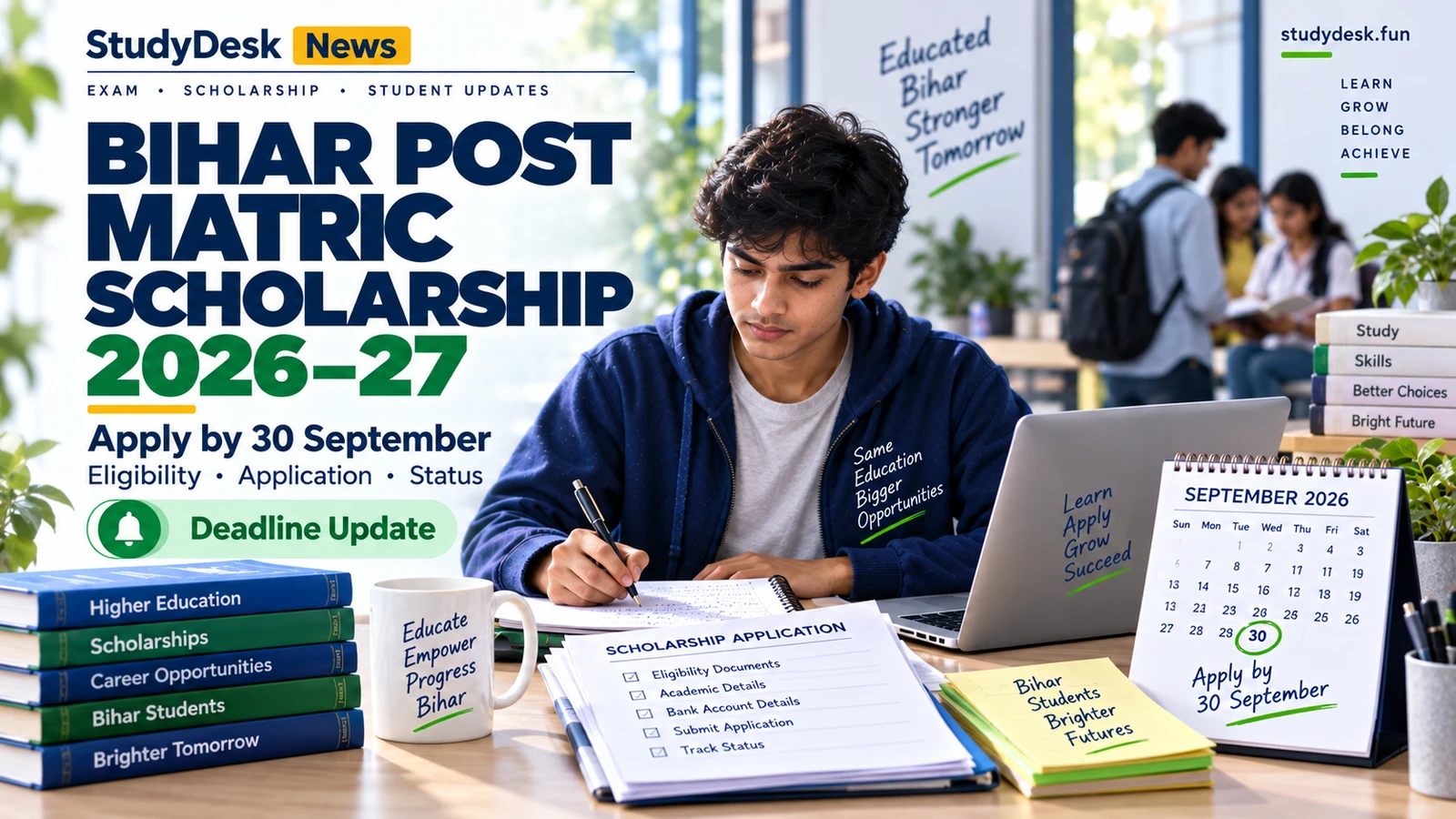
Bihar Post Matric Scholarship 2026–27 applications are open through 30 September 2026. Check eligibility, required documents, Aadhaar seeding and official portal status.
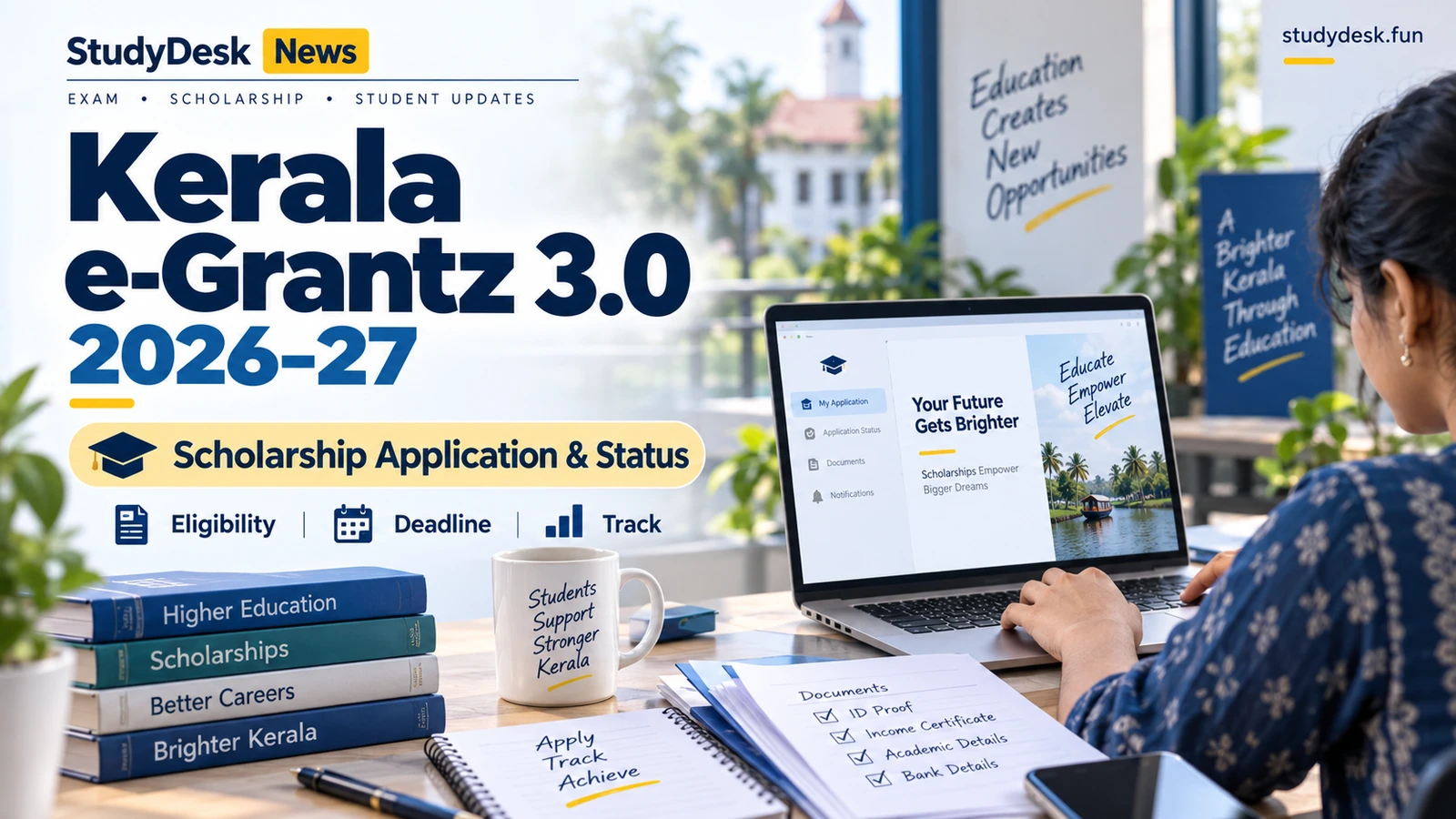
Kerala e-Grantz 3.0 Scholarships 2026–27 current scholarship status, eligibility, benefits, application process, deadline and official-source verification.
UP Scholarship 2026–27 current scholarship status, eligibility, benefits, application process, deadline and official-source verification.

Telangana ePASS Scholarship 2026–27 current scholarship status, eligibility, benefits, application process, deadline and official-source verification.

Swami Vivekananda Merit-cum-Means Scholarship (SVMCM) current scholarship status, eligibility, benefits, application process, deadline and official-source verification.