 StudyDesk
What the exam is
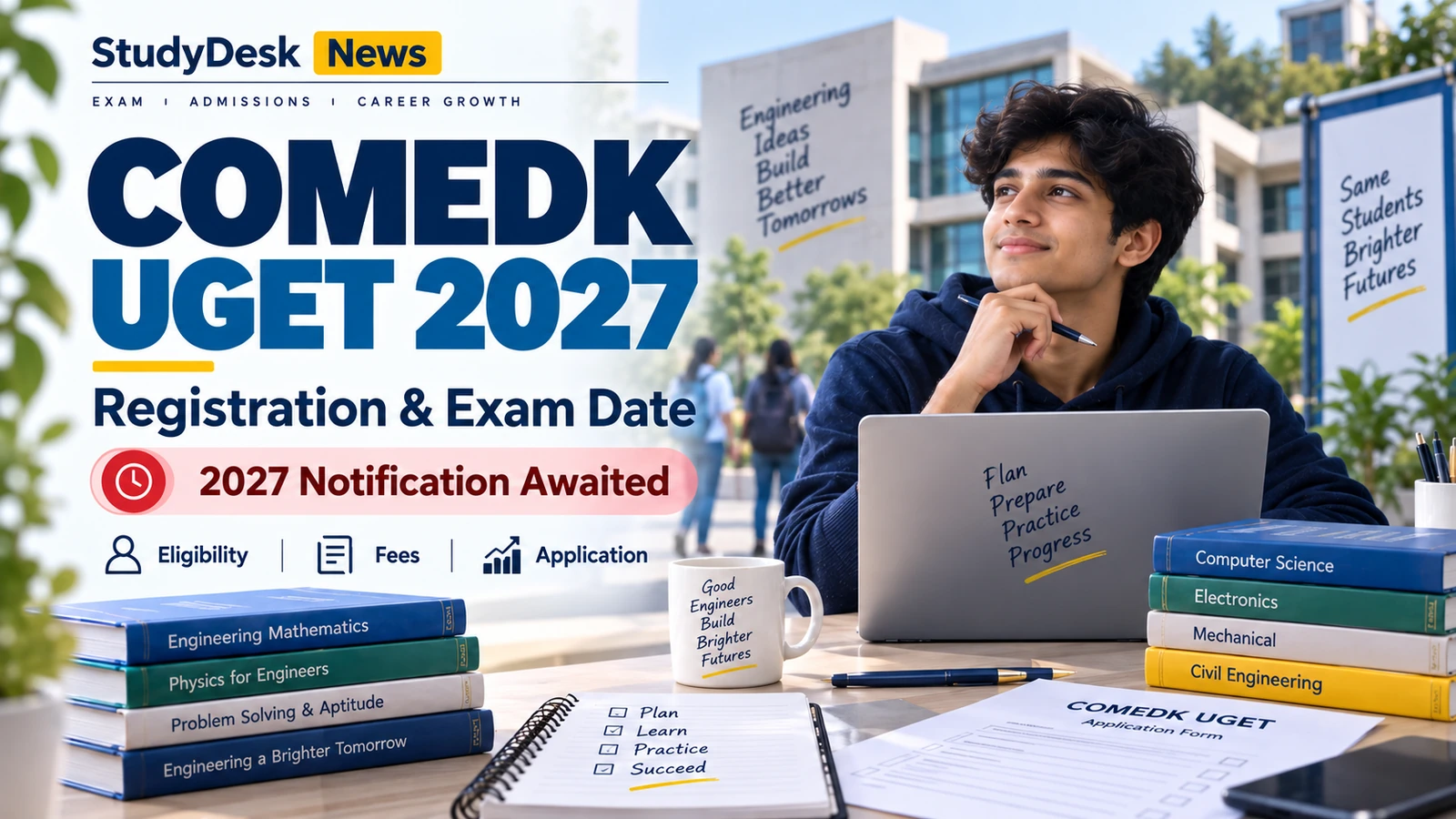
COMEDK UGET (Undergraduate Entrance Test) is a computer-based test held once a year on a single national date across hundreds of centres in India. The 2026 edition was held on Saturday, 9 May 2026; registration ran from 3 February to 16 March 2026, with a correction window from 10 to 13 April 2026. The test score feeds a rank list, and COMEDK then runs centralised single-window counselling — one counselling for its member institutions, not separate rounds per college. In the 2026 cycle the consortium's own pages reported 200,000+ participating students, 150+ colleges, and 200+ exam cities.
Who can apply (2026-cycle eligibility, stable for years)
- Nationality: Indian citizens, plus OCI and PIO candidates (the latter need an eligibility certificate from the affiliated university, VTU Belagavi, before applying).
- Qualification: Passed or appearing in Class 12 / second PUC or equivalent, with Physics and Mathematics as compulsory subjects, plus Chemistry/Biotechnology/Biology/Computer Science/Electronics as the optional subject, and English among the subjects.
- Marks: Minimum 45% aggregate in PCM for general category; 40% for SC/ST/OBC candidates of Karnataka. (A few sources quote 50% for B.E./B.Tech aspirants from older brochures — follow the current year's brochure number when it publishes.)
- Age and attempts: No specific age limit and no restriction on the number of attempts in recent cycles.
- Domicile: None required. This is the key difference from KCET — out-of-state students get full standing in COMEDK counselling.
Note: diploma holders were not eligible for UGET engineering in the 2026 cycle, and B.Arch aspirants do not sit the UGET test — they need a valid NATA score instead.
Exam pattern and syllabus
Pattern below is the confirmed 2026 cycle — the latest confirmed. COMEDK has not published a 2027 pattern; confirm against the 2027 brochure when it appears.
Three hours, 180 multiple-choice questions — 60 each from Physics, Chemistry, and Mathematics — each correct answer earns +1 mark, with no negative marking. The paper is in English only. The syllabus follows the Class 11 and 12 NCERT/CBSE syllabus, with roughly 33% weightage to Class 11 and 67% to Class 12. No negative marking means the strategy is blunt: attempt everything, and spend the last minutes filling anything blank rather than leaving it.
Application fee (2026 cycle)
₹1,800–₹1,950 for COMEDK UGET alone (PCM), depending on the fee revision in that year's brochure, plus convenience charges and GST; the combined COMEDK UGET + Uni-GAUGE option costs more (around ₹2,400–₹3,200 + charges in recent cycles). The fee is non-refundable. Candidates could choose Uni-GAUGE alongside for a wider set of participating universities — worth considering if your target list crosses the COMEDK member boundary.
How to apply when the window opens
- Go to www.comedk.org — COMEDK accepts online applications only; there is no offline form.
- Register with your email ID and mobile number; this creates the application ID you will use through counselling.
- Fill in personal details, academic qualifications, and exam-city preferences carefully — review before submitting.
- Upload scanned documents per the brochure specs: recent colour photograph, candidate signature (black ink on white paper), parent/guardian signature, Class 10 and Class 12 marksheets or appearing certificate, valid photo ID, and category certificate if applicable.
- Pay the fee online, submit, and download the confirmation printout. Use the correction window if you spot an error — COMEDK gives one in each cycle.
What to track, and common mistakes
Track the brochure first (eligibility details change more often than the pattern), then the registration opening/closing dates, the correction window, the admit card release, the answer-key/result dates, and the counselling schedule — COMEDK's own notifications page is the source for all of these. The classic mistakes: assuming domicile rules like KCET (there are none), missing the single correction window, paying for a "COMEDK form" on a fake website (apply only at comedk.org), and — for B.Arch aspirants — preparing for a UGET paper that does not exist for them.
What to do next
Nothing to file until the brochure publishes, expected in early 2027 given the 2026 timeline (February registration, May exam). When it lands, read the eligibility and fee pages first, then register in the first weeks rather than the last — the form is long and the document specs are strict. This page should be refreshed the day the 2027 brochure appears.
Sources & verification
Verified against the official COMEDK source on 6 September 2026. Expected or previous-cycle information is never presented as a confirmed 2027 announcement.
Frequently asked questions
Has the COMEDK UGET 2027 notification been published?
No. As of 20 October 2026 the notification had not been published and the official site was still running the 2026 counselling rounds, so this guide uses the completed 2026 cycle as the working reference.
What were the 2026 registration and exam dates?
Registration ran from 3 February to 16 March 2026, with a correction window from 10 to 13 April 2026, and the exam was held on 9 May 2026.
Who was eligible in the 2026 cycle?
Candidates who passed or were appearing in Class 12 or equivalent with Physics and Mathematics as compulsory subjects, plus Chemistry, Biotechnology, Biology, Computer Science or Electronics as the optional subject, and English among the subjects. The minimum was 45% aggregate in PCM for general category and 40% for SC/ST/OBC candidates of Karnataka.
Is Karnataka domicile required for COMEDK?
No. No domicile is required, and out-of-state students get full standing in COMEDK counselling — the key difference from KCET described in this article.
What was the 2026 exam pattern?
A three-hour computer-based test with 180 multiple-choice questions — 60 each from Physics, Chemistry and Mathematics — with +1 for each correct answer and no negative marking, in English only.
What was the application fee in 2026?
₹1,800–₹1,950 for COMEDK UGET alone (PCM), depending on that year's brochure, plus convenience charges and GST; the fee is non-refundable.
SRMJEEE 2027 guide covering registration, exam date, fees, eligibility and what SRM aspirants should verify before applying.
Looking for Manipal MET 2027 registration or exam dates? MAHE is still showing Admissions 2026 information, so the 2027 MET schedule remains awaited. Track the application form, exam phases, eligibility and admission notices here.
Track VITEEE 2027 registration, exam date, eligibility, fees, syllabus, admit card and result notices in one place. Current status: 2027 B.Tech entrance notice awaited. Confirm time-sensitive details on the linked official source before acting.
Track BITSAT 2027 registration, exam date, eligibility, fees, syllabus, admit card and result notices in one place. Current status: 2027 BITSAT bulletin awaited. Confirm time-sensitive details on the linked official source before acting.

Coast Guard Enrolled Persons Test (CGEPT) batches 01/2027 and 02/2027: 365 vacancies, applications 6-21 October 2026, eligibility and selection process.