 StudyDesk

NIOS Board Exams 2027: Why There Is No Single "NIOS Exam Date" — and How the System Actually Works
The National Institute of Open Schooling does not work like CBSE or a state board, and the April/May 2027 season proves it. NIOS — the world's largest open schooling system, an autonomous body under the Ministry of Education — runs two public examinations a year (an April–May session and an October–November session) plus a year-round On-Demand Examination (ODE) where registered learners choose their own exam dates. As of this writing, NIOS has published no April/May 2027 date sheet; the active official cycle on sdmis.nios.ac.in is the October/November 2026 examination. Anyone quoting you a subject-wise 2027 timetable today is inventing it. What is knowable — admission blocks, eligibility, fees, the ODE route, and how results follow — is set out below.
Who NIOS is for, and the eligibility that matters
NIOS offers two courses: Secondary (Class 10 equivalent) and Senior Secondary (Class 12 equivalent), and its certificates carry the same recognition for college admission, government jobs and entrance tests (including NEET/JEE eligibility routes) as other boards'.
- Secondary: minimum age 14 years (no upper age limit), and either a Class 8 pass certificate or a self-certificate that you have studied enough to cope with the course. No prior board is required — dropouts and first-generation learners enter here.
- Senior Secondary: minimum age 15 years and a passed Class 10 from a recognised board; for this course, the Class 10 certificate is the accepted proof of age.
Admission is organised in streams and blocks: Stream 1 (fresh learners, admitted in two blocks — Block 1 feeding the April–May exams, Block 2 feeding October–November), Stream 2 (learners who failed at another board, entering with Transfer of Credit for the October session), and Streams 3 and 4 (On-Demand entry for fresh and existing learners respectively). The currently open window reported in the 2026–27 schedule is Block 2: admission from 16 September 2026 to 31 January 2027 without late fee (then graded late fees to mid-March 2027) for the October–November 2027 examinations. Admission stays valid for five years, giving you up to nine examination chances within that span — flexibility no conventional board matches.
Transfer of Credit: the benefit failed students miss
If you failed Class 10 or 12 at CBSE, ICSE or a state board, do not re-sit everything. Under Transfer of Credit (TOC), NIOS lets you carry over up to two subjects you already passed at your previous board (from the same level, within the validity window) and appear only in the remaining subjects — potentially saving a full academic year. The catch is timing and stream: TOC belongs to the Stream-2/ODE routes tied to recent board results, so applying as a fresh Stream-1 learner after a board failure throws the benefit away. Read the TOC conditions in the prospectus before you pay anything.
Fees, honestly labelled
Per the currently published NIOS fee structure for 2026–27 (cross-checked across two independent reproductions of the prospectus in the companion NIOS admission rewrite): admission for five subjects is ₹2,340 (Secondary) and ₹2,600 (Senior Secondary) for general-category male learners, with lower slabs for female learners (₹1,890 / ₹2,150) and exempted categories (₹1,560 / ₹1,690), ₹940 per additional subject, and a TOC charge per transferred subject. (An earlier version of this page carried the superseded ₹1,800/₹2,000 figures — do not use them.) Examination fees are separate — ₹250 per theory subject and ₹120 per practical at the last published rates — and ODE costs more per subject (₹500) for its flexibility. NIOS revises these by notification; treat the SDMIS fee notice for your session as the final word, and pay only through the official portal. A cottage industry of lookalike "NIOS admission" sites charges multiples of the official fee for the same form.
The 2027 exam picture, session by session
April–May 2027 public exam: date sheet awaited. The pattern from the latest completed cycle — practicals first under a separate notice, theory papers across April–May, results roughly six weeks after the last paper (the April/May 2026 Senior Secondary result was declared on 5 June 2026) — is the planning shape, not a schedule.
October–November 2026 (live now): if you are already enrolled for this session, your binding documents are the SDMIS exam-fee notice and the practical date sheet circulated through regional channels; confirm your payment status inside SDMIS rather than assuming a paid admission equals a paid exam fee — they are separate transactions, and confusing them is a recurring disaster.
ODE: runs in defined windows through the year (recently January–March and June–September blocks) at NIOS headquarters and regional/Kendriya Vidyalaya centres, for Secondary and Senior Secondary subjects without practical components at HQ and fuller coverage at regional centres. Results follow each exam. If a job application or admission deadline will not wait for April, ODE — not a "fast-track agent" — is the legitimate shortcut.
How to apply, step by step
- Go to sdmis.nios.ac.in (admissions) — NIOS's learner portal — and choose your course and stream/block deliberately, with the TOC question settled first if you have a previous board result.
- Fill the form, choose your study centre (AI) and subjects (minimum five to be certified, with language/subject rules in the prospectus), and upload photograph, signature and documents (age proof, previous marksheet/certificate, address/ID proof; failed marksheet if claiming TOC).
- Pay the admission fee online and download the confirmation; your enrolment number is your identity for the next five years — for hall tickets, exam fees, results and certificates (results are checked on the NIOS results portal, and certificates also reach DigiLocker).
The discipline NIOS demands is calendar discipline: two public cycles, an on-demand lane, block-wise admissions, separate exam fees, separate practical notices. Learners who map their own block and session early find NIOS the most forgiving board in India. Learners who wait for "the NIOS date" discover there never was one.
NIOS Date Sheet 2027 — also covered here
NIOS has not published a 2027 public-examination date sheet yet; the October-November 2026 session is in progress, and the April 2026 session ran theory from 10 April with Senior Secondary results on 5 June 2026.
- 2027 date sheet: Session-specific; await notice
- Courses: Secondary & Sr Secondary
- Exam type: Public Examination
- Authority: NIOS
NIOS Admission 2026–27 — also covered here
NIOS Block I admission is closed and Block II is open from 16 September 2026 to 15 March 2027, with no late fee until 31 January 2027; Senior Secondary fees start at ₹2,600.
- Academic session: 2026–27
- Courses: Secondary & Sr Secondary
- Portal: SDMIS
- Status: Check current notification
NIOS Oct/Nov 2026 Date Sheet — also covered here
NIOS listed its October–November 2026 Secondary and Senior Secondary theory date-sheet notification on 8 October 2026 on the SDMIS notifications page.
- Notice date: 8 Oct 2026
- Session: Oct/Nov 2026
- Levels: Secondary / Senior Secondary
- Official site: SDMIS NIOS
NIOS Latest Updates 2026–27 — also covered here
NIOS released its October/November 2026 public-examination theory date-sheet notice on 8 October 2026, after the Stream 2 admission extension ended 31 August 2026.
- Stream 2 extension: Ended 31 Aug 2026
- Oct/Nov exam fee: Fee/reopening notices issued
- Oct 2026 practical notice: Published 6 Sep 2026
- ODE schedule: Jun–Sep 2026 ODE available
- 2027 generic date sheet: Use session-specific notices
NIOS On-Demand Exam 2027 — also covered here
ODE is separate from public exams; June–Sep 2026 ODE date sheet was available, no 2027 sheet shown
- Exam type: On-Demand Examination (ODE)
- Streams: Secondary and Senior Secondary
- Current status: No 2027 ODE schedule shown yet; use the latest session-specific NIOS ODE notice
- Authority: National Institute of Open Schooling (NIOS)
Sources & verification
NIOS has multiple calendars for Public Examinations and On-Demand Examinations. No final April/May 2027 public-exam date sheet was found in the checked official notices. The expected April–May 2027 window is based on the latest public-exam cycle and is not an official timetable.
Frequently asked questions
Has NIOS released the April–May 2027 date sheet?
No. As of this writing NIOS has published no April/May 2027 date sheet; the active official cycle on sdmis.nios.ac.in is the October/November 2026 examination.
Who can join NIOS Secondary and Senior Secondary?
Secondary requires a minimum age of 14 years with a Class 8 pass certificate or a self-certificate that you have studied enough to cope with the course; Senior Secondary requires a minimum age of 15 years and a passed Class 10 from a recognised board, and there is no upper age limit for Secondary.
What is Transfer of Credit (TOC)?
If you failed Class 10 or 12 at CBSE, ICSE or a state board, TOC lets you carry over up to two subjects you already passed at your previous board and appear only in the remaining subjects, through the Stream-2/ODE routes tied to recent board results.
How much are the NIOS admission and exam fees?
Per the published 2026–27 figures in this guide, admission for five subjects is ₹2,340 (Secondary) and ₹2,600 (Senior Secondary) for general-category male learners; examination fees are ₹250 per theory subject and ₹120 per practical, and ODE costs ₹500 per subject.
How long is NIOS admission valid?
Admission stays valid for five years, giving you up to nine examination chances within that span.
When does Block 2 admission for 2026–27 close?
Block 2 admission runs from 16 September 2026 to 31 January 2027 without late fee, then with graded late fees to mid-March 2027, for the October–November 2027 examinations.
NIOS परीक्षा और दाखिला हब का हिंदी संस्करण: Secondary (कक्षा 10 समकक्ष) और Senior Secondary (कक्षा 12 समकक्ष) शिक्षार्थियों के लिए सार्वजनिक परीक्षाएँ, दाखिला, On-Demand परीक्षा, तिथि पत्रक और परिणाम।
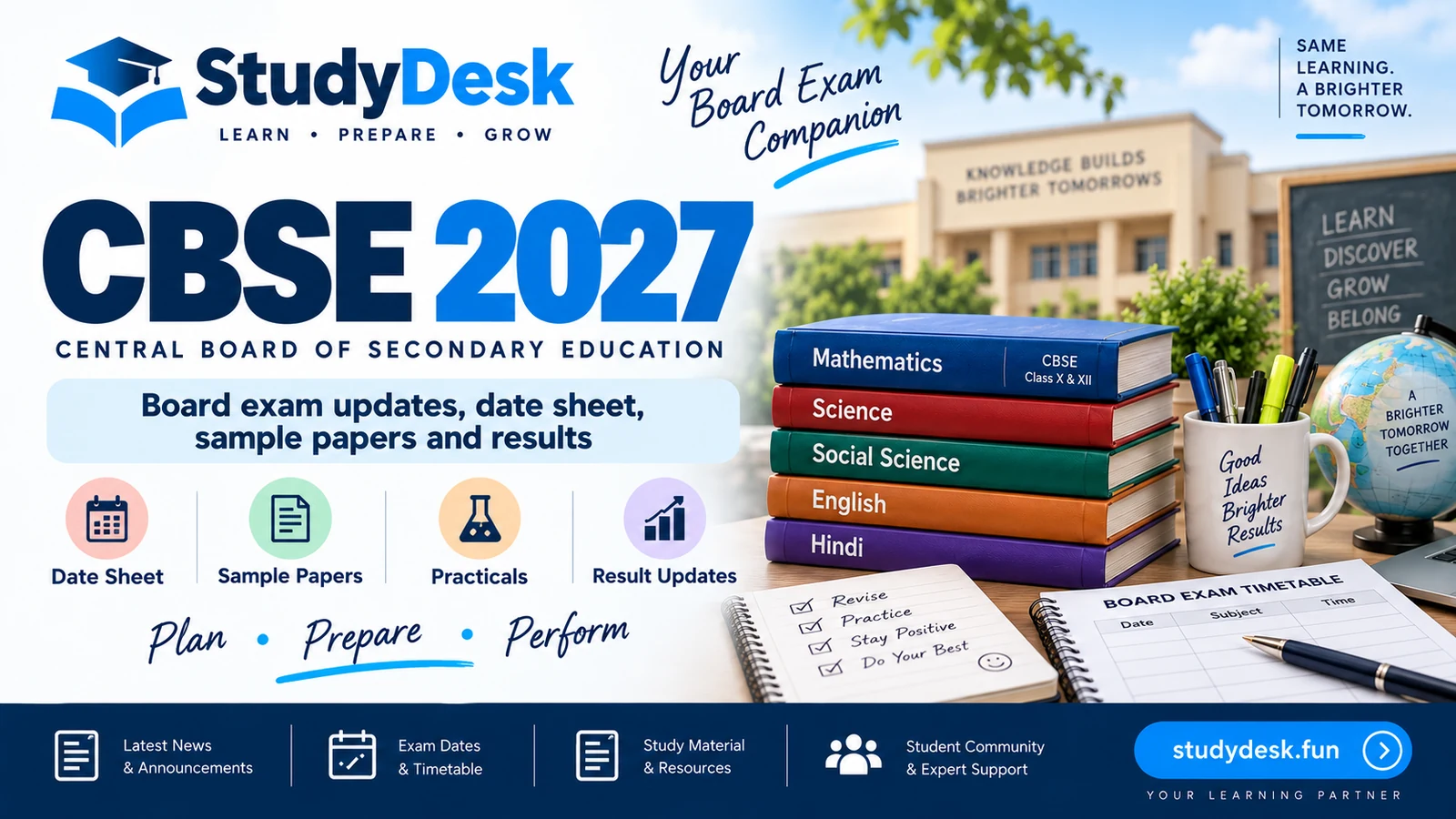
Complete CBSE 2027 board-exam hub connecting Class 10/12 date sheets, sample papers, Class 10 second-board updates, results and official circulars.
Bihar Board, CBSE and NIOS compared on the facts that decide a student's year: exam pattern and subjects, the 33% passing mark and how it is applied, what happens when you fail one or two subjects, when results came in 2026, and where each certificate is accepted. The 2027 date sheets are not out yet for any of the three boards, so the 2027 rows give the 2026 pattern and say what is still to be announced.

A verified exam hub covering CBSE, CISCE (ICSE/ISC), IB, IGCSE, Bihar Board and NIOS on StudyDesk.
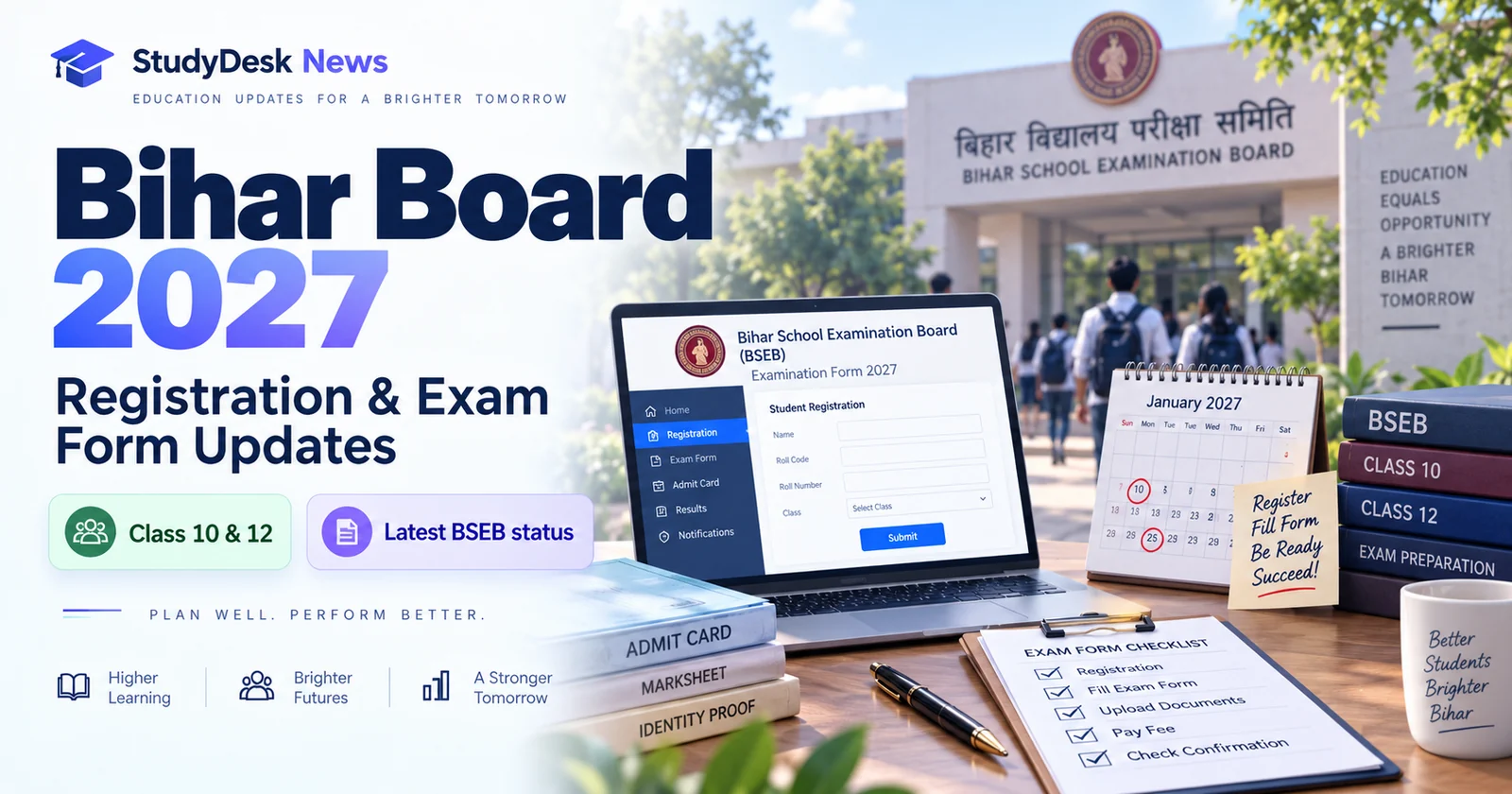
Bihar Board 2027 hub — Intermediate exam-form third window 1–15 Oct 2026 (fee till 14 Oct); final 2027 timetable awaited.