 StudyDesk
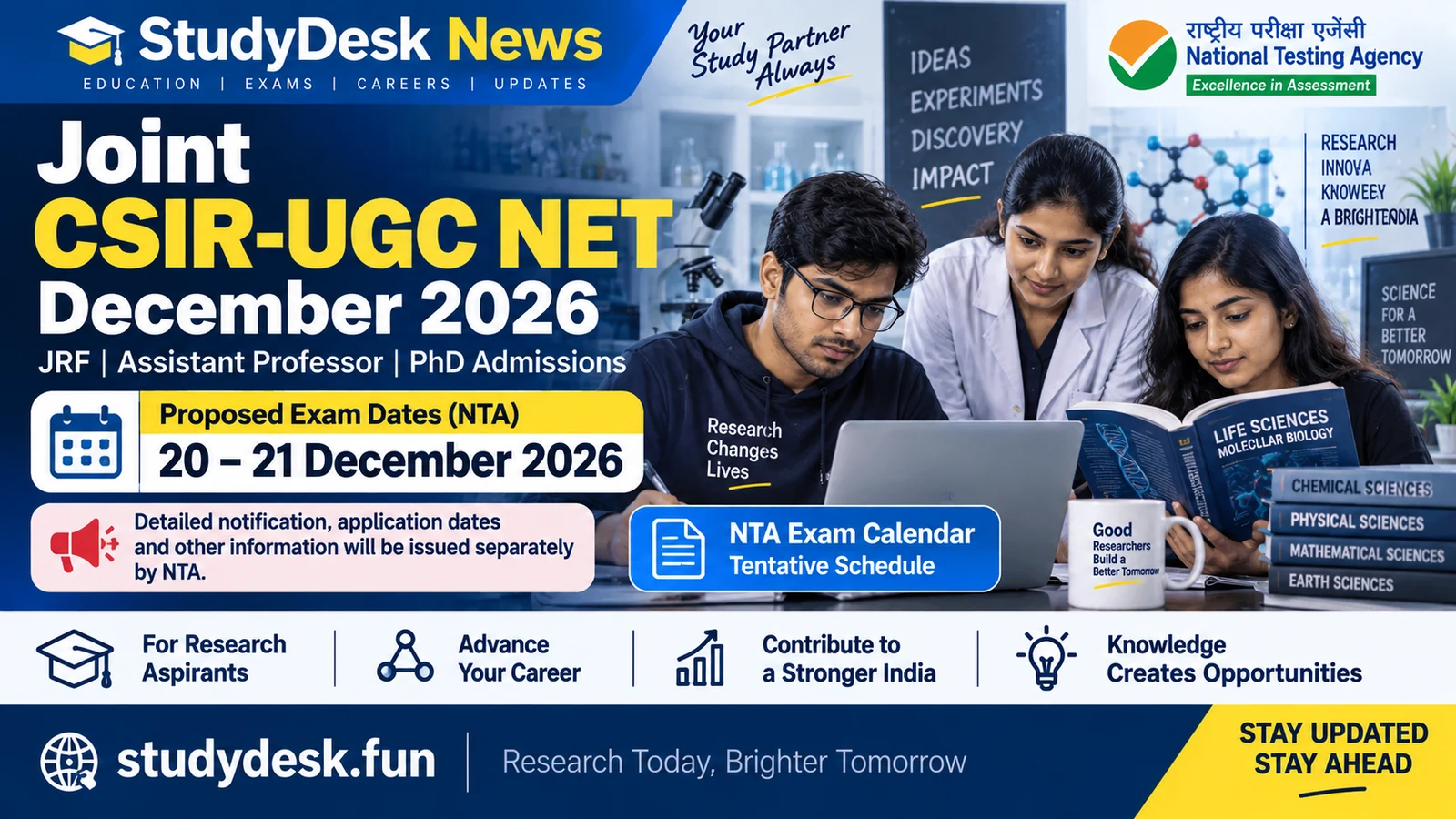
What this test decides
The Joint CSIR-UGC NET is conducted by NTA on behalf of the Council of Scientific and Industrial Research (CSIR), with UGC, to determine the eligibility of Indian nationals for three things: Junior Research Fellowship (JRF), Assistant Professor, and admission to Ph.D. programmes in Indian universities and colleges. It is a science-only test, covering five subjects: Chemical Sciences; Earth, Atmospheric, Ocean and Planetary Sciences; Life Sciences; Mathematical Sciences; and Physical Sciences. Qualifying candidates in the JRF category become eligible for the CSIR research fellowship — ₹37,000 per month for the first two years, plus HRA and an annual contingency of ₹20,000, rising to ₹42,000 per month on upgradation to Senior Research Fellowship (SRF) from the third year, subject to assessment and Ph.D. registration. Assistant Professor eligibility and Ph.D. admission categories carry no fellowship by themselves; the score is used by universities for those purposes under UGC rules.
Who can apply
- Education: a Master's degree (or equivalent) in a science subject with at least 55% marks for General/Unreserved/General-EWS candidates and 50% for OBC-NCL, SC, ST, PwD/PwBD and third-gender candidates, marks counted without rounding off. The Bulletin also admits candidates holding a qualifying four-year bachelor's degree with 75% marks under the category provisions it spells out — read that clause carefully if it is your route.
- Final-year candidates can apply provisionally, but must complete the Master's with the required percentage within the period the Bulletin prescribes (two years from the NET result; one year for the Ph.D.-admission-only category), failing which the candidature is disqualified.
- Age: for JRF, not more than 30 years as on the first day of the month in which the examination concludes (December 2026), with relaxation of up to five years for OBC-NCL/SC/ST/PwD/third-gender candidates and women applicants, as detailed in the Bulletin. There is no upper age limit for Assistant Professor or Ph.D. admission categories.
Dates, fee and the late window
| Event | Date |
|---|---|
| Online application opens | 7 October 2026 |
| Last date to apply (regular) | 5 November 2026, up to 11:50 pm |
| Late application window (₹500 additional fee) | 6–9 November 2026 |
| Correction window | 10–12 November 2026 |
| Examination (CBT) | 19, 22 and 27 December 2026 |
The application fee is ₹1,150 for General, ₹600 for General-EWS/OBC-NCL, and ₹325 for SC/ST/PwD/PwBD/third-gender candidates, payable online by card, net banking or UPI. The ₹500 late charge in the 6–9 November window is over and above the category fee. NTA will publish exam-city intimation and admit cards before the examination; the recorded responses, provisional answer key with a challenge window, and results follow after it.
The paper
The test is a single computer-based paper of 200 marks per subject, in three parts. Part A is common to all subjects and tests general aptitude — reasoning, quantitative comparison, data interpretation and the like. Part B covers the subject syllabus with conventional multiple-choice questions, and Part C carries higher-mark questions that test scientific concepts and their application, including analytical and experimental-design reasoning. There is negative marking, with the scheme varying by part and subject as set out in the Bulletin — which is why indiscriminate guessing is a losing strategy in Part C especially. The five subjects sit across the three examination days in two shifts a day; your subject's day and shift will be printed on your admit card, and that document, not any predicted table, is authoritative.
How to apply, step by step
- Go to csirnet.nta.nic.in and open the Joint CSIR-UGC NET December 2026 application link. Read the Information Bulletin first — eligibility disputes are not entertained after the fee is paid.
- Register with your own email ID and mobile number; the application number generated is your login for the admit card, answer key and result.
- Fill the form: personal details, category, the eligibility category you are applying under (JRF / Assistant Professor / Ph.D.), your subject, and exam-city preferences.
- Upload your photograph, signature and category/PwD certificate where applicable, in the formats the portal specifies.
- Pay the fee online and submit. Download the confirmation page and keep it.
- Use the 10–12 November correction window if anything is wrong — after it closes, the details on your form are the details on your record.
Common mistakes
Applying under the wrong eligibility category is the most expensive one; a candidate who wants the fellowship must be in the JRF reckoning, and age is counted exactly as the Bulletin defines it. The second is trusting the old tentative dates — preparation planned around 20–21 December now has to stretch to a paper that may fall on the 27th. The third is leaving the form to the last evening of 5 November: payment failures on deadline night are a recurring feature of NTA cycles, and the fix — the late window — costs ₹500. Apply in October, verify in the correction window, and spend December on the syllabus rather than on the portal.
Sources & verification
StudyDesk separates tentative calendar dates from final exam-specific notices. Recheck the issuing authority before application, payment, counselling, recruitment or exam-day action because later notices may supersede this page.
Frequently asked questions
What is the last date to apply for CSIR UGC NET December 2026?
Registration closes on 5 November 2026 (up to 11:50 pm); a late application window runs 6–9 November 2026 with a ₹500 additional fee, and the correction window is 10–12 November 2026.
When is the CSIR UGC NET December 2026 examination?
The examination is fixed for 19, 22 and 27 December 2026 in computer-based mode; the older tentative calendar dates of 20–21 December have been superseded by the Information Bulletin.
What is the application fee?
The application fee is ₹1,150 for General, ₹600 for General-EWS/OBC-NCL, and ₹325 for SC/ST/PwD/PwBD/third-gender candidates, payable online by card, net banking or UPI.
Who can apply for CSIR UGC NET?
Candidates need a Master's degree (or equivalent) in a science subject with at least 55% marks for General/Unreserved/General-EWS candidates and 50% for OBC-NCL, SC, ST, PwD/PwBD and third-gender candidates, marks counted without rounding off.
What is the age limit for JRF?
For JRF, not more than 30 years as on the first day of the month in which the examination concludes (December 2026), with relaxation of up to five years for OBC-NCL/SC/ST/PwD/third-gender candidates and women applicants; there is no upper age limit for Assistant Professor or Ph.D. admission categories.
Which subjects does CSIR UGC NET cover?
It is a science-only test covering five subjects: Chemical Sciences; Earth, Atmospheric, Ocean and Planetary Sciences; Life Sciences; Mathematical Sciences; and Physical Sciences.

Official NTA examination calendar published 16 September 2026 with tentative dates through March 2027.

Official SWAYAM July 2026 semester examination-date notice from NTA.

NTA’s examination calendar up to March 2027 places the UGC NET December 2026 cycle in mid-December with buffer dates reserved.

NTA has declared the Joint CSIR-UGC NET June 2026 result and rank after the earlier score and final-answer-key release.

MAT December 2026 session: AIMA registration open, PBT exam 20 December and CBT exam 27 December 2026. Deadlines, fees, eligibility and exam pattern.