 StudyDesk
JEE Main 2027 Syllabus: Physics, Chemistry, Maths — Paper 1, Paper 2A & 2B
NTA has not released a JEE Main 2027 syllabus PDF. The 2027 information bulletin is still awaited, so no additions, removals or restructuring have been announced. What follows is the latest official syllabus structure — the NTA JEE Main 2026 syllabus — which has been broadly stable year to year and remains the correct preparation reference. When the 2027 bulletin appears, check only the changes against this list rather than restarting your preparation from zero.
Paper 1 (B.E./B.Tech): the three subjects
Mathematics — Sets, relations and functions; complex numbers and quadratic equations; matrices and determinants; permutations and combinations; binomial theorem; sequences and series; limits, continuity and differentiability; applications of derivatives; indefinite and definite integrals; applications of integrals; differential equations; straight lines; circles; conic sections (parabola, ellipse, hyperbola); probability; statistics; vector algebra; three-dimensional geometry; trigonometric functions; inverse trigonometric functions.
Physics — Units and measurements; motion in a straight line; motion in a plane; laws of motion; work, energy and power; system of particles and rotational motion; gravitation; thermodynamics; kinetic theory of gases; electrostatics; current electricity; magnetic effects of current and magnetism; electromagnetic induction and alternating currents; electromagnetic waves; optics (ray and wave); dual nature of matter and radiation; atoms and nuclei; electronic devices and semiconductors.
Chemistry — Physical: some basic concepts of chemistry (mole concept), atomic structure, chemical bonding and molecular structure, chemical thermodynamics, solutions, equilibrium, redox reactions and electrochemistry, chemical kinetics. Inorganic: classification of elements and periodicity in properties, p-block elements, d- and f-block elements, coordination compounds. Organic: purification and characterisation of organic compounds, basic principles of organic chemistry, hydrocarbons, organic compounds containing halogens, oxygen and nitrogen, biomolecules, principles related to practical chemistry.
This is an NCERT Class 11–12-based syllabus, with Class 11 and Class 12 topics carrying roughly balanced weight. Year after year, calculus (differentiation, integration, differential equations) and coordinate geometry together account for a large share of the Mathematics marks, mechanics and electrodynamics dominate Physics, and organic chemistry plus coordination compounds carry disproportionate weight in Chemistry — useful for ordering your revision, but not an excuse to skip whole chapters. Toppers study the whole list. Weightage only tells you the order in which to fix weaknesses: start with the chapters you keep getting wrong inside the heavy blocks, because a lost mark in calculus costs exactly as much as a lost mark anywhere else, and the heavy blocks simply offer more chances to bleed marks. A practical way to work: print the unit list, mark every chapter green (can solve mixed timed problems), amber (know the theory, slow on problems) or red (not revised), and let only the red list drive your study plan each week.
Paper 2A (B.Arch) and Paper 2B (B.Planning)
Paper 2A (B.Arch) has three parts: Mathematics (same syllabus as Paper 1), an Aptitude Test (visualisation, spatial ability, analytical reasoning, 3D perception, building forms and materials, awareness of persons, places and buildings), and a Drawing Test — sketching scenes and activities, perspective drawing, 2D and 3D composition from memory. The drawing section is pen-and-paper even within the CBT exam; Mathematics and Aptitude are computer-based.
Paper 2B (B.Planning) keeps Mathematics and the Aptitude Test but replaces drawing with a Planning section: general awareness, social sciences, and thinking and decision-making, with urban and regional planning basics.
The exam pattern it serves
JEE Main runs as a computer-based test. Paper 1 has 300 marks. Read the question count carefully, because older secondary sources state it two ways and one of them is out of date: up to 2024 the paper presented 90 questions (per subject, 20 MCQs plus 10 numerical-value questions) of which you attempted 75, but from 2025 NTA removed the internal choice — the 2026 paper presents and requires 75 questions (per subject, all 20 MCQs plus all 5 numerical-value questions, with no optional questions) — 75 × 4 marks = 300. Marking in the 2026 pattern: +4 for a correct answer, −1 for a wrong answer — for numerical-value questions as well as MCQs — and 0 for unanswered. Paper 2A and Paper 2B carry 400 marks each with their own sectional splits (see the table below). Confirm the question count and marking in the 2027 bulletin — it is the one pattern detail NTA has adjusted in recent cycles. (Deep-audit correction, 2026-10-20: an earlier version of this section described the pre-2025 presented-90/attempt-75 structure and no-negative-marking numericals as the 2026 pattern; that was wrong for 2026 and has been corrected against the 2026 bulletin pattern as reproduced by Careers360, Collegedunia and CollegeDekho.)
The three papers side by side
| Paper | For | Sections | Mode |
|---|---|---|---|
| Paper 1 | B.E./B.Tech | Physics, Chemistry, Mathematics — 25 attempted questions each | CBT, 3 hours, 300 marks |
| Paper 2A | B.Arch | Mathematics (as Paper 1), Aptitude Test, Drawing Test (2 questions) | Maths/Aptitude CBT; Drawing pen-and-paper |
| Paper 2B | B.Planning | Mathematics (as Paper 1), Aptitude Test, Planning section | CBT, 3 hours, 400 marks |
A worked study plan from the unit list above: print it, count the units (roughly 16–17 in Mathematics, 20+ in Physics, and Chemistry split across its three branches), then work in 3-week blocks — one heavy block (calculus, mechanics/electrodynamics, organic + coordination) plus one red-list block per cycle, closing each block with a timed mixed test. A topic only moves from red to green when you solve mixed timed questions from it, not when you finish reading it. That discipline, applied to this exact list, is worth more than any predicted weightage table — none of which NTA publishes.
How to use this syllabus until the 2027 PDF arrives
Download the latest official syllabus PDF from jeemain.nta.nic.in when you begin, and work through it unit by unit as a checklist — a topic is done only when you can solve mixed questions from it under time pressure. Keep one eye on the 2027 bulletin when it releases: NTA occasionally rationalises units (as it did aligning closer to NCERT), and deletions are the one change that genuinely affects strategy. Everything else — depth, speed, accuracy — is cycle-independent.
Common mistakes with this syllabus
Studying from a pre-rationalisation chapter list and wasting weeks on units NTA removed when it aligned the syllabus closer to NCERT; treating Paper 2A's Drawing Test as computer-based (it is pen-and-paper inside a CBT sitting); skipping "low-weightage" units entirely — at +4/−1, two easy questions from a skipped unit cost more than one hard question from a favourite unit gains; and downloading a "2027 syllabus PDF" from a coaching site before NTA has published one — until the bulletin appears, that file is the 2026 syllabus with a new cover, at best.
Flags
- UNVERIFIED: No JEE Main 2027 syllabus has been published by NTA; the unit lists above are the latest official (2026) syllabus structure, to be re-checked against the 2027 bulletin.
- UNVERIFIED: jeemain.nta.nic.in was opened on 2026-10-20 but its bulletin detail pages did not render in this session; unit lists are cross-verified across multiple independent sources citing the official NTA syllabus.
Sources & verification
Checked 6 September 2026: NTA has not yet published the JEE Main 2027 information bulletin on its official JEE Main bulletin page. Any 2027 dates or rules shown as expected are planning estimates based on the recent official cycle, not announced NTA dates.
Frequently asked questions
Has NTA released the JEE Main 2027 syllabus?
No. NTA has not released a JEE Main 2027 syllabus PDF and the 2027 information bulletin is still awaited, so the latest official syllabus structure — the NTA JEE Main 2026 syllabus — remains the correct preparation reference.
How many questions and marks is JEE Main Paper 1?
In the 2026 pattern, Paper 1 presents and requires 75 questions — per subject, all 20 MCQs plus all 5 numerical-value questions, with no optional questions — for 300 marks.
What is the marking scheme for JEE Main Paper 1?
In the 2026 pattern, marking is +4 for a correct answer, −1 for a wrong answer — for numerical-value questions as well as MCQs — and 0 for unanswered.
Is the Paper 2A Drawing Test computer-based?
No. The Drawing Test is pen-and-paper even within the CBT exam; Mathematics and Aptitude are computer-based.
How many marks are Paper 2A and Paper 2B?
Paper 2A (B.Arch) and Paper 2B (B.Planning) carry 400 marks each, with their own sectional splits.
JEE Main 2027 exam-date tracker for Session 1 and Session 2 with expected planning windows kept separate from official NTA announcements.
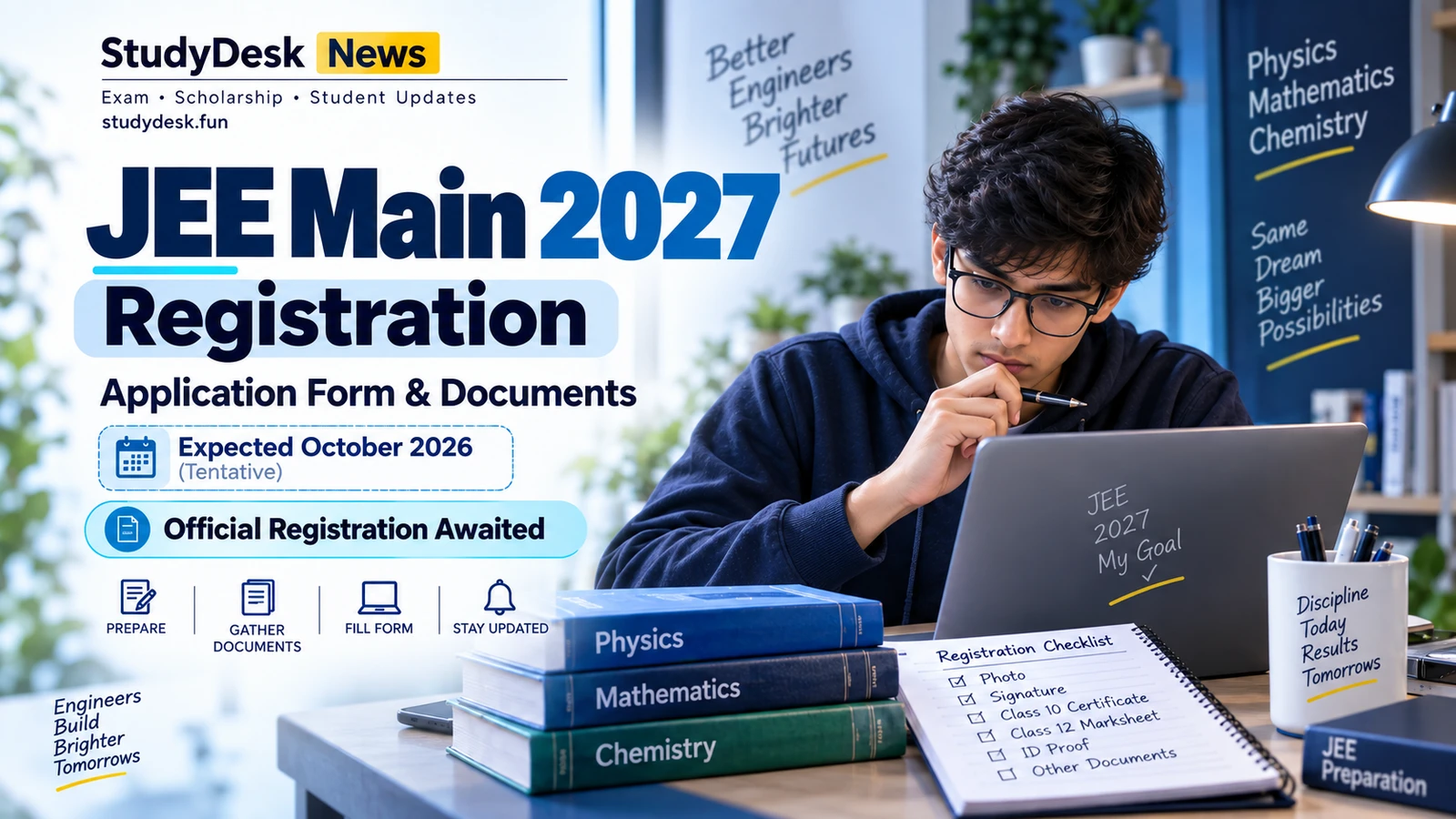
JEE Main 2027 registration guide with expected October 2026 timing clearly labelled, plus documents, application steps and official NTA status.
JEE Main 2027 eligibility guide: age limit, Class 12 passing-year rule, subject requirements, NIT+ 75% or top-20-percentile rule and official-status updates.
JEE Main 2027 admit card latest status, expected release timing, official download process, login details, information to verify and exam-day checks.
JEE Main 2027 answer key guide: official status, provisional answer key, recorded response sheet, challenge process, final answer key and score estimation.