 StudyDesk

Earth Care Foundation Project Udaan 2.0: what it actually is
Project Udaan 2.0 is not a cash scholarship in the usual sense, and understanding that one point will save you confusion. It is a subsidised-education programme run by the Earth Care Foundation (ECF), a New Delhi-based non-profit, aimed squarely at poor and underprivileged young people — especially students in villages and small towns whose local schools and coaching options are thin. Instead of paying money into your bank account, the foundation arranges access to online courses at a highly subsidised, in its own words almost-zero, cost, and awards scholarship support for those courses depending on its selection criteria. ECF's camp office is in Sector 150, Noida, its registered address is in Neb Sarai, New Delhi, and its published helplines run Monday to Saturday, 10 AM to 6 PM.
The problem Udaan 2.0 is built around is real. A student in a small Bihar or UP town preparing for NEET, JEE, CUET, SSC or banking exams competes against city students with expensive coaching, better English, and adults around them who know how admissions work. Udaan's course basket attacks exactly those gaps: subject coaching for competitive and entrance exams, English language proficiency, personality development and soft skills, and career counselling. Under the programme's first phase, Udaan 1.0, ECF says it set up knowledge-upgradation centres for the children of migrant labourers, reaching over 3,000 students; phase 2 moves the model online, so a learner can study from any device and any location. Partner delivery pages for Udaan 2 also describe access to mainstream course content — including Physics Wallah courses at reduced cost for NEET and JEE aspirants — channelled through CSC and ECF arrangements.
That is the honest shape of the offer: discounted, structured online learning plus guidance, targeted at students for whom even a mid-priced coaching course is out of reach. It is not a government scheme, it is not a lump-sum award, and it does not replace exam application fees, devices or internet costs, which remain yours.
Who it is for
The foundation's own framing is consistent: poor and underprivileged youth, with a deliberate focus on rural areas and small towns, and on young women as well as men. The 2026 aggregator listing for the scholarship describes eligibility in broad terms — Indian citizens, open to all genders and all categories, applying for the courses offered under Project Udaan for the academic year, with the option to choose up to four courses across academic, competitive-exam and personal-development options. Treat that list as a guide to who the programme wants, not as a verified rulebook: the official ECF page currently says project details "will be added soon," and the criteria that actually bind you are the ones on the live registration form and in ECF's screening. If your family's income is genuinely low and your schooling options are genuinely limited, you are the applicant this programme was designed around — and you should expect to be asked to demonstrate that, not merely assert it.
How registration works, step by step
- Start on the official site.Open the Project Udaan 2.0 page on theearthcarefoundation.org and follow its "Apply Now / Apply for scholarship" route (the application portal is linked from that page). Do not register through lookalike pages or agents.
- Fill the scholarship registration formfor the course or courses you want. The form is the gateway: filling it makes you eligible to be considered for a scholarship award against ECF's selection criteria. Choose courses you will actually complete — the listing's four-course ceiling is not a target.
- Provide the documents and details the form asks for.Per the aggregator listing, the expected set is: Aadhaar card, a valid email ID and mobile number, an income certificate, a ration card copy, your previous year's marksheet, and an EWS certificate if applicable. Have clean scans ready before you start.
- Complete any screening or verification.ECF describes selection as criteria-based; depending on the course, expect scrutiny of your academic record and income documents, and respond promptly to any follow-up from the foundation.
- Wait for confirmation of course activation / scholarship selectionthrough ECF's official channels before assuming any subsidy has been granted.
What courses actually cost: the partner price table
The CSC partner documentation for Udaan 2.0 does publish a course-wise price structure — an indicative market price against the amount the student pays. Selected rows:
| Course (provider: Physics Wallah unless noted) | Minimum qualification | Market price | You pay |
|---|---|---|---|
| Arjuna (Class 11) + Lakshya (Class 12) JEE or NEET, 800 days | Class 10/11 pass, 60% (science) | ₹9,000 | ₹850 |
| Arjuna JEE/NEET for Class 11, or Lakshya NEET for Class 12, 365 days | Class 10/11 pass, 60% (science) | ₹4,800 | ₹500 |
| NDA, 365 days | Class 11 pass, 60% | ₹4,999 | ₹500 |
| CDS, 230 days | Class 11 pass, 60% | ₹2,499 | ₹500 |
| SSC MTS / GD / CHSL / CGL | Class 10 or 12 pass (50% where stated) | ₹299–₹1,499 | ₹200 |
| SBI PO / SBI Clerk / IBPS PO foundation | Pursuing bachelor's degree, 50% | ₹1,300–₹1,699 | ₹200 |
| Banking MahaPack, 365 days | Pursuing bachelor's degree, 50% | ₹2,799 | ₹300 |
| English Speaking Course (Fast Info Classes), 60 days | Class 10 pass | ₹4,500 | ₹500 |
| Career Counselling (Know Thy Choice), 90 days | Class 10 pass | ₹4,999 | ₹500 |
| Personality Development (Orbit), 10 days | Class 10 pass | ₹3,999 | ₹400 |
Read the pattern, not just the rows: competitive-exam courses cluster at ₹200–₹500 payable, and the two-year JEE/NEET bundle is the most expensive item at ₹850 against a ₹9,000 market price — a subsidy of over 90%. A worked example makes the choice concrete: a Class 11 science student with 60%+ who wants both years of NEET preparation pays ₹850 once for the combined Arjuna + Lakshya course, instead of ₹500 + ₹500 buying the two years separately — and keeps three of her four course slots free for, say, the English Speaking Course (₹500) and Career Counselling (₹500), a total outlay of ₹1,850 for a basket with a combined market price of ₹18,499.
Two cautions belong with these numbers. The partner table's rows carry validity up to the 2025 or 2026 exams, so the exact course open to you today, and its exact price, must be confirmed on the registration portal before you pay. And "payable" is the student's share after the foundation and its donors absorb the rest — it is a real payment, not a free course with a fee-shaped formality.
How need is identified, and the registration rules that bind you
The partner documentation is specific about how economically weaker students are identified: a family member must hold a BPL card, an EWS certificate, an income certificate, or a ration card (orange/red/yellow) issued by the Tehsildar/Tehsil office, and any one of these is uploaded to the portal at registration. That is the document that proves need — not a self-declaration.
Registration itself has hard edges worth knowing before you start:
- A maximum of four courses per student, on the same email ID and mobile number; a candidate cannot register more than twice.
- Login credentials for every course are sent to that one email ID and mobile number and verified by OTP — register with a number you will keep, because the courses are accessible only on it.
- Course fees are non-refundable.
- If a student is inactive in a course for 30 days without responding, the scholarship for that course may be restricted.
- A course counts as completed only if you pass at least 50% of its examinations/tests.
Deadlines and what is not published
No fixed closing date is displayed for the current cycle on the official page — registration appears to run on a rolling basis, which is precisely why you should apply early rather than treat "no deadline" as "no hurry": subsidised seats in a given course batch are finite in practice even when no date is printed. Before you commit, ask ECF directly, on its published numbers or at [email protected], what your chosen course will actually cost you after subsidy, and keep the answer with your registration confirmation.
Common mistakes
The first is category confusion: applying while expecting a cash transfer, then abandoning good courses when no money arrives. The second is document carelessness — an income certificate in a parent's name mismatched with the form, or a blurry marksheet — in a programme whose entire selection logic is need-based, weak documentation reads as weak need. The third is course hoarding: enrolling in four unrelated courses and finishing none, when one competitive-exam course completed properly would change your year. And the fourth is paying intermediaries. Registration runs through ECF's own site and its authorised partners; anyone charging you a "processing fee" to submit this form, or asking for OTPs and banking PINs, is not part of the programme — walk away.
The bottom line
Udaan 2.0 is a modest, real thing: a non-profit using subsidy to put structured online courses — exam coaching, English, soft skills, career guidance — within reach of students who are normally priced out of them. If that describes you, register on the official page, document your need properly, pick courses narrowly, and confirm your post-subsidy cost in writing. If you need cash support for fees at a college you already attend, this is the wrong scheme, and your time is better spent on your state post-matric or NSP scholarships instead.
Sources & verification
Checked against Earth Care Foundation (ECF)'s official source on 6 September 2026. Closed, renewal-only, expected and open statuses are kept separate.
Frequently asked questions
Is Project Udaan 2.0 a cash scholarship?
No. It is a subsidised-education programme: instead of paying money into your bank account, the Earth Care Foundation arranges access to online courses at a highly subsidised, almost-zero cost, with scholarship support for those courses depending on its selection criteria.
Who is Project Udaan 2.0 for?
It is aimed at poor and underprivileged young people, with a focus on rural areas and small towns. The 2026 listing describes it as open to Indian citizens of all genders and all categories applying for the courses offered under Project Udaan, though the criteria on the live registration form are the ones that bind you.
How many courses can I register for?
A maximum of four courses per student, on the same email ID and mobile number, and a candidate cannot register more than twice. Course fees are non-refundable.
How is financial need proved?
A family member must hold a BPL card, an EWS certificate, an income certificate, or a ration card (orange/red/yellow) issued by the Tehsildar/Tehsil office, and any one of these is uploaded to the portal at registration.
How much do the courses cost the student?
In the CSC partner documentation, competitive-exam courses cluster at ₹200–₹500 payable by the student, and the two-year Arjuna + Lakshya JEE/NEET bundle is ₹850 against a ₹9,000 market price. Confirm the amount payable for your course on the registration portal before paying.
What is the last date to apply for Project Udaan 2.0?
No fixed closing date is displayed on the official page or the listing — registration appears to run on a rolling basis. Apply early, because subsidised seats in a course batch are finite in practice even when no date is printed.
College Board India Scholars Program current scholarship status, eligibility, benefits, application process, deadline and official-source verification.

Sitaram Jindal Foundation Scholarship current scholarship status, eligibility, benefits, application process, deadline and official-source verification.

Reliance Foundation Scholarships 2026–27 current scholarship status, eligibility, benefits, application process, deadline and official-source verification.
NSP 2026–27 guide covering the open Academic Year 2026–27 portal, mandatory OTR, scheme-specific deadlines, fresh/renewal applications and verification stages.
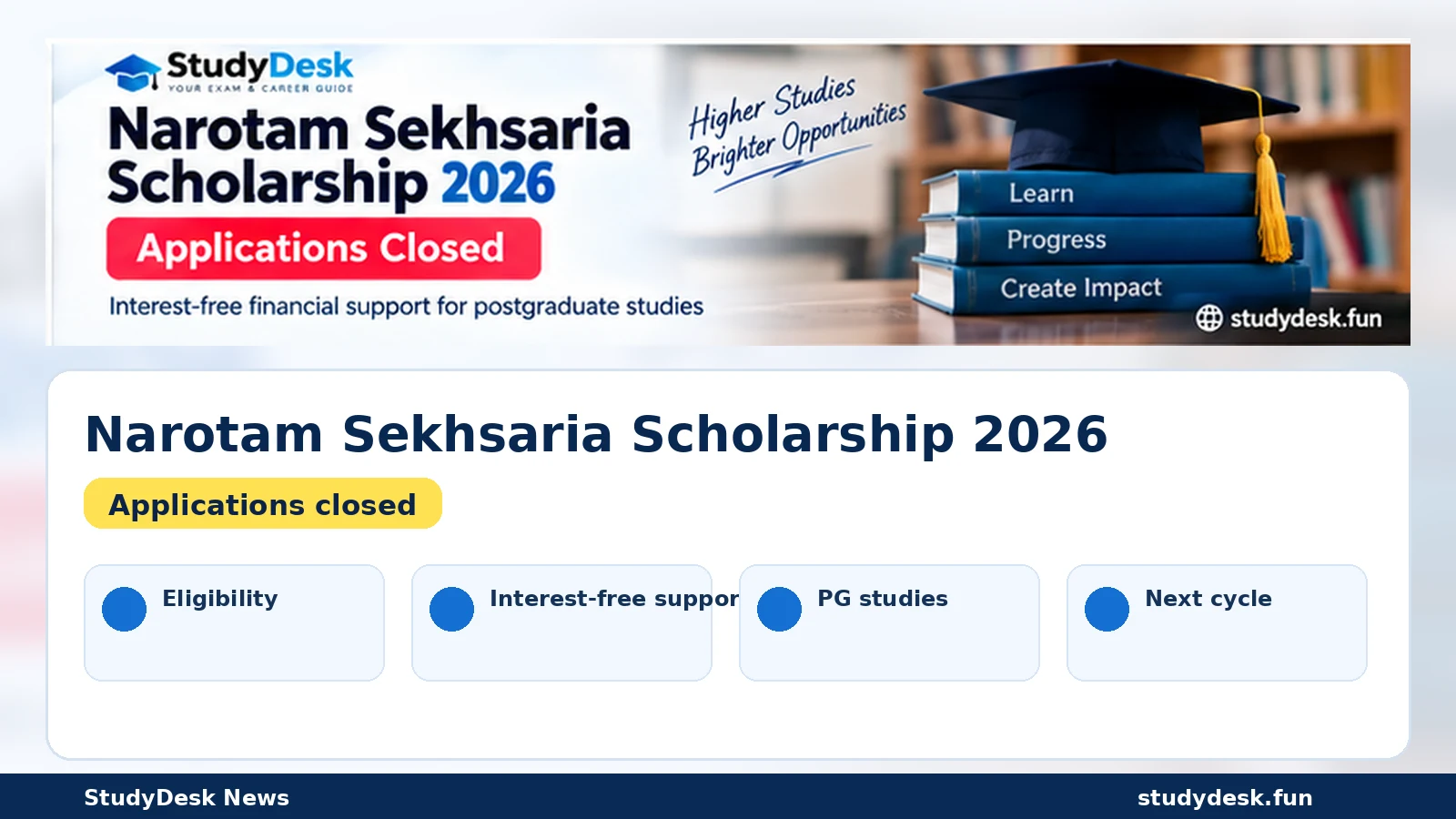
The Narotam Sekhsaria Foundation says the 2026 application process is closed; its published deadline was 23 March 2026. This page explains the interest-free support model, eligibility and what to watch for in the next annual call.