 StudyDesk
What the scheme is
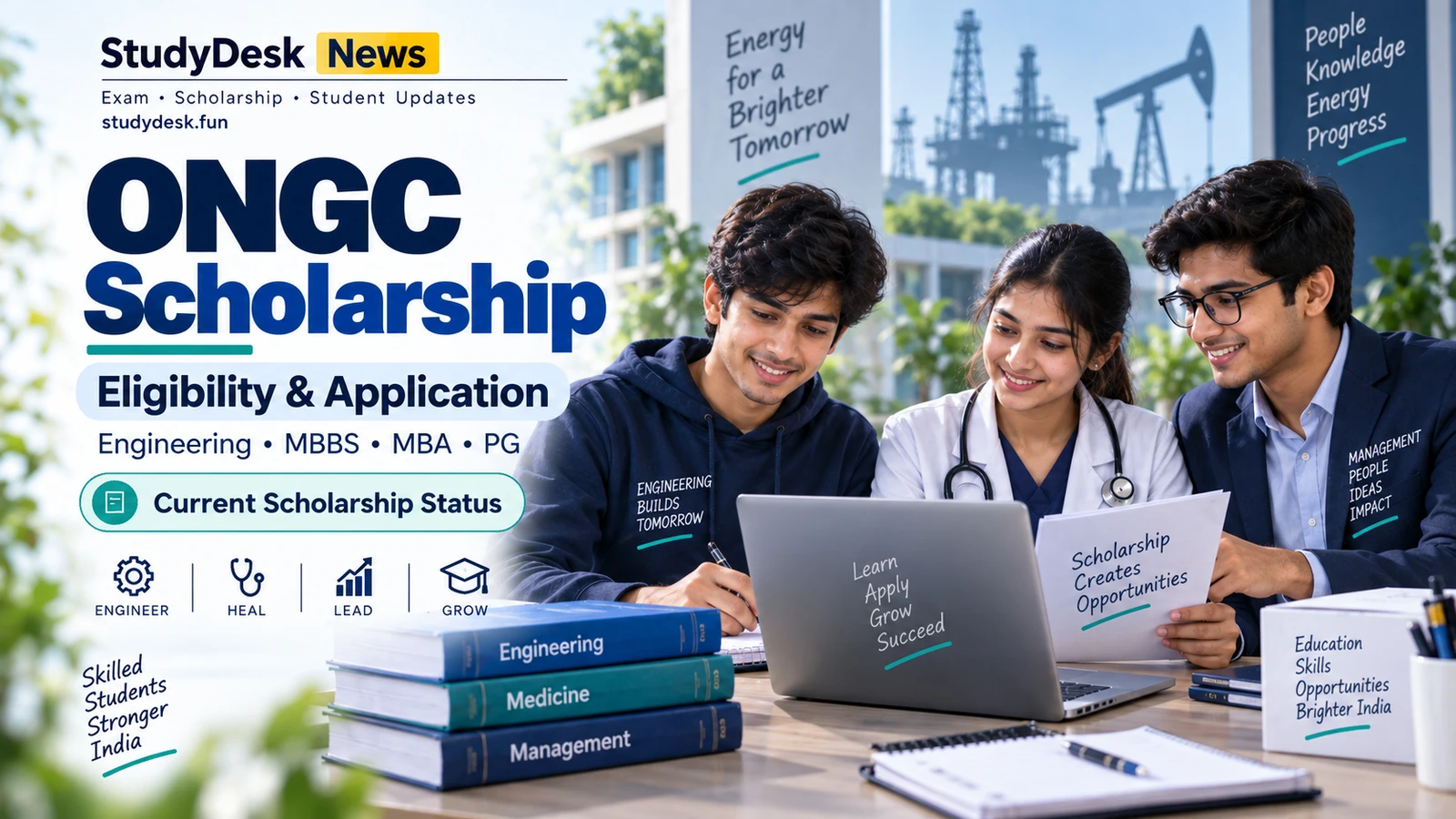
The ONGC Scholarship (also called the ONGC Merit Scholarship Scheme) is run by the ONGC Foundation, the CSR arm of Oil and Natural Gas Corporation Limited. It is deliberately narrow: it does not fund school students, general degree students, or anyone beyond the first year. It funds four professional courses, and only students entering the first year of a full-time, regular programme:
- Engineering (B.E./B.Tech) — four-year programmes recognised by AICTE
- MBBS — recognised by the medical regulator
- MBA — two-year programmes recognised by UGC/AICTE
- Master's in Geology or Geophysics — the geoscience degrees that feed ONGC's own industry
Part-time, distance, and diploma programmes are not covered. Neither are students studying outside India.
Who is eligible
Four conditions decide everything, and students trip on them in this order:
- Category and income.You must belong to SC/ST, OBC, or General (EWS). Annual family income from all sources must be below ₹4.5 lakh for SC/ST applicants, or below ₹2 lakh for OBC and General (EWS) applicants. These limits come straight from earlier official notifications, and they are the reason most ineligible applications fail.
- Marks.At least 60% marks (or 6.0 CGPA) in the qualifying exam — Class 12 for Engineering and MBBS applicants, graduation for MBA and Geology/Geophysics applicants.
- Age.Not more than 30 years on the cutoff date in the notification.
- No other scholarship.You cannot hold another scholarship or financial aid while taking this one; only one category (SC/ST, OBC, or General/EWS) may be applied under.
Preference goes to students from Below Poverty Line (BPL) families when marks are equal, and 50% of awards are reserved for girl students. You must be an Indian citizen studying in India, with a bank account in your own name (not a minor account).
Dates, honestly
The 2025–26 cycle ran 1 April to 15 May 2026 (with an extension reported to 25 May 2026). The next cycle's dates have not been verified on the official portal at the time of writing — the portal was unreachable during our research — so treat any specific "last date" you see on other sites with suspicion until it appears on ongcscholar.org. The pattern is stable, though: applications open in spring, and the shortlist/merit list is published on the same portal.
How to apply, step by step
- Open ongcscholar.org and register as a new user when the cycle window is live. Use your own mobile number and email — all communication comes to these.
- Fill the application with your personal details, category, course and institute details, and qualifying-exam marks exactly as they appear on your documents.
- Upload the required documents (below) in the formats the portal specifies.
- Submit and note your application ID. In previous cycles, an attested hard copy of the application also had to be sent to the designated ONGC office — read the current-cycle notification carefully on whether that step still applies.
- Track status and the merit/result list on the portal using your application ID.
Documents needed
Keep scanned copies ready before you begin: Class 10 certificate, Class 12 marksheet (or graduation marksheet for PG applicants), caste/category certificate (SC/ST/OBC or EWS income-and-asset certificate), family income certificate, Aadhaar card, admission letter or institute bonafide certificate from your current programme, bank passbook first page (your own savings account), and a recent photograph. An undertaking confirming the accuracy of your information, attested by your institution's head, has been required in past cycles.
What the award is worth over your whole course
₹48,000 a year sounds abstract until it is multiplied by the course length — and the total is also how you should compare ONGC against a smaller one-time award:
| Course | Years paid (with renewal) | Total value |
|---|---|---|
| Engineering (B.E./B.Tech) | 4 | ₹1,92,000 |
| MBBS | 4 (course duration as approved) | ₹1,92,000 |
| Master's in Geology/Geophysics | 2 | ₹96,000 |
| MBA | 2 | ₹96,000 |
Half of the 2,000 awards — 1,000 — are reserved for girls, spread across the same category split (1,000 SC/ST, 500 OBC, 500 General-EWS). A girl applicant is therefore competing inside both her category pool and a reserved half of it, which is why an eligible first-year girl who skips this application over a document doubt is giving up better odds than the headline 2,000 figure suggests.
Renewal and common mistakes
The scholarship renews every year until your course ends if you keep scoring 60% or above (6.0 CGPA) and progress normally. Renewal is an upload exercise on the portal, not a fresh competition: in the 2026 renewal round (1 June – 15 July 2026), continuing scholars uploaded their semester marksheets by cohort — for example, the 2023–24 cohort uploaded 1st and 2nd semester marksheets for the second instalment, and the 2020–21 cohort uploaded 5th and 6th semester marksheets for the fourth. Miss the renewal upload window for your cohort and that year's instalment is what you lose. The ONGC Foundation helpdesk published by the programme is at ONGC Foundation, 10th Floor, Core III, Scope Minar, Laxmi Nagar, Delhi-110092, phone 011-22406854 / 011-22406859 (10 AM – 5 PM).
The three commonest mistakes: applying in the second year (the scheme is first-year only), applying while already holding another scholarship (grounds for disqualification and recovery), and misstating family income — false information leads to immediate disqualification and can be reported to your institution. A fourth, quieter one: if you cannot produce a PAN card at application time, the guides reproducing the notification say to state a tentative date for submitting it rather than leaving the field blank or inventing a number. If you qualify on category, income, and marks, this is one of the most valuable first-year scholarships in India; the only way to lose it is carelessness with the facts.
Sources & verification
Checked against ONGC Foundation / primary published information on 6 September 2026.
Frequently asked questions
How much is the ONGC scholarship, and how many students receive it?
Each scholar receives ₹48,000 per year (₹4,000 per month). There are 2,000 awards every year — 1,000 for SC/ST students, 500 for OBC students and 500 for General-EWS students — and half of them are reserved for girls.
Which courses does the ONGC scholarship fund?
Only students entering the first year of a full-time, regular programme in Engineering (B.E./B.Tech), MBBS, MBA, or a Master's in Geology or Geophysics. Part-time, distance and diploma programmes are not covered.
What are the income and marks conditions?
Annual family income from all sources must be below ₹4.5 lakh for SC/ST applicants or below ₹2 lakh for OBC and General (EWS) applicants, and you need at least 60% marks (or 6.0 CGPA) in the qualifying exam, with an age limit of not more than 30 years on the notification's cutoff date.
When did the last ONGC cycle run?
The 2025–26 cycle ran from 1 April to 15 May 2026, with an extension reported to 25 May 2026. The next cycle's dates had not been verified on the official portal, ongcscholar.org, when this page was prepared.
Can I hold another scholarship alongside ONGC?
No. You cannot hold another scholarship or financial aid while taking this one, and misstating family income leads to immediate disqualification.
How does ONGC renewal work?
The scholarship renews every year until your course ends if you keep scoring 60% or above (6.0 CGPA) and progress normally; renewal is an upload of your semester marksheets on the portal within your cohort's renewal window, not a fresh competition.
OPJEMS Scholarship 2026 guide covering amount, eligibility, participating institutes, selection and what students should verify before applying.

Legrand Empowering Scholarship 2026–27 guide covering last date, eligibility, amount and who can apply under the general and special-category tracks.
Rupa Rahul Bajaj Scholarship 2026–27 current status, eligibility, benefits, deadline, application route and official-source verification.

Rolls-Royce Unnati Scholarship current status, eligibility, benefits, deadline, application route and official-source verification.

Infosys Foundation STEM Stars Scholarship current status, eligibility, benefits, deadline, application route and official-source verification.