 StudyDesk
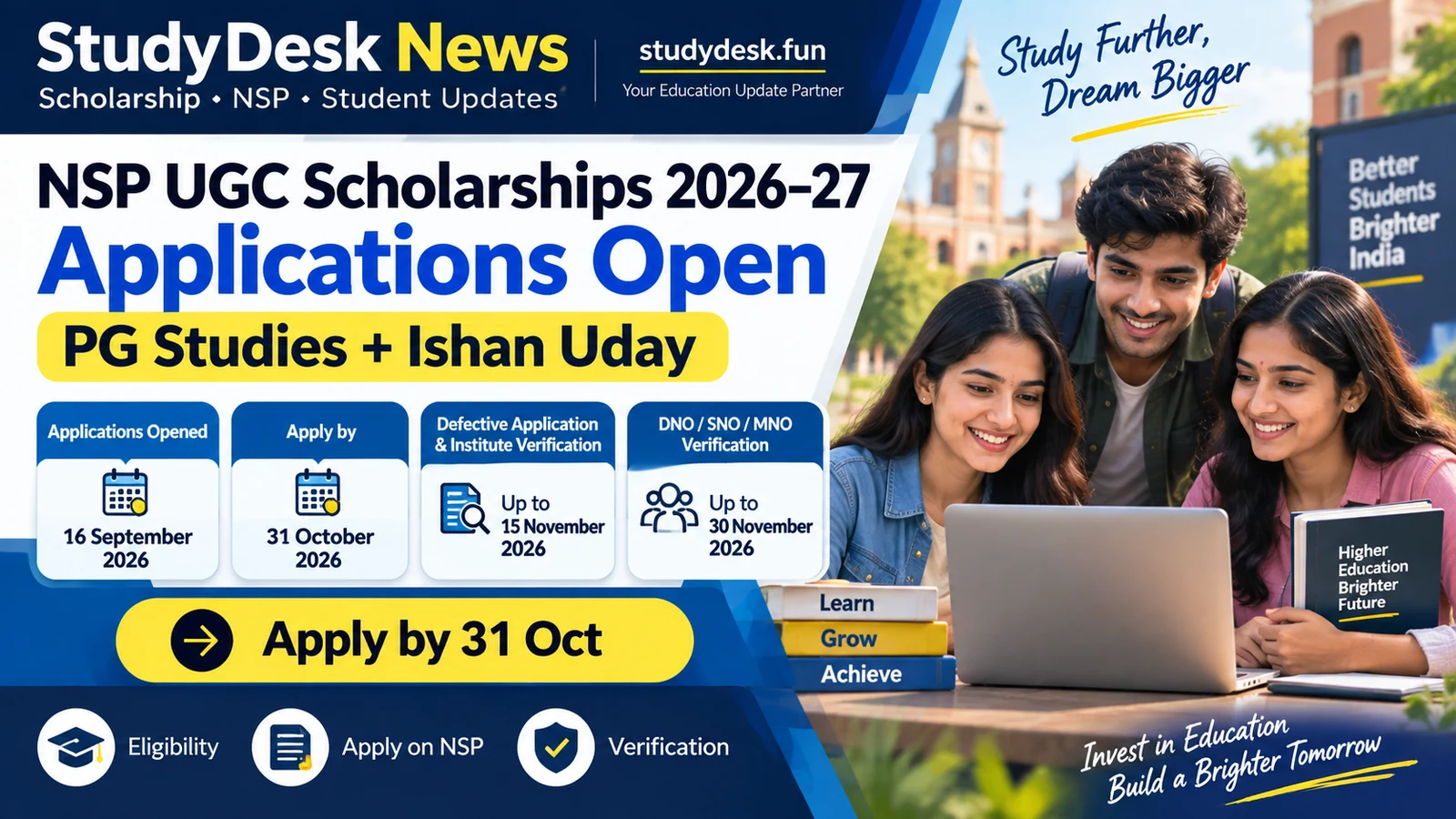
Two UGC scholarships, one portal, one deadline
Every year the University Grants Commission routes two of its biggest scholarships through the National Scholarship Portal (NSP): the National Scholarship for Post Graduate Studies (NSPG) and the Ishan Uday Special Scholarship Scheme for the North Eastern Region. For the 2026–27 academic year, both opened on 16 September 2026, and both accept student applications only until 31 October 2026. But the deadline that actually ruins applications is not 31 October — it is the verification chain that follows it.
Both schemes are merit-linked and paid by direct benefit transfer (DBT) into the student's own bank account. Neither requires an entrance exam. But they serve very different students.
What each scheme actually is
Ishan Uday exists to push higher education in the North Eastern Region. It is for students with a domicile of one of the eight North Eastern states — Arunachal Pradesh, Assam, Manipur, Meghalaya, Mizoram, Nagaland, Sikkim and Tripura — who have just entered the first year of a regular, full-time undergraduate degree. You may study anywhere in India; the domicile is what matters. Roughly 10,000 fresh scholarships are awarded each year, selected on Class 12 merit, for the duration of the course (three to five years).
The money is meaningful: ₹5,400 per month for general degree courses (BA, BSc, BCom and similar) and ₹7,800 per month for technical, medical, professional and paramedical courses (BTech, MBBS, BPharm, nursing and the like), paid for ten months each academic year through DBT. Your college categorises your course on the NSP — and this is where students silently lose money. A BTech student wrongly tagged as a "general degree" loses ₹2,400 every month. Check the category your institute selects.
The National Scholarship for Post Graduate Studies supports students admitted to the first year of a regular, full-time postgraduate programme at a UGC-recognised institution. You must be an Indian citizen, and distance, part-time and correspondence enrolments do not count. The stated support is around ₹1.5 lakh per year, disbursed monthly over the two years of the PG course — but, as flagged above, portals quote this figure inconsistently, so confirm the exact monthly rate on the scheme page before planning finances around it.
Who is eligible — the real criteria
For Ishan Uday, all of these must be true:
- You hold a valid domicile or permanent residence certificate of a North Eastern state.
- You passed Class 12 from a recognised board (the scheme is aimed at students who studied in the NER) and have taken admission in the first year of a regular UG degree. Lateral-entry and second-year students are not fresh applicants.
- Your parents' combined annual income from all sources is below ₹4.5 lakh. An income certificate is mandatory.
- You are not already receiving another scholarship for the same purpose.
For NSPG:
- You are in the first year of a regular, full-time PG course at a recognised university or college.
- You are an Indian citizen.
- Your institution and course are recognised/approved as the scheme requires — check the scheme guidelines on NSP rather than assuming your college qualifies.
In both cases, "first year" is load-bearing. These are fresh-application schemes for students beginning their degree.
The timeline that matters more than the deadline
| Stage | Last date |
|---|---|
| Student application on NSP | 31 October 2026 |
| Defective-application verification | 15 November 2026 |
| Institute-level verification | 15 November 2026 |
| DNO / SNO / MNO verification | 30 November 2026 |
Here is the part most guides bury: submitting your form on 31 October does not complete your application. Your college's nodal officer must verify it by 15 November, and district/state/ministry officers must finish by 30 November. If your institute misses its verification date, your application dies regardless of how perfect your form was. Apply by the second week of October and then follow up in person with your college's scholarship nodal officer.
How to apply, step by step
- Complete One-Time Registration (OTR) first. NSP now requires a 14-digit Aadhaar-based OTR number before you can apply for any scholarship. It stays valid for your entire academic career, so do it once and keep the number safe.
- Go to scholarships.gov.in, log in with your OTR, and open the application for the correct scheme — Ishan Uday or National Scholarship for PG Studies.
- Fill in personal, academic and bank details. The bank account should be in your own name and Aadhaar-seeded — DBT failures from unseeded accounts are one of the top reasons payments stall.
- Upload documents (full list below) in the specified formats and sizes.
- Submit before 31 October 2026, then track the application status on NSP and confirm with your institute that it appears in their verification queue.
Documents you will need
- Recent passport-size photograph
- Aadhaar card (and OTR number)
- Domicile / permanent residence certificate (Ishan Uday — essential)
- Class 12 marksheet and passing certificate (Ishan Uday); UG degree documents (NSPG)
- Income certificate showing parental income below ₹4.5 lakh per annum (Ishan Uday)
- Caste/category certificate if applying under a reserved category
- Bonafide / enrolment certificate from your college or university
- Bank passbook or cancelled cheque — account in your name, Aadhaar-seeded, with correct IFSC
- Disability certificate, if applicable
Get the income and domicile certificates issued early. Tehsil offices slow down exactly when scholarship season peaks, and a certificate applied for on 25 October will not arrive by 31 October.
Common mistakes that kill applications
- Treating 31 October as the finish line and never checking whether the institute verified by 15 November. This is the number-one failure mode.
- Skipping OTR or entering wrong Aadhaar linkage, which blocks the form entirely.
- A bank account that is not Aadhaar-seeded, so the DBT bounces after selection.
- Wrong course category on the NSP (general vs technical), silently cutting the monthly amount.
- Applying to the wrong scheme — e.g. a second-year student applying as "fresh," or a PG student clicking Ishan Uday.
- Changing institution or course mid-tenure and expecting the scholarship to follow. It does not transfer; the award is tied to the original admission.
- Last-week document runs for income and domicile certificates that do not arrive in time.
One last practical note: NSP deadlines in past years have sometimes been extended by a few days through corrigenda. Do not plan on it. Extensions are announced on the portal, never guaranteed, and the verification dates shift with them. Apply early, verify with your college, and keep screenshots of every submitted stage.
Sources & verification
Dates/status are taken from the linked official source. Recheck the issuing authority before payment, admission, scholarship submission or exam-day action because later corrigenda/extensions may supersede this page.
Frequently asked questions
What is the last date for the UGC scholarships on NSP in 2026–27?
Both Ishan Uday and the National Scholarship for Post Graduate Studies opened on 16 September 2026, and both accept student applications only until 31 October 2026.
How much does Ishan Uday pay?
₹5,400 per month for general degree courses and ₹7,800 per month for technical, medical, professional and paramedical courses, paid for ten months each academic year through DBT. Roughly 10,000 fresh scholarships are awarded each year, selected on Class 12 merit.
Who can apply for Ishan Uday?
Students who hold a domicile of one of the eight North Eastern states — Arunachal Pradesh, Assam, Manipur, Meghalaya, Mizoram, Nagaland, Sikkim and Tripura — and have entered the first year of a regular, full-time undergraduate degree, with parents' combined annual income below ₹4.5 lakh.
Who can apply for the National Scholarship for Post Graduate Studies?
Indian citizens admitted to the first year of a regular, full-time postgraduate programme at a UGC-recognised institution. Distance, part-time and correspondence enrolments do not count, and neither scheme requires an entrance exam.
Is submitting my form by 31 October enough?
No. Institute-level and defective-application verification must finish by 15 November 2026 and DNO / SNO / MNO verification by 30 November 2026; if your institute misses its verification date, your application fails regardless of how perfect your form was.
What must I complete before applying on NSP?
One-Time Registration (OTR): a 14-digit Aadhaar-based OTR number is required before you can apply for any scholarship, and it stays valid for your entire academic career. Your bank account should be in your own name and Aadhaar-seeded, because payment is by DBT.

Complete guide to Siemens Scholarship Program 2026-27 (14th edition): eligibility, benefits for all four years, documents and how to apply on siemens.co.in/scholarship.
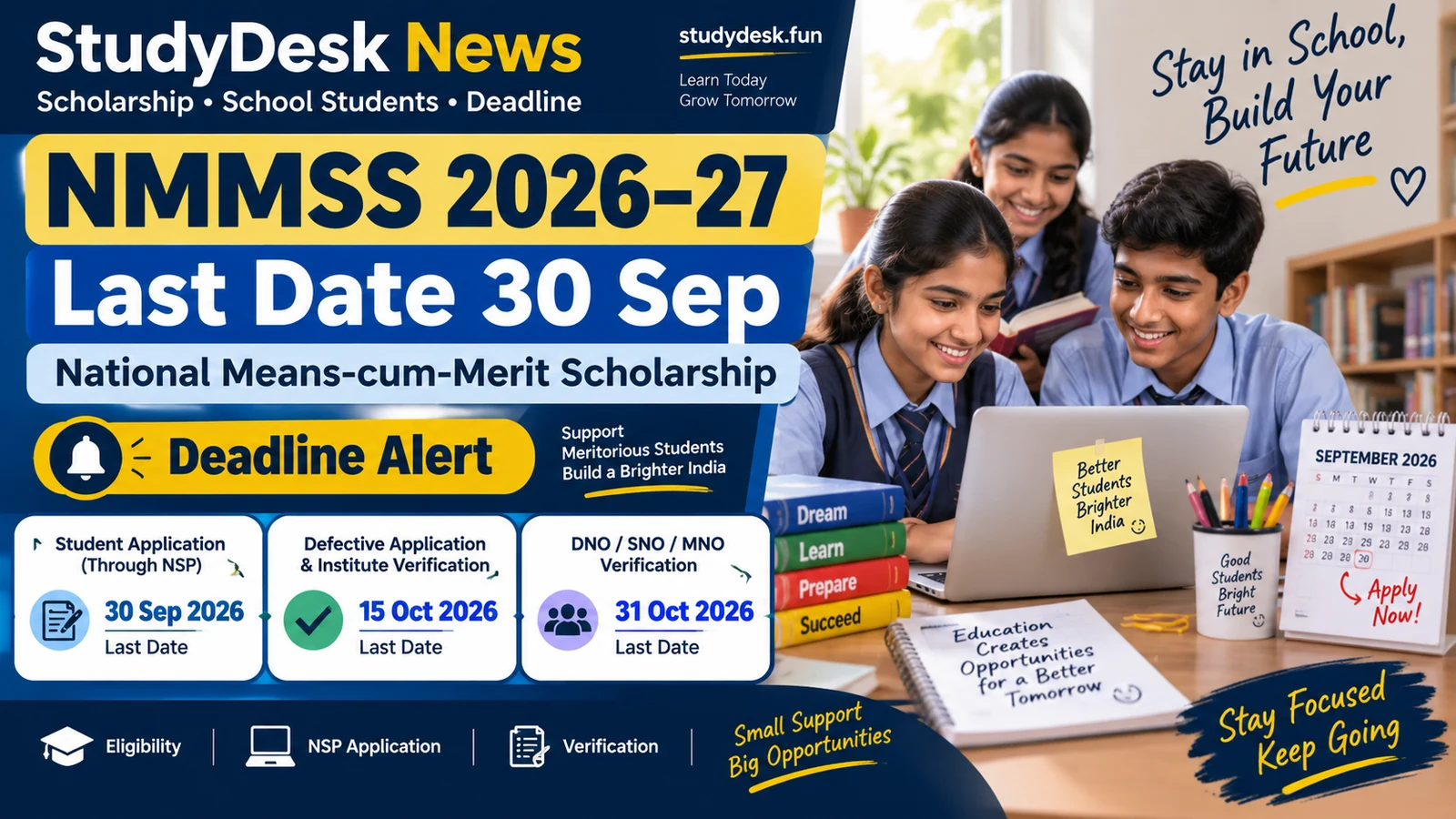
Deadline alert for National Means Cum Merit Scholarship 2026–27 applications on the National Scholarship Portal.
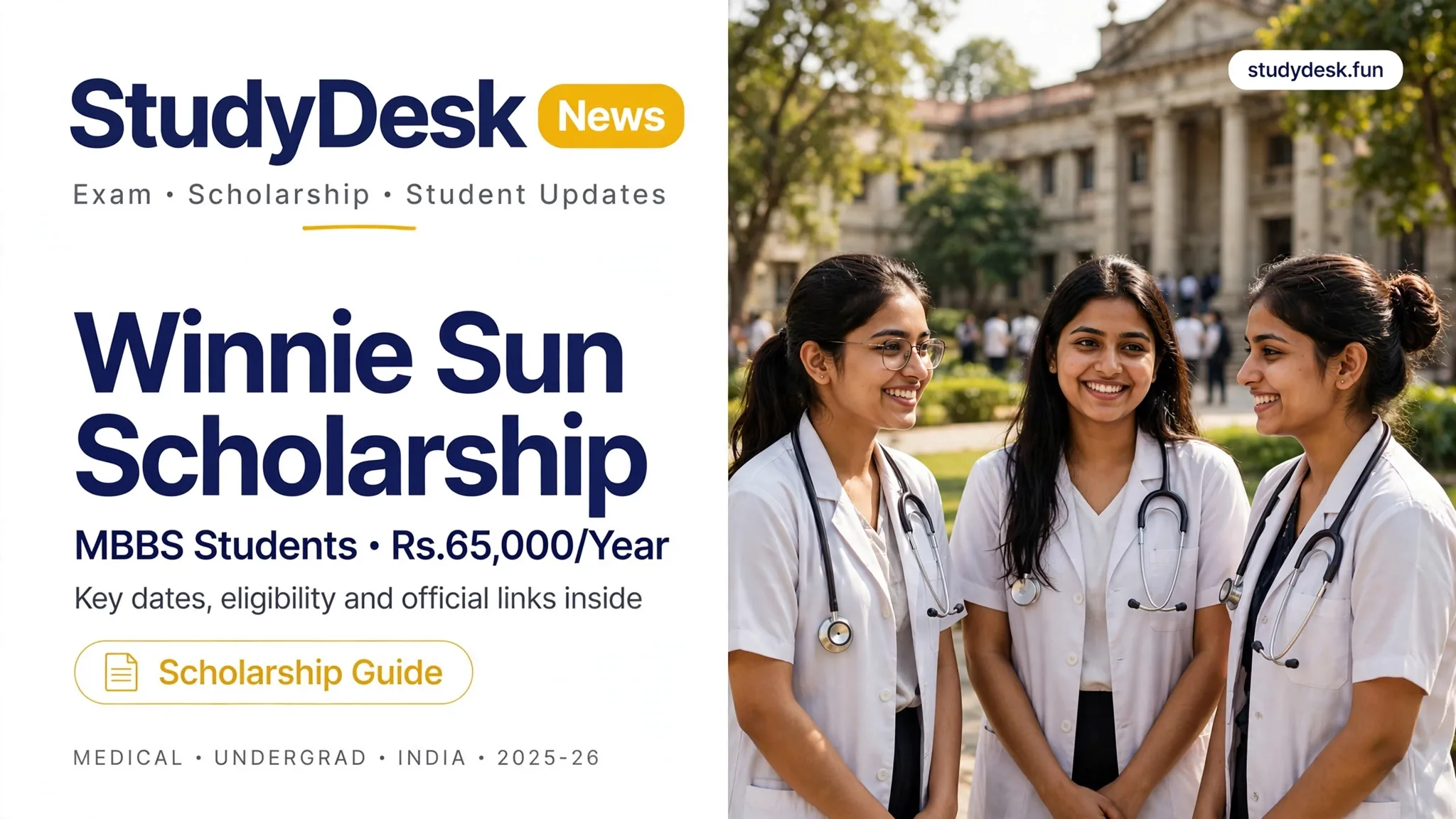
Complete guide to Winnie Sun Scholarship 2026-27: Lotus Petal Foundation support of up to Rs.65,000/year for girl students admitted to MBBS in FY 2026-27, eligibility, selection and how to apply.
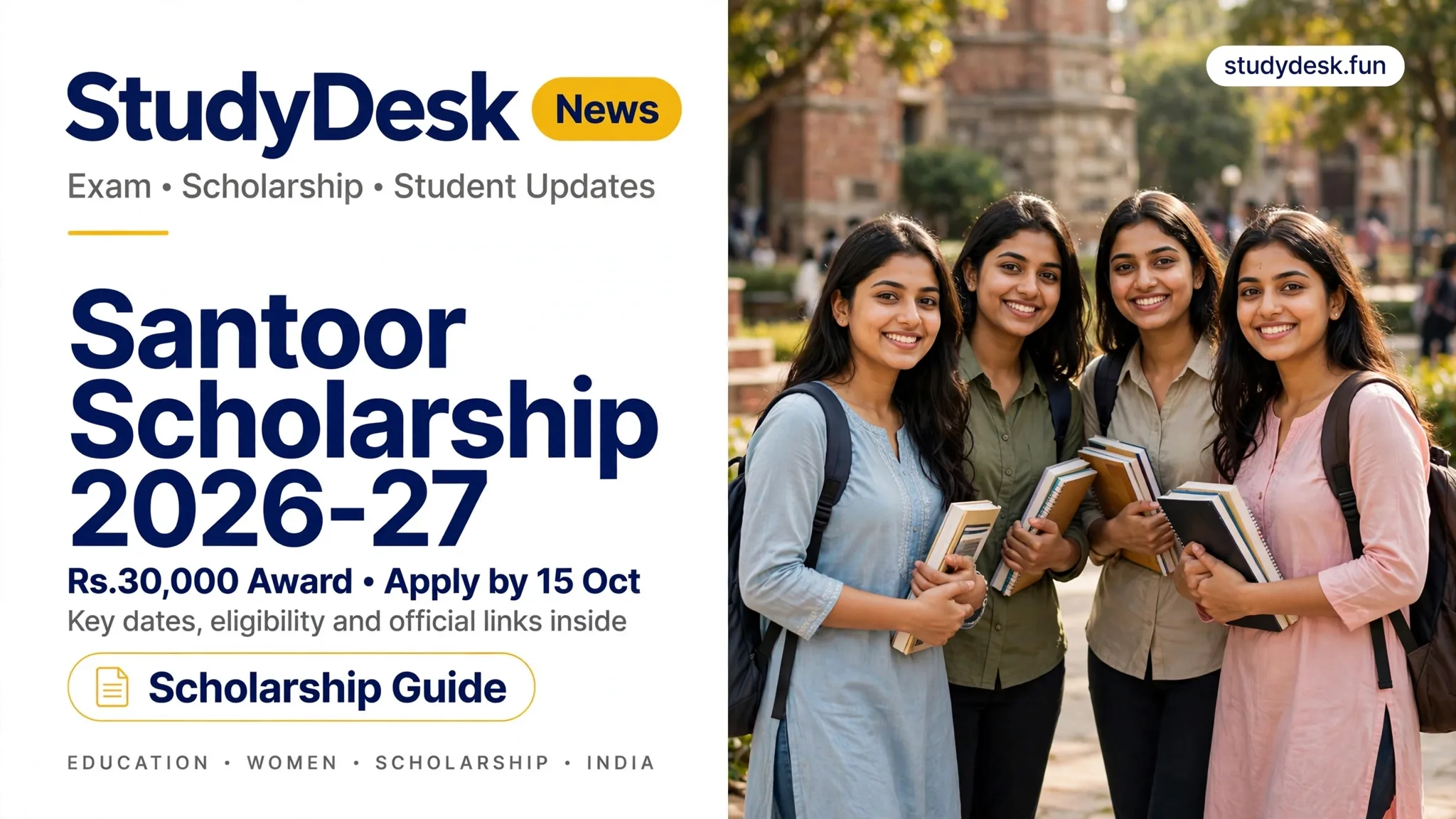
Complete guide to Santoor Scholarship Program 2026-27 by Wipro Consumer Care and Wipro Cares: eligibility for first-year undergraduate girls in Andhra Pradesh and Maharashtra, Rs.30,000 one-time award, and how to apply via santoorscholarships.com.
Complete guide to Rajasthan SJE Scholarship 2026-27: Social Justice and Empowerment Department's post-matric schemes (PMS, CM Sarvjan, Dr Ambedkar EBC, SBC), eligibility, documents and how to apply on sje.rajasthan.gov.in.