 StudyDesk
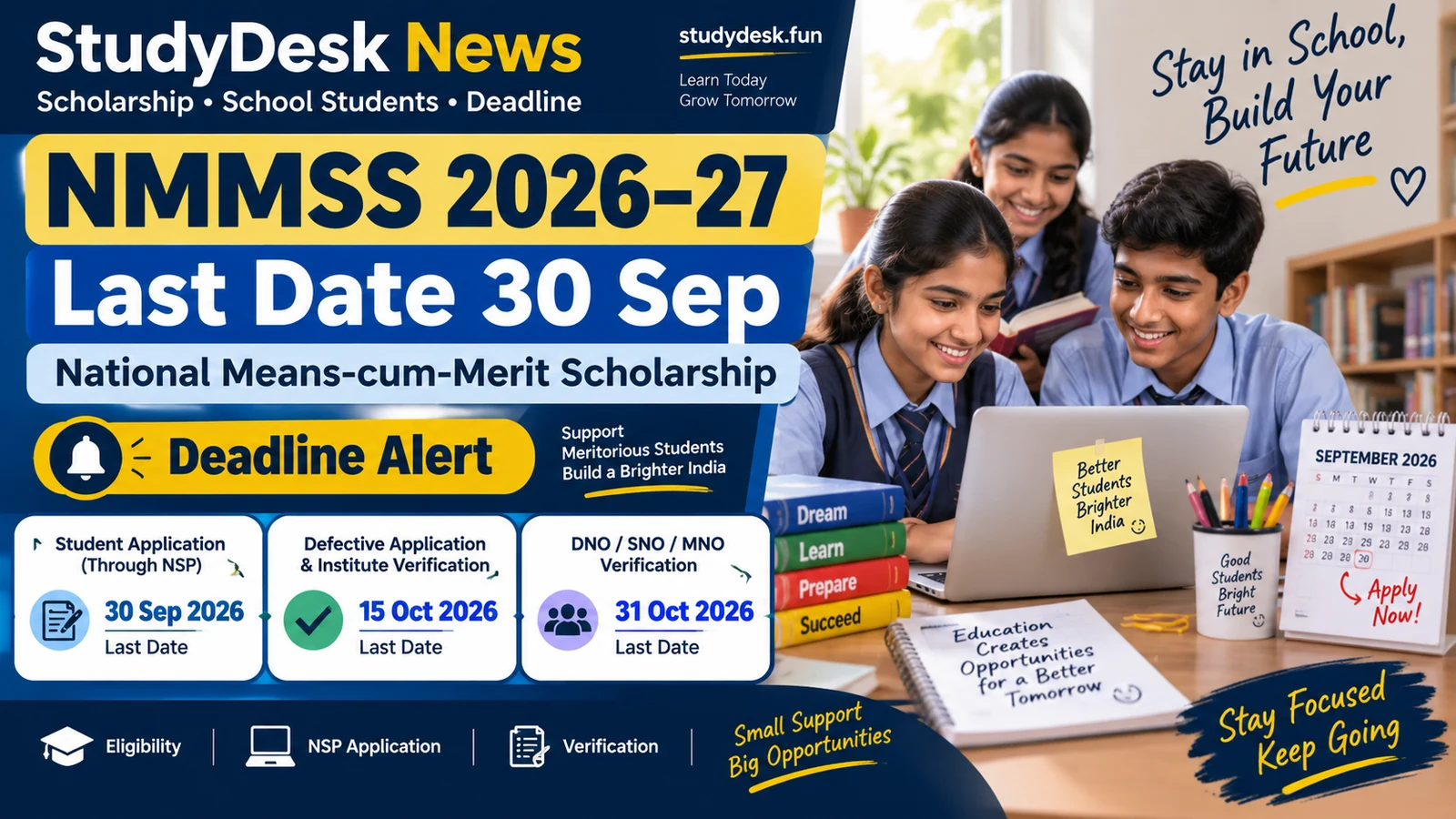
NMMSS 2026–27: the deadline has moved twice — 31 October is the date that counts
The National Means-cum-Merit Scholarship Scheme (NMMSS) application window for 2026–27 will now close on 31 October 2026 on the National Scholarship Portal (scholarships.gov.in). This is the second extension of the year: the window, which opened on 1 June 2026, was originally to close on 31 August, was pushed to 30 September, and has now been extended again by the Ministry of Education to give students time to finish their applications and let institutes and districts complete verification in an orderly way.
The rest of the schedule moved with it:
| Stage | Revised last date |
|---|---|
| Student application (fresh and renewal) on NSP | 31 October 2026 |
| Institute Nodal Officer (L1) verification | 15 November 2026 |
| District Nodal Officer (L2) verification | 30 November 2026 |
If you saw an earlier version of this page — or any older alert — showing institute verification ending 15 October and district verification ending 31 October, that was the superseded September schedule. Do not work to it. One practical point follows from the new dates: your application is not finished when you press submit. It still has to be verified by your school (L1) and then by the district (L2), and applications that sit unverified because a school was never told are the single most common way eligible students lose this scholarship. By 30 September, the Ministry reported 88,522 fresh and 1,97,133 renewal applications had already been submitted, so the verification queue is long — submit early in October, not on the 31st.
What NMMSS is
NMMSS is a central sector scheme of the Department of School Education and Literacy, Ministry of Education, designed to stop meritorious students from economically weaker families dropping out after Class 8. It awards one lakh fresh scholarships every year, divided among states and UTs, each worth ₹12,000 per year (₹1,000 per month), paid by Direct Benefit Transfer into the student's own bank account. The scholarship begins in Class 9 and can continue through Class 12 — four years in all — as long as the renewal conditions below are met each year.
Who is eligible
Fresh applicants are students who have been selected through the state-level NMMSS selection test held when they were in Class 8 and are now entering Class 9. The underlying conditions are:
- You study, as a regular student, in a government, government-aided or local body school. Students of Kendriya Vidyalayas, Jawahar Navodaya Vidyalayas and residential schools with free boarding are not eligible.
- Your parents' annual income from all sources does not exceed ₹3,50,000.
- To sit the selection test, you needed at least 55% marks in Class 7 (50% for SC/ST students).
Renewal applicants are existing scholars moving into Classes 10, 11 or 12, applying again on NSP for the new year.
How selection worked — the test behind the scholarship
NMMSS is not applied for cold; the money follows a test your state conducted in Class 8. The test has two papers of 90 multiple-choice questions each, each lasting 90 minutes (with extra time for students with disabilities): the Mental Ability Test (MAT) — reasoning, analogy, classification, numerical series, patterns and hidden figures — and the Scholastic Aptitude Test (SAT) — science, social studies and mathematics from the Class 7 and 8 syllabus. To qualify, a student must score at least 40% in aggregate across the two tests (32% for SC/ST students), and state merit lists are drawn from those who clear it. If you are in Class 8 now, your state's test notice — not the NSP deadline on this page — is the date you are working towards; NSP is where selected students claim and renew the scholarship from Class 9 onwards.
Keeping the scholarship: renewal conditions
The scholarship continues only if you keep meeting the academic conditions: a minimum of 55% marks in Class 9 and in Class 11 for continuation into Classes 10 and 12, and at least 60% in Class 10 for continuation into Class 11, with a 5% relaxation for SC/ST students; promotion must be in the first attempt. You must also remain in an eligible school and renew on NSP every year — the scholarship does not roll over by itself, and a discontinued scholarship cannot be revived.
How to apply on NSP, step by step
- Complete One-Time Registration (OTR) first. Since 2024–25, NSP requires OTR before any scholarship application. It generates a 14-digit OTR ID from your Aadhaar or Aadhaar Enrolment ID and is valid for your whole academic career. Do this before starting the NMMSS form.
- Log in on scholarships.gov.in with your OTR credentials and select the NMMSS scheme for 2026–27, choosing Fresh if you were selected last year and are entering Class 9, or Renewal if you already hold the scholarship.
- Fill in personal, school and bank details exactly as they appear on your documents. The bank account should be in the student's name and Aadhaar-seeded, because payment is by DBT.
- Upload the documents (below) and submit before 31 October 2026. Download and keep the final application copy and application ID.
- Take the submitted application to your school and confirm the Institute Nodal Officer has verified it — L1 verification closes 15 November. Then track your status on the portal dashboard until L2 district verification (by 30 November) shows approved.
Documents normally required: previous class marksheet (Class 8 for fresh applicants), income certificate from a competent authority, caste/category certificate if applicable, Aadhaar, and bank account details/passbook copy; renewal applicants need the last class marksheet showing the required percentage.
Mistakes to avoid
Applying without completing OTR; entering a parent's bank account instead of the student's; assuming submission equals approval and never checking whether your school verified the form; and — for Class 8 students — confusing the NSP claiming window with your state's selection test, which is a separate notice with its own date. The extension to 31 October gives you room, but the verification deadlines behind it are the ones that actually decide whether the ₹12,000 reaches you.
Sources & verification
Dates/status are taken from the linked official source. Recheck the issuing authority before payment, admission, scholarship submission or exam-day action because later corrigenda/extensions may supersede this page.
Frequently asked questions
What is the last date to apply for NMMSS 2026–27?
Student applications, fresh and renewal, close on the National Scholarship Portal on 31 October 2026. Institute Nodal Officer (L1) verification follows by 15 November 2026 and District Nodal Officer (L2) verification by 30 November 2026.
How much is the NMMSS scholarship?
It is worth ₹12,000 per year (₹1,000 per month), paid by Direct Benefit Transfer into the student's own bank account, beginning in Class 9 and continuing through Class 12 if the renewal conditions are met each year.
Who is eligible for NMMSS?
Students selected through the state-level NMMSS selection test held in Class 8 who study as regular students in a government, government-aided or local body school, with parents' annual income from all sources not exceeding ₹3,50,000. One lakh fresh scholarships are awarded every year.
What marks were needed for the selection test?
You needed at least 55% marks in Class 7 to sit the test (50% for SC/ST students), and at least 40% in aggregate across the Mental Ability Test and Scholastic Aptitude Test to qualify (32% for SC/ST students).
What marks do I need to keep the scholarship?
A minimum of 55% in Class 9 and in Class 11 for continuation into Classes 10 and 12, and at least 60% in Class 10 for continuation into Class 11, with a 5% relaxation for SC/ST students and promotion in the first attempt; you must also renew on NSP every year.
What documents do I need to apply?
The previous class marksheet (Class 8 for fresh applicants), an income certificate from a competent authority, a caste/category certificate if applicable, Aadhaar, and bank account details or a passbook copy; you must also complete One-Time Registration (OTR) on NSP before starting the form.
National Means-cum-Merit Scholarship Scheme (NMMSS) 2026–27 का हिंदी गाइड: NSP पर आवेदन की अंतिम तिथि, पात्रता, चयन परीक्षा, नवीनीकरण शर्तें और आवेदन के चरण। यह StudyDesk के अंग्रेज़ी NMMSS गाइड का हिंदी संस्करण है।
Complete guide to Siemens Scholarship Program 2026-27 (14th edition): eligibility, benefits for all four years, documents and how to apply on siemens.co.in/scholarship.
Complete guide to Winnie Sun Scholarship 2026-27: Lotus Petal Foundation support of up to Rs.65,000/year for girl students admitted to MBBS in FY 2026-27, eligibility, selection and how to apply.
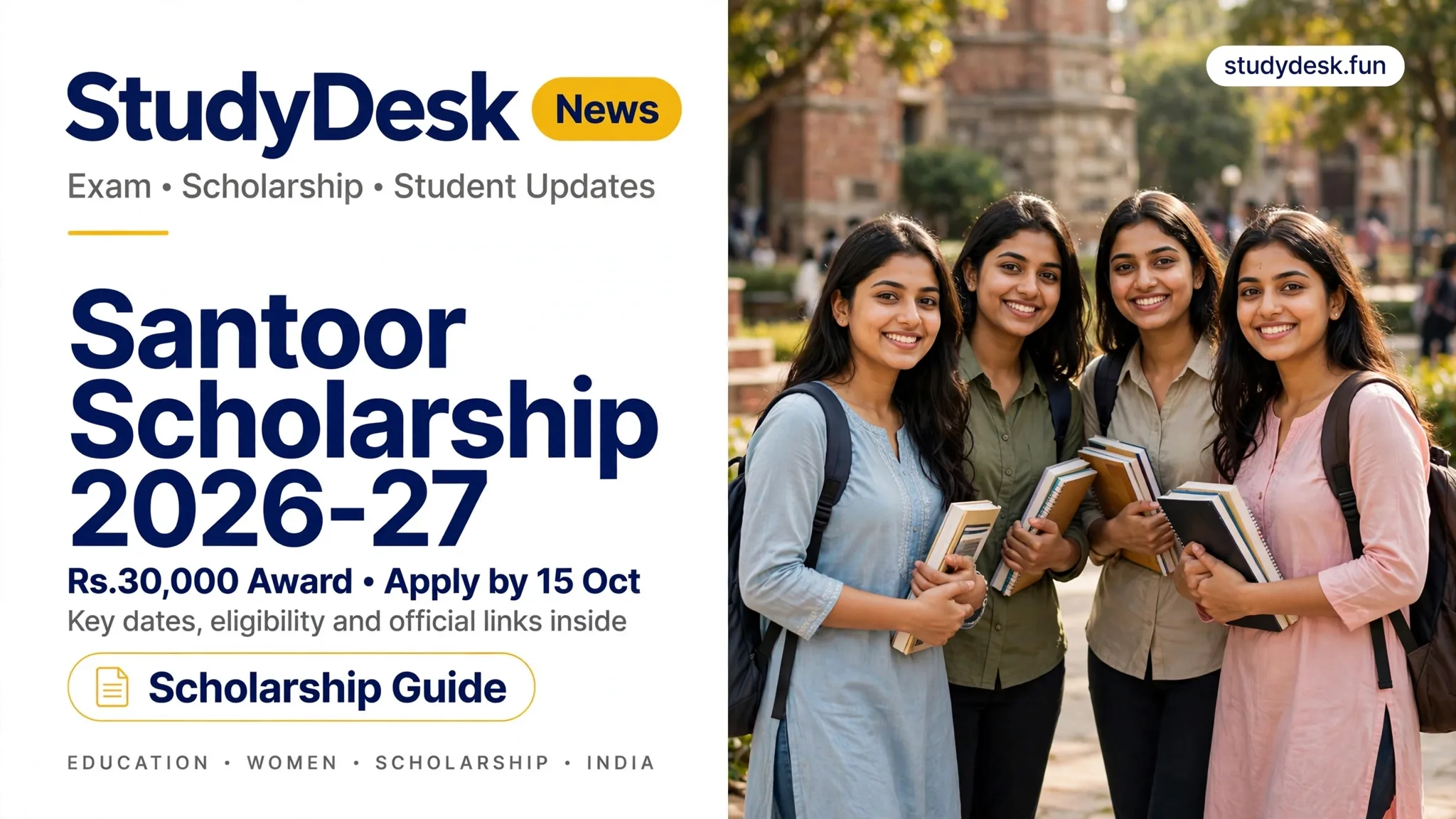
Complete guide to Santoor Scholarship Program 2026-27 by Wipro Consumer Care and Wipro Cares: eligibility for first-year undergraduate girls in Andhra Pradesh and Maharashtra, Rs.30,000 one-time award, and how to apply via santoorscholarships.com.
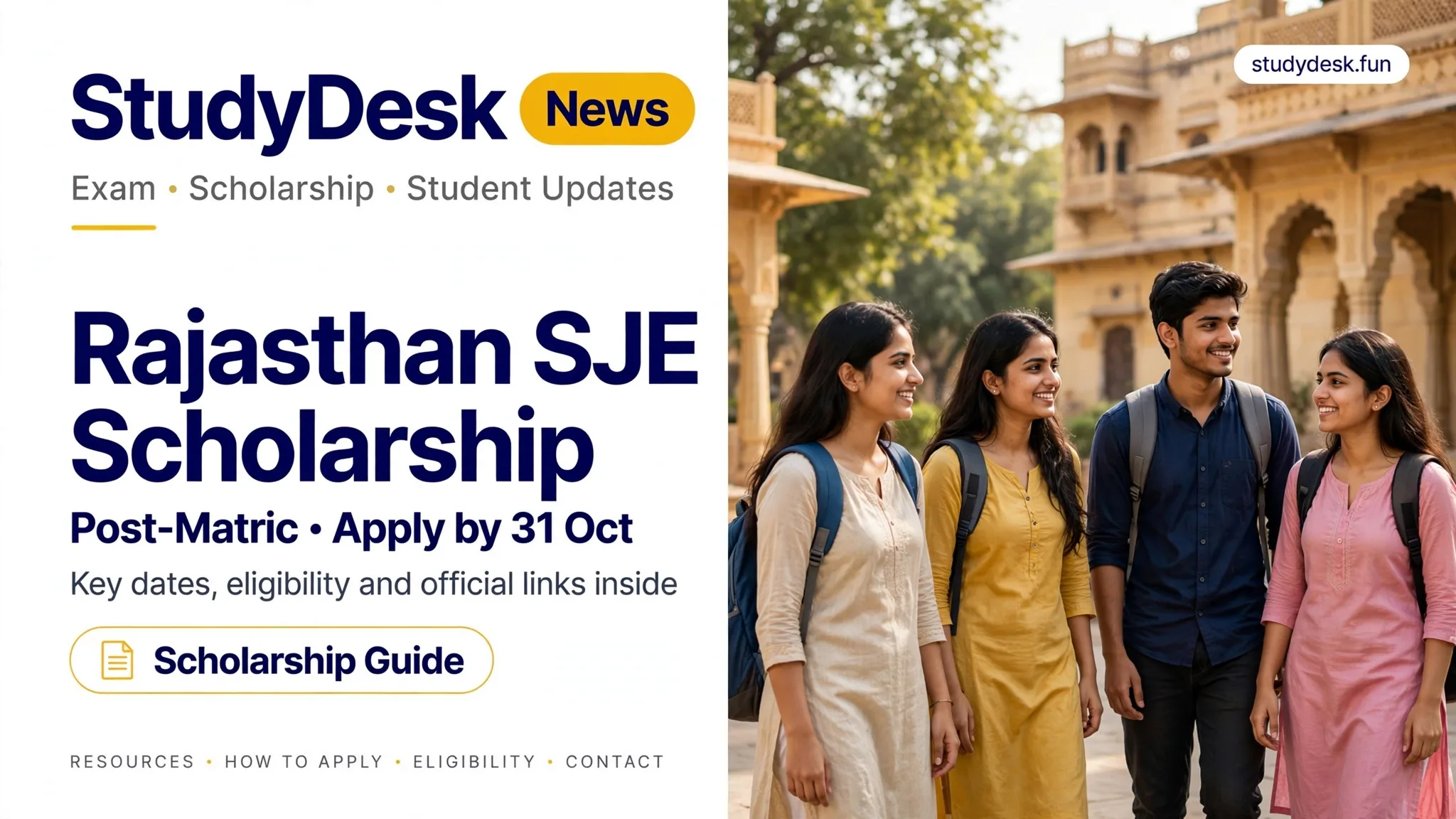
Complete guide to Rajasthan SJE Scholarship 2026-27: Social Justice and Empowerment Department's post-matric schemes (PMS, CM Sarvjan, Dr Ambedkar EBC, SBC), eligibility, documents and how to apply on sje.rajasthan.gov.in.