 StudyDesk

What the NTA calendar actually says — and what it does not
On 16 September 2026, the National Testing Agency published its tentative examination calendar for the 2027 cycle. For CUET PG 2027 it proposes exam dates of 1–5 March, 8 March, 12–20 March and 24–25 March 2027, with 30–31 March 2027 held as buffer dates. That is 17 exam days across nearly a full month, which tells you something important about the exam's scale: CUET PG runs in multiple shifts across many subjects and cannot fit into a single weekend.
Here is the discipline this page will maintain throughout: the calendar is not the notification. NTA itself describes these dates as tentative, and the exam-specific information bulletin — the document that actually governs eligibility, registration dates, fees, the subject list and the paper pattern — has not been released for 2027. Registration has not opened. No fee has been announced. Any website presenting a "complete CUET PG 2027 guide" with confirmed fees and a confirmed subject list right now is guessing. What follows separates what is official from what is informed planning reference.
What CUET PG is and who runs it
The Common University Entrance Test for Postgraduate admissions (CUET PG) is the National Testing Agency's single-window entrance exam for postgraduate admissions across participating central, state, deemed and private universities. Instead of applying separately to a dozen universities and sitting a dozen different entrance tests, you take one NTA exam and use the score to apply to the universities and programmes you want. The 2026 cycle drew roughly five lakh candidates, and the 2027 cycle is reported at around 198 participating universities and 157 subjects — which is why the exam needs 17 days of shifts rather than a weekend.
CUET PG also sits at the end of NTA's December–March calendar, and that placement matters if you are appearing in more than one NTA test: UGC NET's December cycle runs 14–18 and 21 December 2026 (revised schedule per NTA's 16 October 2026 corrigendum), JEE (Main) Session 1 runs in late January 2027, and CMAT is on 7 February 2027 — all before CUET PG opens on 1 March. A candidate juggling NET and CUET PG has a natural sequence, not a clash, but only if preparation is phased that way from the start.
Eligibility in the 2026 cycle — and, in broad outline, what to expect for 2027 — was straightforward: you need a bachelor's degree (or equivalent) from a recognised institution, and final-year undergraduate students appearing in the current academic year could also apply. There was no age limit for the exam itself, though individual universities could set age criteria for specific programmes. The crucial fine print: NTA sets a general eligibility bar, but programme-specific eligibility is set by each university. An MA English at one central university might require English as a UG subject; another might not. You must check the eligibility conditions of every university and programme you intend to apply to, not just NTA's baseline.
The exam pattern (2026 cycle — planning reference)
Until the 2027 bulletin lands, the 2026 pattern is the only honest reference point:
- Mode: computer-based test (CBT), online
- Duration: 90 minutes per paper
- Questions: 75 multiple-choice questions per paper
- Total marks: 300
- Marking: +4 for a correct answer, −1 for a wrong answer
- Medium: English and Hindi (except language-specific papers)
The negative marking is the tactical heart of the paper. At −1 per wrong answer against +4 per correct one, blind guessing is clearly negative, but eliminating even one option flips the maths in your favour. The 2026 paper rewarded accuracy over attempt-count — a lesson worth internalising before 2027.
Worked example, using the 2026 marking: two candidates both attempt 60 of 75 questions. Candidate A gets 45 right and 15 wrong — 45 × 4 − 15 × 1 = 165. Candidate B attempts only the 50 she is sure of, gets 44 right and 6 wrong — 44 × 4 − 6 × 1 = 170. B attempted ten fewer questions and still won by five marks. On this paper, the marginal value of a guess you cannot narrow down is negative; the marginal value of one eliminated option is what turns a guess into a fair bet.
Application fees (2026 cycle — planning reference)
For candidates appearing within India, the 2026 fees for up to two test papers were:
- General: ₹1,400
- OBC-NCL / Gen-EWS: ₹1,200
- SC / ST / Third Gender: ₹1,100
- PwBD: ₹1,000
Each additional paper cost ₹700 (₹600 for reserved categories). Candidates appearing outside India paid ₹7,000 for up to two papers and ₹3,500 per additional paper. Payment was online only — debit/credit card, net banking or UPI — and applications without successful fee payment were not accepted. Expect the 2027 structure to be similar, but do not budget to the rupee until the bulletin confirms it.
The registration process, when it opens
Based on the 2026 cycle, the sequence will look like this:
- NTA releases the information bulletin on exams.nta.ac.in/CUET-PG. Read it before anything else — it contains the subject/paper list and programme-wise eligibility pointers.
- Online registration opens on the same portal. You create an account, fill in personal and academic details, and select your test papers (subjects). Choose papers that match the PG programmes you actually want — the paper list maps to university programmes, and a wrong paper choice cannot be converted later.
- Upload photograph, signature and category documents in the specified formats.
- Pay the fee online and save the confirmation page.
- A short correction window (two to three days in 2026) opens after registration closes — but only for editable fields. Get it right the first time.
- Closer to the exam: the advance city intimation slip, then the admit card, then the exam in your allotted shift.
For 2026, registration ran roughly December 2025 to January 2026 for a March exam. If 2027 follows the same rhythm against a March 2027 exam window, expect the bulletin and registration in late 2026 — but that is inference, not announcement. Watch the portal.
Documents to keep ready now
You can prepare these before the bulletin drops: Class 10 certificate (for name and date-of-birth proof), bachelor's degree marksheets or final-year bonafide certificate, category certificate (SC/ST/OBC-NCL/EWS) in the central-government format if applicable, PwBD certificate if applicable, a recent photograph and signature in digital format, a valid photo ID, and an active email ID and mobile number. OBC-NCL and EWS certificates must be current for the relevant financial year — an expired certificate is the classic correction-window panic.
Common mistakes
- Treating the tentative calendar as the final schedule and booking travel or skipping preparation around it. Buffer dates exist precisely because shifts move.
- Choosing test papers without checking university programme mapping. The paper you sit determines which programmes you can apply to.
- Assuming NTA eligibility equals university eligibility. Always check the participating university's own criteria for your target programme.
- Missing the correction window because you assumed "submitted" meant "correct." Download the submitted form and re-read it.
- Preparing from outdated patterns. If the 2027 bulletin changes the question count or marking, older mock tests become misleading — recalibrate immediately.
What to do right now: a month-by-month planner
There is nothing to apply for yet, and that is fine — this is preparation time. A realistic sequence from here:
| When | Do this |
|---|---|
| October–November 2026 | Map target universities and programmes; check each one's 2026 eligibility as a proxy; assemble the documents listed above and renew any expiring OBC-NCL/EWS certificate |
| December 2026 | Watch for the information bulletin and registration opening (the expected window, following the 2026 rhythm); read the bulletin the day it drops and confirm your paper choices against programme mapping |
| January 2027 | Complete registration well before the deadline; use the correction window only if you must; shift preparation to timed, full-length papers |
| February 2027 | Mock-test phase: one paper a week under the 90-minute, +4/−1 rules, with error analysis by cause, not just by chapter |
| March 2027 | City intimation slip, then admit card, then your allotted shift between 1 and 25 March; keep 30–31 March free until your actual date is confirmed |
Check exams.nta.ac.in/CUET-PG periodically; the information bulletin is the single document that will convert everything on this page from planning reference into confirmed fact. When it drops, this page should be updated the same week.
Sources & verification
The NTA calendar gives tentative CUET PG 2027 examination dates. NTA says exam-specific information bulletins and notices will be issued separately.
Frequently asked questions
When will CUET PG 2027 be held?
NTA's tentative calendar proposes 1–5 March, 8 March, 12–20 March and 24–25 March 2027, with 30–31 March 2027 held as buffer dates — 17 exam days in total. NTA describes these dates as tentative, and the 2027 information bulletin has not been released.
Has CUET PG 2027 registration opened?
No. Registration has not opened and no 2027 fee has been announced; the information bulletin that governs registration dates, fees, the subject list and the pattern is still awaited. On the 2026 rhythm, the bulletin and registration are expected in late 2026.
Who is eligible for CUET PG?
In the 2026 cycle you needed a bachelor's degree (or equivalent) from a recognised institution, and final-year undergraduate students could also apply, with no age limit for the exam itself. Each university sets its own programme-specific eligibility, so you must also check the criteria for every programme you intend to apply to.
What is the CUET PG exam pattern?
On the 2026 reference pattern, each paper is a 90-minute computer-based test with 75 multiple-choice questions for 300 marks, marked +4 for a correct answer and −1 for a wrong answer. The 2027 bulletin will confirm whether this pattern continues.
What was the CUET PG application fee?
In 2026, for candidates within India, the fee for up to two test papers was ₹1,400 for General, ₹1,200 for OBC-NCL / Gen-EWS, ₹1,100 for SC / ST / Third Gender and ₹1,000 for PwBD, with each additional paper costing ₹700 (₹600 for reserved categories). The 2027 fee has not been announced.
How many universities and subjects does CUET PG cover?
The 2027 cycle is reported at around 198 participating universities and 157 subjects, which is why the exam runs across 17 days of shifts rather than a single weekend.

CUET UG 2027 tracker for registration, exam date, subjects, eligibility and syllabus with the 2027 notification status kept separate from the completed/current 2026 cycle.

Official NTA examination calendar published 16 September 2026 with tentative dates through March 2027.

Coast Guard Enrolled Persons Test (CGEPT) batches 01/2027 and 02/2027: 365 vacancies, applications 6-21 October 2026, eligibility and selection process.
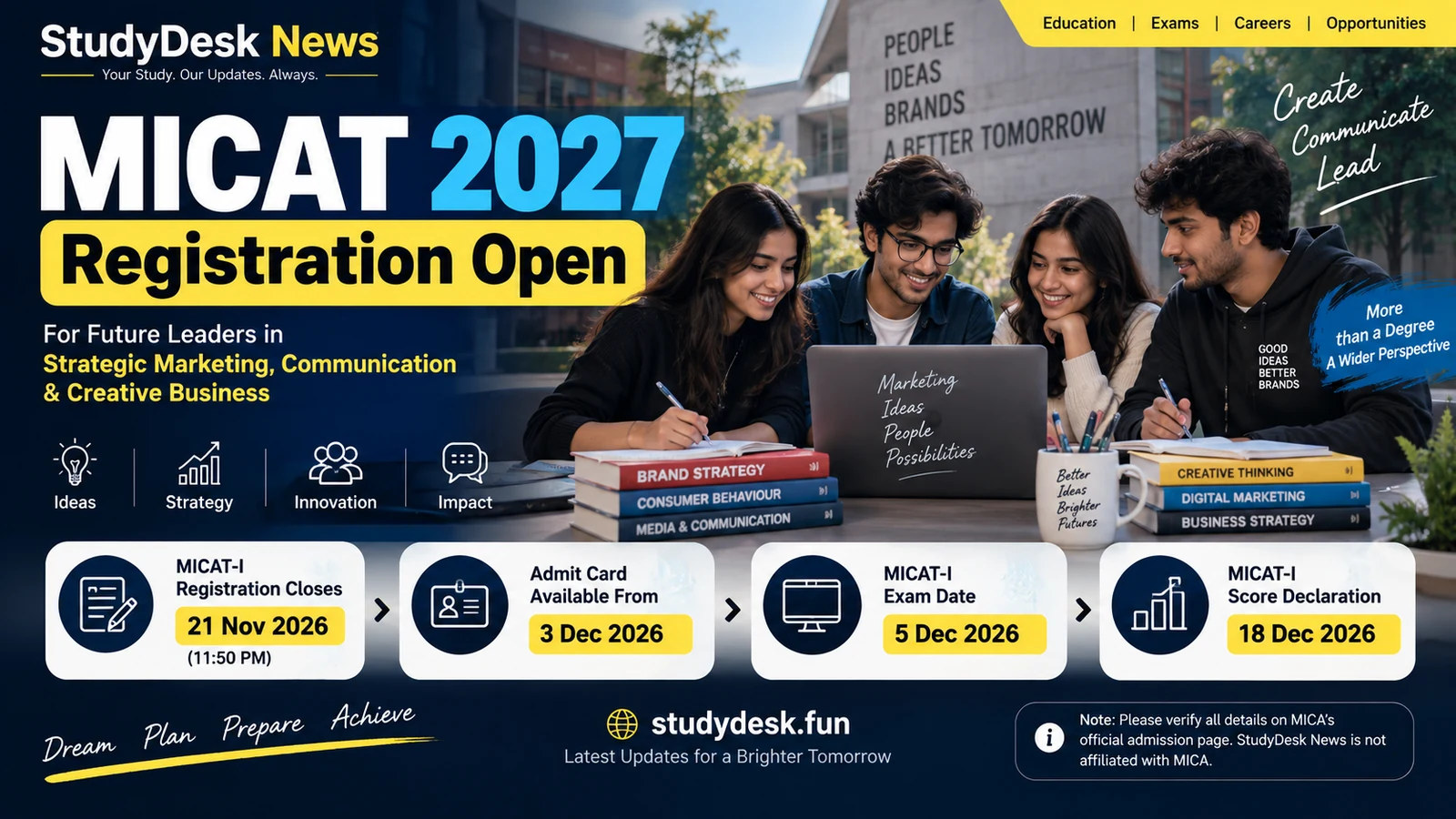
MICAT 2027 registration dates, MICAT-I exam schedule, official MICA admissions source and next steps.

A current, source-led IGCSE 2027 guide separating Cambridge IGCSE from Pearson Edexcel International GCSE and explaining timetables, subjects, grading, assessment, private-candidate routes, results and progression.