 StudyDesk

CLAT 2027: applications close on 31 October, exam on 6 December
The Common Law Admission Test is the single entrance examination for undergraduate and postgraduate law programmes at India's National Law Universities, and it is run by the Consortium of National Law Universities — the body the NLUs themselves formed to conduct the test and the centralised counselling that follows it. If you want a five-year integrated LL.B. at an NLU, or a one-year LL.M., CLAT is the route. The one important exception is NLU Delhi, which does not take CLAT scores and runs its own test, AILET — applying for CLAT does not apply you there.
For the 2027 cycle the Consortium has already fixed the two dates that matter most. Online applications opened on 3 August 2026 and close at 11:59 PM on 31 October 2026. The examination itself is on Sunday, 6 December 2026, from 2:00 PM to 4:00 PM, in offline pen-and-paper mode. Candidates with disabilities get extended time, up to 4:40 PM. The Consortium's notification, issued on 22 July 2026, also confirmed that the exam pattern and syllabus for CLAT 2027 are unchanged from the previous cycle — reforms recommended by the expert committee reviewing CLAT will only apply from CLAT 2028 onwards, so last year's preparation material and pattern analysis remain valid for this attempt.
Who can apply
For the undergraduate programme (the five-year integrated LL.B.), you need to have passed Class 12 (10+2) or an equivalent examination with at least 45% marks or the equivalent grade. For candidates belonging to SC, ST and PwD categories, the minimum is 40%. There is no upper age limit. If you are appearing for your Class 12 examination in March/April 2027, you can still apply now — but you must produce proof of having passed, with the required marks, at the time of admission, failing which you lose your right to be considered. Indian nationals, NRIs, PIO and OCI card holders can sit CLAT; foreign nationals cannot, and must apply to individual NLUs directly.
For the postgraduate programme (LL.M.), the Consortium's own eligibility page states that you need an LL.B. degree or an equivalent examination with a minimum of 50% marks or its equivalent grade, reduced to 45% for candidates belonging to SC, ST and PwD categories. There is no upper age limit for the PG programme either. Candidates appearing for their qualifying LL.B. examination in 2027 are eligible to apply, subject to producing proof of passing at admission. Note that some coaching portals still quote older PG figures — the 50%/45% split above is what the Consortium's CLAT 2027 page itself says, and that is the number to rely on.
The paper: 120 questions, two hours, no sectional escape
CLAT UG is a passage-based test of 120 multiple-choice questions carrying 120 marks, to be answered in two hours. The questions are grouped into five sections: English Language, Current Affairs including General Knowledge, Legal Reasoning, Logical Reasoning, and Quantitative Techniques. Current Affairs and Legal Reasoning carry the largest share — roughly a quarter of the paper each — while Quantitative Techniques is the smallest section. Every wrong answer costs 0.25 marks, so blind guessing across the paper is a losing strategy; the test rewards candidates who can read long passages quickly, extract the principle, and move on. The PG paper follows the same broad format, drawing on core law subjects from the LL.B. curriculum. The Consortium has confirmed no pattern change for 2027, so prepare to the existing structure rather than waiting for a new one.
Fees and how to apply
The application fee is ₹4,000 for General and OBC candidates and ₹3,500 for SC, ST, BPL and PwD candidates. You can optionally add previous years' question papers for an additional ₹500. The fee is non-refundable.
Applications are accepted online only, at consortiumofnlus.ac.in. The process, step by step:
- Open the CLAT 2027 section on the Consortium's website and register with your name, a working mobile number and email address. Verify the mobile number and set a password — this login is also where your admit card and result will appear.
- Log in and fill the application form, choosing UG or PG, and enter personal details, communication address and qualifying-examination details exactly as they appear on your certificates.
- Select your examination centre preferences and your category/reservation claims carefully. You can apply without uploading a reservation certificate, but you must produce it at admission — and if your documents do not match the category you claimed, you lose the reserved seat.
- Upload a recent passport-size photograph with a plain background, your signature, and category or PwD certificates where applicable, in the format the portal specifies.
- Pay the fee online and submit. Download and keep the confirmation page — an incomplete or unpaid form is not considered submitted, and you can edit the form only until the 31 October deadline.
Documents to keep ready
Have these ready before you start, and again at counselling: Class 10 and Class 12 mark sheets and certificates (or the LL.B. degree and mark sheets for PG), a category certificate (SC/ST/OBC/EWS as claimed), a PwD certificate if applicable, domicile certificate where an NLU's state quota requires it, and a government photo ID. Appearing candidates should keep their board/ university hall ticket details handy and track the deadline by which final mark sheets must be produced at admission.
What happens after the exam, and the mistakes that cost seats
After 6 December, the Consortium will publish a provisional answer key and invite objections, followed by the final key and results — those dates have not been announced yet, and counselling is expected in December 2026 or January 2027 through the Consortium's centralised process, where you fill NLU preferences and seats are allotted in rounds against your rank and category. Do not miss a round's fee or document deadline: in a centralised system, silence is treated as withdrawal.
The common mistakes are unglamorous and avoidable. Missing the 31 October deadline because you assumed an extension — none has been announced. Claiming a category in the form that your certificate does not support. Entering a name or date of birth that differs from your Class 10 certificate, which creates a verification problem at admission. Assuming CLAT covers NLU Delhi — it does not. And for appearing candidates, forgetting that a seat won in December still depends on producing a passing mark sheet with the required percentage at admission. Register early, check every field against your certificates, and keep the Consortium's website — not social media forwards — as your source for the answer-key and counselling dates when they come.
Sources & verification
Verified against the official Consortium of NLUs CLAT 2027 instructions on 19 September 2026. Online enrolment remains open through 31 October 2026 (11:59 PM), and CLAT 2027 is scheduled for 6 December 2026 from 2:00 PM to 4:00 PM, subject to revision if necessary.
Frequently asked questions
When does CLAT 2027 registration close and when is the exam?
Applications opened on 3 August 2026 and close at 11:59 PM on 31 October 2026. The examination is on Sunday, 6 December 2026, from 2:00 PM to 4:00 PM, in offline pen-and-paper mode.
Who is eligible for CLAT UG 2027?
Candidates who have passed Class 12 or an equivalent examination with at least 45% marks, reduced to 40% for SC, ST and PwD candidates in this article's Consortium-sourced account. There is no upper age limit, and candidates appearing in March/April 2027 can apply subject to producing proof of passing at admission.
What is the CLAT 2027 application fee?
₹4,000 for General and OBC candidates and ₹3,500 for SC, ST, BPL and PwD candidates, non-refundable. Previous years' question papers can optionally be added for an additional ₹500.
How many questions are there and what is the negative marking?
CLAT UG has 120 multiple-choice questions carrying 120 marks in two hours, across five sections. Every wrong answer costs 0.25 marks.
Does CLAT cover admission to NLU Delhi?
No. NLU Delhi does not take CLAT scores and runs its own test, AILET.
What are the PG eligibility marks?
An LL.B. degree or equivalent with a minimum of 50% marks, reduced to 45% for SC, ST and PwD candidates, as stated on the Consortium's CLAT 2027 PG eligibility page. There is no upper age limit for PG either.

Coast Guard Enrolled Persons Test (CGEPT) batches 01/2027 and 02/2027: 365 vacancies, applications 6-21 October 2026, eligibility and selection process.
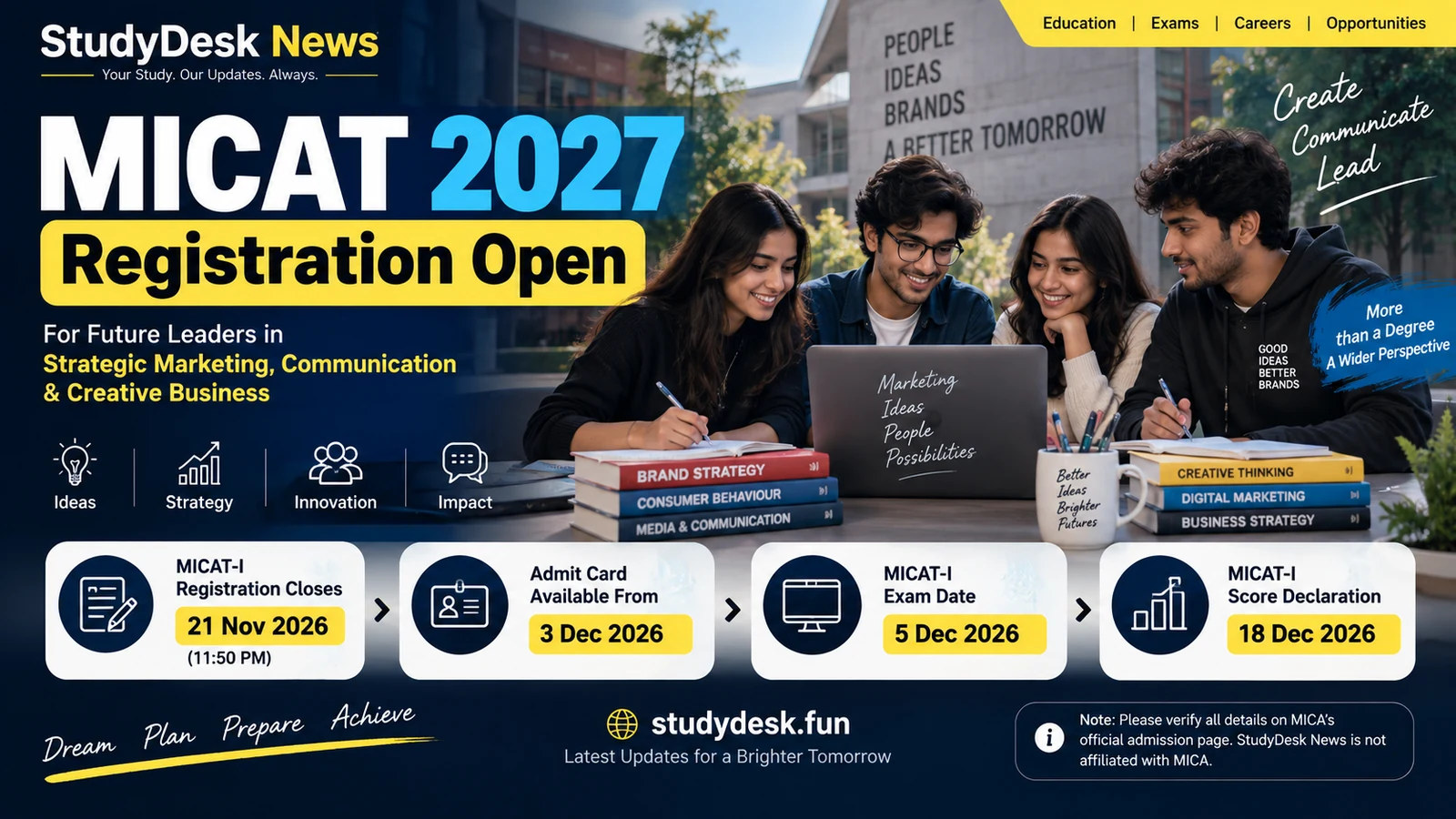
MICAT 2027 registration dates, MICAT-I exam schedule, official MICA admissions source and next steps.

A current, source-led IGCSE 2027 guide separating Cambridge IGCSE from Pearson Edexcel International GCSE and explaining timetables, subjects, grading, assessment, private-candidate routes, results and progression.

NEST 2027 registration date, exam date, eligibility, fee, syllabus and NISER / CEBS admission status. Check the official update, previous-cycle timeline and what students should track next.
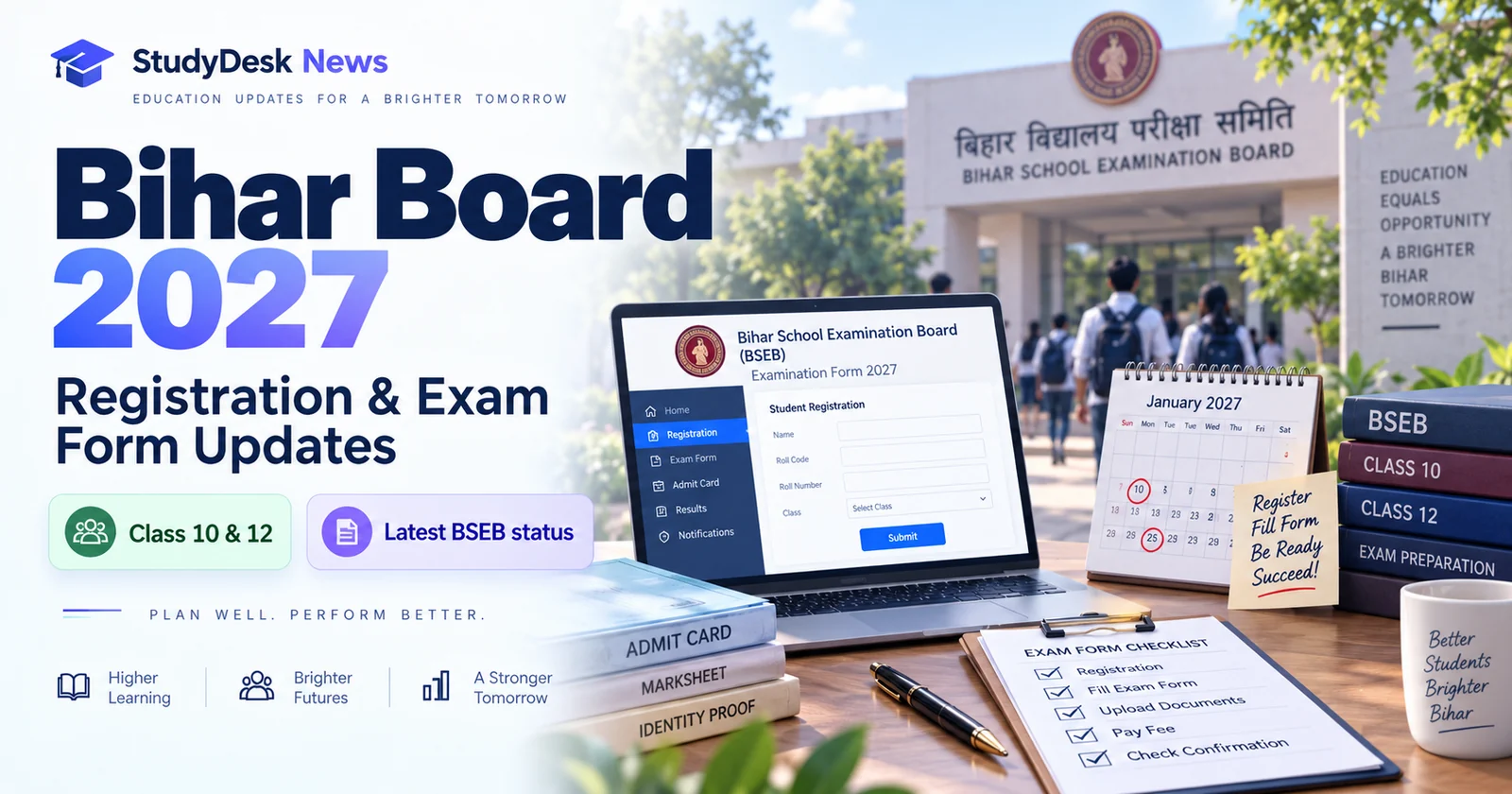
Bihar Board 2027 hub — Intermediate exam-form third window 1–15 Oct 2026 (fee till 14 Oct); final 2027 timetable awaited.