 StudyDesk
BSAEU M.Ed 2026–28: Where the Admission Stands After the Merit Lists
Baba Saheb Ambedkar Education University — the Kolkata university for teacher education, formerly WBUTTEPA — is deep into the 2026–28 M.Ed admission cycle. The entrance examination was held on 29 September 2026. BSAEU's notice list then carried the M.Ed Merit List for Counselling & Admission on 7 October 2026 and the M.Ed Combined Merit List 2026–2028 on 9 October 2026, together with counselling/admission notices and corrigenda for the Department of Teacher Education and for self-financed affiliated colleges. As of this check on 20 October 2026, no M.Ed notice newer than the 9 October combined merit list appears in the university's notice list — the live phase is counselling and admission confirmation against those lists. If your name is on one, you are in the phase where the admission is won or lost on paperwork and presence — the exam is done, but the seat is not.
What M.Ed at BSAEU is
The M.Ed is a 2-year postgraduate professional programme in education — the degree for B.Ed graduates who want to become teacher-educators, school administrators, educational researchers, or meet the qualification bar for teaching in teacher-training colleges. BSAEU runs it centrally for its own Department of Teacher Education (David Hare Campus) and its affiliated/self-financed colleges under a common admission process, which is why the notices you see are split into "department" and "self-finance" streams.
Who was eligible — and how merit works
BSAEU's published rules require at least 50% marks (or equivalent grade) in one of: B.Ed.; B.A. B.Ed./B.Sc. B.Ed.; B.El.Ed.; or D.El.Ed. with an undergraduate degree (50% in each). SC/ST/PWD candidates (minimum disability 40%) get 5% relaxation in the qualifying marks. Candidates appearing in the final semester of the qualifying degree were allowed to sit the entrance, with admission conditional on clearing the degree at the required percentage — a real path, not a technicality, but also the clause that quietly cancels admissions when final-semester results fall short.
Selection is by the entrance examination alone: the merit list is prepared on the basis of the entrance exam score. The university's entrance-exam form fee is Rs 750 for General/OBC and Rs 450 for SC/ST/PWD. Candidates must bring the downloaded M.Ed entrance admit card — and final-semester students must also carry their 4th-semester B.Ed admit card — into the examination hall.
The entrance examination, on the record
Many summaries of this admission never describe the test itself. BSAEU's portal rules do:
- 50 multiple-choice questions, 50 marks, one and a half hours.
- Negative marking of 0.25 marks per wrong answer — four wrong answers cancel one right one, so blind guessing across the paper is a losing strategy.
- Questions are drawn mostly from the core papers of BSAEU's B.Ed. curriculum — your B.Ed. coursework, not general knowledge, is the syllabus.
That pattern explains the merit list's shape: with only 50 questions and a guessing penalty, the gap between ranks is built on B.Ed. subject mastery and on leaving genuinely unknown questions blank.
Seats: how the 50 are divided
The Department of Teacher Education and each affiliated college have 50 seats each, divided by subject group: 30% Language Group, 30% Science & Mathematics Group, 40% Social Science Group. The ratio of home-university to other-university students is 80:20, and reservation follows state government norms. Deputed teachers serving in substantive posts in government, government-sponsored or government-aided teacher-training institutions are given preference, selected on the basis of length of continuous teaching experience — a separate logic from the entrance-score merit that governs everyone else. Read the merit list for your own group and stream: a rank that looks safe in the Social Science group means nothing in the Language group, where the seat pool is smaller.
If scores tie: the academic-score tie-break, with a worked example
If entrance scores tie, BSAEU's rules break the tie with an academic score built from your earlier examinations, weighting each stage's percentage: Madhyamik 0.2, Higher Secondary 0.2 (best five subjects, excluding Environmental Studies), undergraduate General/Pass 0.2, undergraduate Honours or B.E./B.Tech. 0.3, postgraduate 0.3, with M.Phil./Ph.D. adding up to 5 points. A concrete illustration: two candidates tied on the entrance score, identical except that one scored 70% in an Honours degree and the other 60% — the first candidate's weighted contribution from that stage is 70 × 0.3 = 21 points against the other's 60 × 0.3 = 18 points, a 3-point tie-break gap created entirely by a degree finished years before the entrance. This is why BSAEU asks for your full marks history even though the merit list is "entrance only": the history is the reserve that settles dead heats.
The 2026–28 timeline as it ran
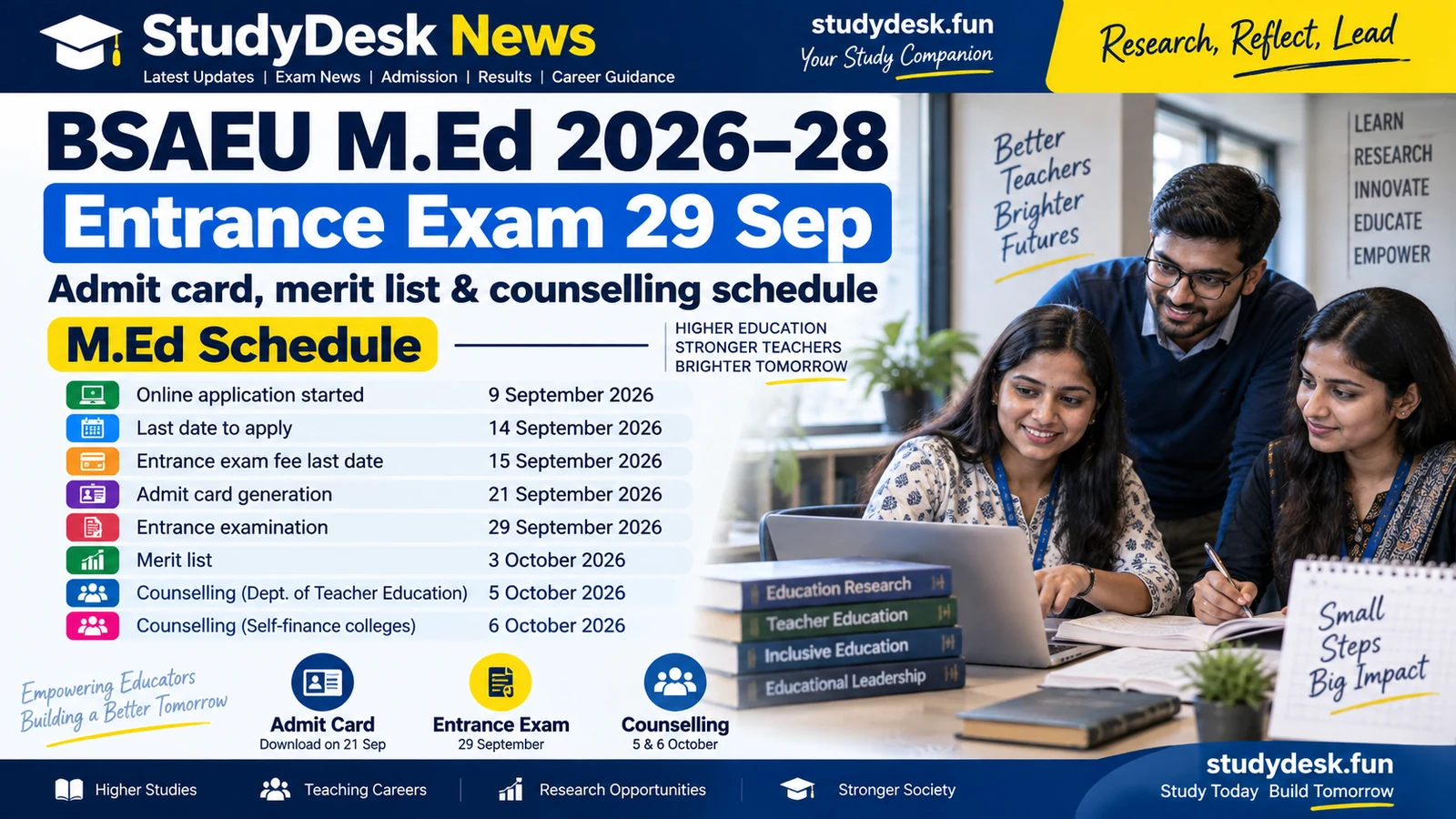
Online applications opened 9 September 2026 and closed 14 September (fee payment by 15 September); admit cards were generated on 21 September; the entrance examination was held on 29 September. The merit lists followed on the BSAEU notice list — counselling & admission merit list on 7 October 2026, combined merit list on 9 October 2026 — together with counselling/admission notices and corrigenda for the department and for self-financed colleges.
That puts you, reading this after the merit lists, at the counselling stage. The notices on the board are the only authoritative source for your round: which rank band is called on which day, whether reporting is in person at the campus or the college, and what the admission confirmation deadline is. Self-financed college counselling runs in parallel — do not assume one notice covers both streams. Corrigenda matter: BSAEU has issued corrections to its counselling schedule in this cycle, and a student who read only the original notice can easily report on the wrong day.
What to do now — a checklist for the counselling window
- Open bsaeu.in's notice board yourself and read the latest counselling/admission notice and every corrigendum after it.Do not trust forwarded screenshots; a correction notice may have changed your reporting date.
- Identify your stream and group.The Department of Teacher Education's 50-seat matrix (Language 30%, Science & Mathematics 30%, Social Science 40%) is separate from self-financed college admissions, and each college also has 50 seats. Know which merit list — and which subject group within it — you are on.
- Budget the counselling fee:BSAEU's rules set a counselling fee of Rs 1,000, paid to the university at the time of counselling and non-refundable. Carry a payment route that works on the day; "non-refundable" means it is not returned even if you decline the seat offered.
- Assemble originals plus copies:qualifying degree mark sheets and certificates, category/PWD certificate if applicable, the M.Ed entrance admit card, ID proof, and — if you were a final-semester applicant — your degree completion proof at the required percentage. Counselling bodies verify originals, not photocopies.
- Prepare the anti-ragging declaration.BSAEU's rules make an anti-ragging declaration in the prescribed format mandatory at the time of admission for every selected candidate — complete the registration and keep the declaration ready instead of discovering it at the desk.
- Confirm by the stated date.University notices in this cycle gave a fixed admission-confirmation deadline (reported as 12 October 2026 on one board notice — verify against the current corrigendum). Missing confirmation is the most common way an earned seat is forfeited.
- Pay fees and preserve the receipts.The M.Ed programme fee is modest (reported total around ₹25,600 for the two years on the university side — see Flags; affiliated colleges charge their own approved fees — verify your college's figure in writing before paying).
Common failures, named plainly
Waiting for a college to call you instead of reading the notice board; assuming the department and self-finance notices are the same; reading your rank across the whole list instead of inside your subject group, where the 30/30/40 split decides what your rank is worth; final-semester candidates discovering their B.Ed. aggregate is below the required percentage after the admission was made conditional; category candidates arriving at counselling without the correct certificate in the correct format; arriving without the Rs 1,000 counselling fee arranged or the anti-ragging declaration ready; and students who ranked but never downloaded their entrance admit card before the portal's download window closed. The entrance exam was the contest; this phase is administration — and administration has forfeited more admissions than low scores have.
Sources & verification
The BSAEU notice board (bsaeu.in) was checked on 9 October 2026. It shows the Combined Merit List for M.Ed. Session 2026–2028 and counselling/admission corrigendum notices for the Department of Teacher Education and self-financed colleges; the 29 September entrance exam has been held.
Frequently asked questions
When were the BSAEU M.Ed 2026–28 merit lists published?
BSAEU's notice list carried the M.Ed Merit List for Counselling & Admission on 7 October 2026 and the M.Ed Combined Merit List 2026–2028 on 9 October 2026.
Who is eligible for BSAEU M.Ed?
BSAEU's published rules require at least 50% marks (or equivalent grade) in B.Ed., B.A. B.Ed./B.Sc. B.Ed., B.El.Ed., or D.El.Ed. with an undergraduate degree (50% in each), with 5% relaxation for SC/ST/PWD candidates (minimum disability 40%).
What is the BSAEU M.Ed entrance examination pattern?
50 multiple-choice questions, 50 marks, in one and a half hours, with negative marking of 0.25 marks per wrong answer, drawn mostly from the core papers of BSAEU's B.Ed. curriculum.
What is the entrance-exam form fee for BSAEU M.Ed?
Rs 750 for General/OBC and Rs 450 for SC/ST/PWD.
How are the 50 seats in each department or college divided?
By subject group — 30% Language Group, 30% Science & Mathematics Group and 40% Social Science Group — with a home-university to other-university ratio of 80:20 and reservation following state government norms.
What counselling fee must I pay for BSAEU M.Ed?
A counselling fee of Rs 1,000, paid to the university at the time of counselling and non-refundable.

Medical scholarship hub for MBBS and related students, including first-year, government-college, girls and need-based scholarship opportunities.

UP Super TET 2026 (UPESSC Advt 05/2026): 12,405 Assistant Teacher vacancies, online applications 16 September-15 October 2026, written exam 3-4 December 2026.
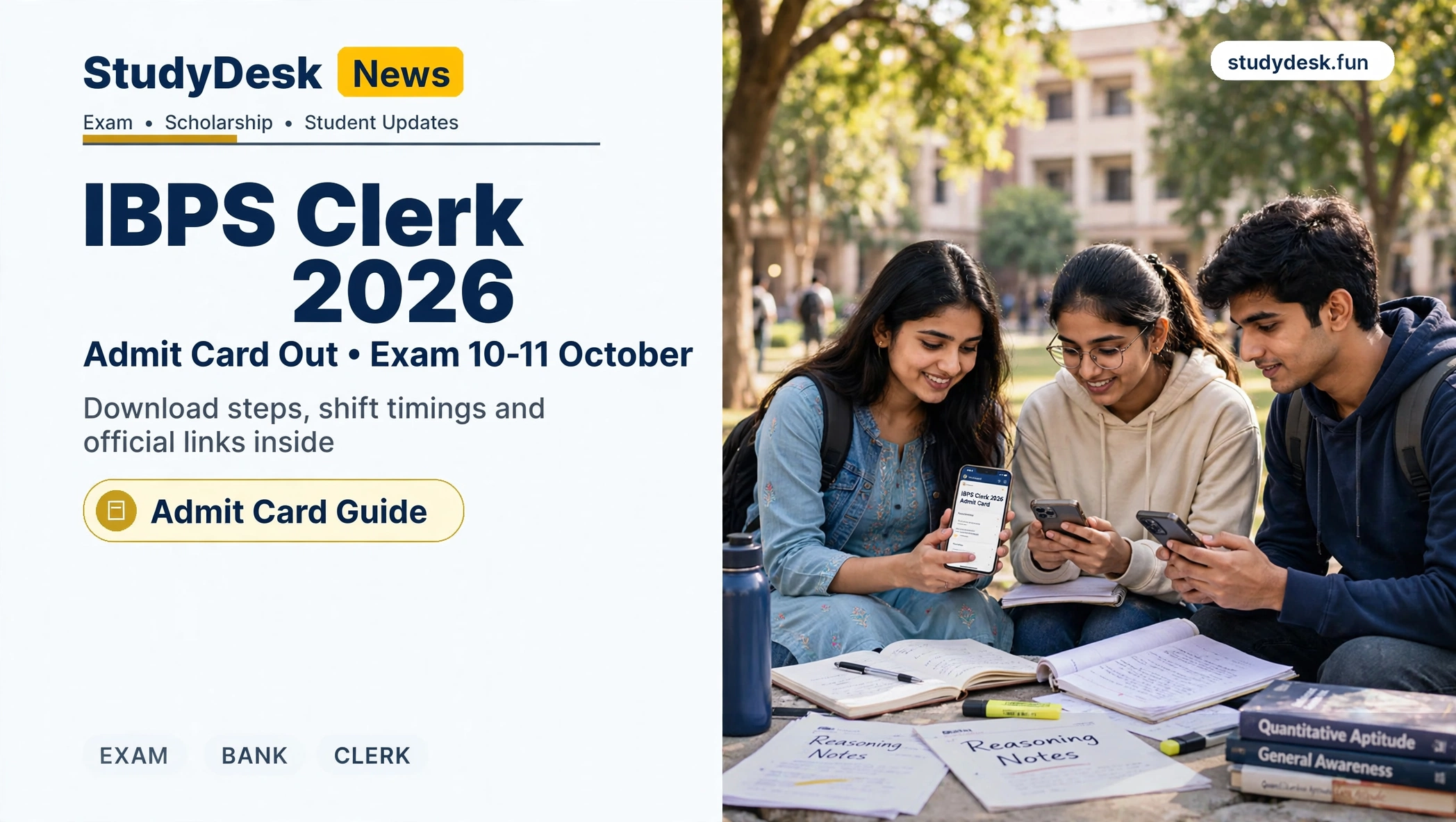
IBPS Clerk 2026 (CRP CSA-XVI): prelims call letter released, exam on 10-11 October 2026, mains on 27 December 2026. Full schedule and download guide.

Complete guide to Siemens Scholarship Program 2026-27 (14th edition): eligibility, benefits for all four years, documents and how to apply on siemens.co.in/scholarship.
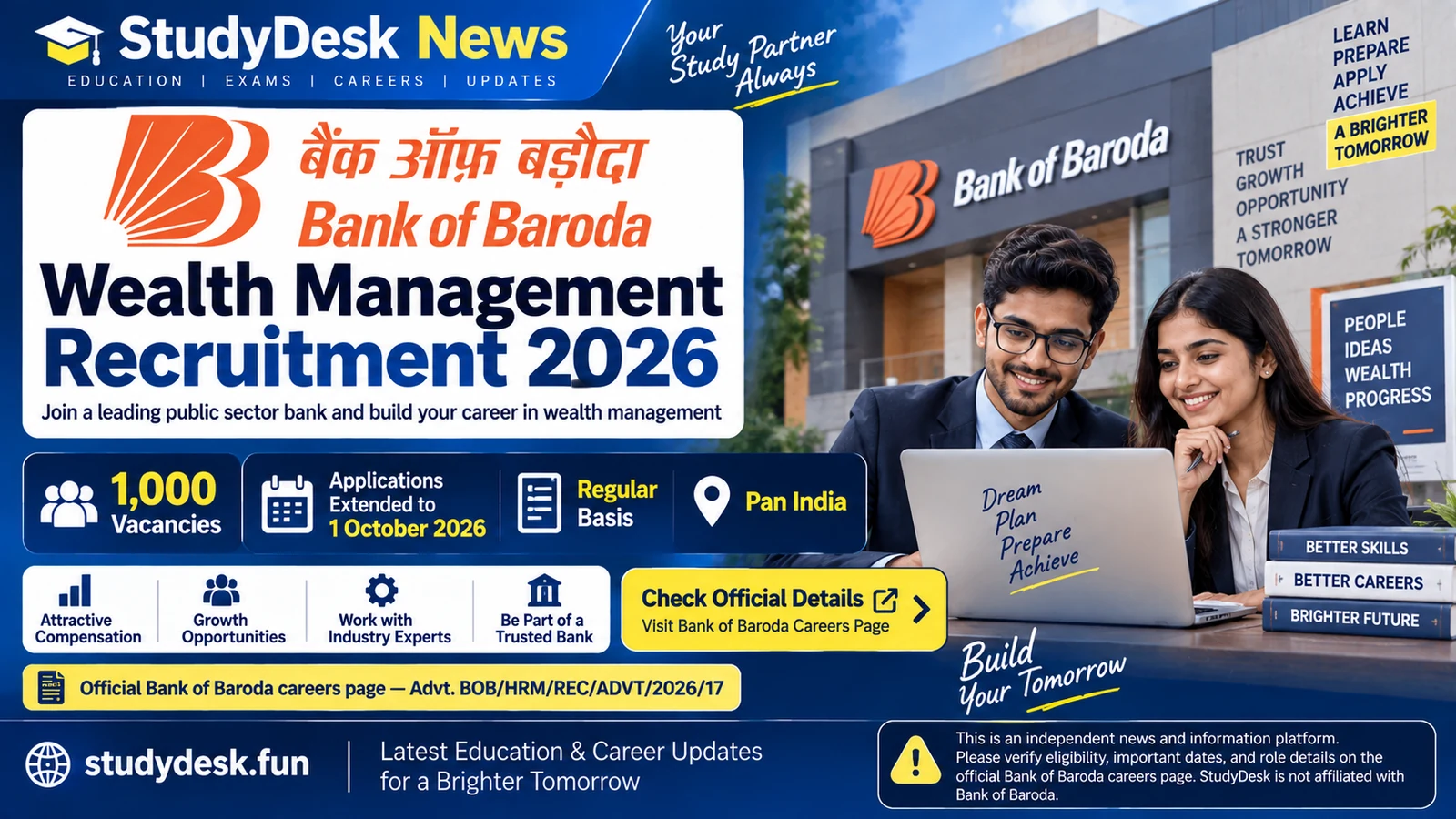
Bank of Baroda Wealth Management Services recruitment tracker for 1,000 regular-basis vacancies and the extended 1 October deadline.