 StudyDesk

BSAEU B.Ed Admission 2026–28: Where the Process Stands Now
If you want to teach in a West Bengal school, the odds are your B.Ed runs through one institution: Baba Saheb Ambedkar Education University (BSAEU), Kolkata — the state's affiliating university for teacher education (formerly WBUTTEPA), to which the vast network of government, aided and self-financed B.Ed colleges across West Bengal is affiliated.
For the 2026–28 session, the admission story splits into two tracks that are constantly confused with each other: admission to the university's own Department of Teacher Education, and admission to the self-financed colleges under the university. This page is about the university's published schedule for the cycle — including the self-financed track, whose application window has now closed — and about what admitted and waitlisted candidates should do next.
The self-financed colleges track: schedule as it ran
Under BSAEU's schedule notice dated 14 September 2026 for B.Ed admission in self-financed colleges:
- Online applications opened: 14 September 2026
- Application window closed: 24 September 2026, 11:00 PM
- Fee submission deadline: 24 September 2026, 11:30 PM
- College/subject-wise merit list: 30 September 2026, 4:00 PM
- Admission at colleges: 1–3 October 2026
- Classes begin: 3 November 2026
That window is closed. There is no late or offline route into a self-financed college outside the university's process — a college that offers you a seat "directly" outside the merit list is offering you something the university may not recognise, and you should verify any such offer against the university's published list of self-financed colleges permitted to admit for 2026–28 (the notice board carries lists dated 14 and 16 September 2026).
Meanwhile the university's notice board has moved on to the live end of the process: merit-list and second-counselling notices for the department B.Ed programme, and lists of selected and waiting candidates for B.Ed 2026–28 (published 3 October 2026). If you are on a waiting list, that notice board — not a phone call from a college — is where movement will be announced.
There is no entrance exam
BSAEU B.Ed admission is merit-based, calculated from your qualifying examination marks, following the state government's admission rules and NCTE norms. No entrance test is held for the B.Ed programme. This is why the merit list is everything: your rank is your marks record, and errors in the marks you entered at application stage follow you into the merit calculation. The university runs a modification window after applications close precisely because candidates do get this wrong — if you applied, that window was your chance to fix it.
Who was eligible
The NCTE eligibility framework that BSAEU follows:
- At least 50% marks either in the Bachelor's degree or the Master's degree in Sciences, Social Sciences or Humanities; or
- A Bachelor's degree in Engineering or Technology with specialisation in Science and Mathematics with 55% marks; or an equivalent qualification.
- Relaxations in the qualifying marks apply for reserved categories as per state norms (a 5% relaxation for SC/ST candidates is the standard provision).
- You apply for a school subject you have actually studied at the qualifying level — your pedagogy subject must come from your degree subjects, and the college/subject-wise merit lists are drawn up on that basis.
The B.Ed is a two-year, full-time, NCTE-approved programme. The university department itself has a limited intake (around 120 seats); the self-financed college network is where the bulk of seats sit.
The APAAR ID requirement
Recent BSAEU admission processes have required candidates to have an APAAR ID (Automated Permanent Academic Account Registry — the national "One Nation, One Student ID" under the Academic Bank of Credits). If you are preparing for the 2027–29 cycle and do not have one yet, generate it now through the DigiLocker/APAAR route with your Aadhaar-linked details; candidates lose days every cycle discovering at the application stage that the ID is mandatory and their Aadhaar name does not match their marksheets. Fix name mismatches in your academic records before the next window opens, not during it.
If you were admitted — or nearly
- Admitted (1–3 October window): complete your college-level document verification with originals — degree and marksheets, caste/reservation certificate if claimed, and migration certificate if your qualifying degree is from another university (the university's notice board carries a standing notice about pending migration certificates; do not let yours become one). Classes begin 3 November 2026.
- Waitlisted: watch the notice board for second-counselling and vacancy notices; the department programme's second round was already appearing on the board in October.
- Missed this cycle: the honest answer is that BSAEU runs this once a year. Use the year to check your eligibility arithmetic (is your qualifying aggregate really 50%?), keep your APAAR ID and documents in order, and expect the next schedule around September 2027, following the Higher Education Department's admission order — the 2026–28 admission notice itself was issued in supersession of an earlier notice, under the Department's order dated 31 August 2026, which is a reminder that dates move and the notice board is the only source that counts.
The two tracks, side by side
Most confusion — and most wrong dates circulating online — comes from treating the two tracks as one. They are not:
| University department (David Hare Campus) | Self-financed affiliated colleges | |
|---|---|---|
| Where you study | BSAEU's own Department of Teacher Education, Kolkata | One of the affiliated self-financed B.Ed colleges across West Bengal |
| Schedule source | Department corrigendum / seat-matrix notice on the BSAEU notice board | Schedule notice dated 14 September 2026 (dates in the section above) |
| Where the lists appear | Department selected/waiting lists; a second-counselling list was on the board in October 2026 | College/subject-wise merit lists |
| Scale | Limited intake (see Flags) | The bulk of West Bengal's B.Ed seats |
| Course fee level | University programme fee (see "What it costs") | Set at college level within the state framework — far higher than the department's (see "What it costs") |
Before you act on any date you have seen shared online, ask one question: which track is it for? A date that is correct for one track is wrong for the other.
How to apply — the steps the portal actually uses
The application itself runs on the BSAEU admission portal (bed.bsaeu.net.in). The sequence, as documented for the 2026–28 cycle:
- Open the B.Ed online application link from the university website and read the instructions, eligibility rules and payment directions before starting — the form does not forgive wrong marks.
- Fill the academic step first: qualifying examination, marks, university and subject details.
- Fill the personal step next, exactly as your certificates read — name and date of birth mismatches surface at verification, not at application.
- Upload a scanned photograph in JPEG/JPG format within 110 KB and a signature within 50 KB. Files over the limit are the most common reason an application stalls at the last step.
- Complete the CAPTCHA, accept the declaration and submit.
- Save the Application ID and password generated on submission — you need them for login, status checks, modification and merit-list follow-up.
- Pay the application fee through the "Pay Now" link in the portal's left panel after submitting or modifying the form.
- Print and keep the application receipt.
To check the merit list: open the B.Ed admission section on the university website, find the 2026–28 merit-list notice for your track, open the list for your subject or college, and search it by name or Application ID. The list — not a call, message or agent — is the result.
What it costs
Two different costs are routinely confused:
- Application fee (self-financed track): reported for this cycle as Rs 600 for General, OBC-A and OBC-B candidates and Rs 350 for SC, ST and PwD candidates (see Flags — single secondary source; confirm the amount on the portal's payment screen before paying).
- Course fee: the university's own B.Ed programme is reported at Rs 20,000 total for the two years — among the lowest NCTE-approved B.Ed fees in India. Self-financed affiliated colleges charge far more: listings across roughly 390 affiliated B.Ed courses put tuition anywhere from about Rs 72,000 to Rs 1.73 lakh for the programme. That gap is the single biggest financial decision in this admission: a merit rank that gets you into the department or a government/aided seat can save you well over a lakh against a self-financed seat. Never pay a college-level fee before verifying the college is on the university's published list of self-financed colleges permitted to admit for 2026–28.
The 24 pedagogy subjects
Your B.Ed pedagogy subject must come from what you studied at degree level. BSAEU's B.Ed is offered across 24 school subjects: Bengali, English, Hindi, Sanskrit, Urdu, Arabic, Nepali, Santhali, History, Geography, Economics, Political Science, Philosophy, Psychology, Sociology, Commerce, Computer Science, Mathematics, Physical Science, Life Science, Fine Arts, Music, Home Management, and Food and Nutrition. If your degree subject is not on this list, you do not have a pedagogy subject for BSAEU B.Ed — check this before you pay any application fee, not after the merit list leaves you out.
Common mistakes
- Confusing the department schedule with the self-financed schedule — they are separate notices with separate lists.
- Trusting a college's verbal assurance over the university's published merit list.
- Entering application marks from memory instead of the marksheet, then missing the modification window.
- Ignoring the migration-certificate requirement until enrolment is blocked.
Flags
- UNVERIFIED: the self-financed schedule PDF itself (bsaeu.in link) could not be opened in this check — the university site presented a verification screen; the dates above are as published in BSAEU's 14 September 2026 schedule notice and reported from it. Confirm current counselling status on the official notice board.
- UNVERIFIED: the application fee amount for the self-financed track — not confirmed from an official document in this check; do not rely on any amount quoted by third-party sites.
- UNVERIFIED: the department programme's own application dates differed from the self-financed track; if you applied to the department, follow the department's corrigendum/seat-matrix notice on the notice board.
- UNVERIFIED: the department intake figure of "around 120 seats" in the body is a commonly reported figure that was not read from a 2026–28 seat-matrix notice in this check; confirm against the department seat matrix on the notice board.
- UNVERIFIED (added 2026-10-20, red-team pass): the application fee of Rs 600 (General/OBC-A/OBC-B) / Rs 350 (SC/ST/PwD) for the self-financed track, the 9-step portal sequence and the 110 KB photograph / 50 KB signature limits come from a single secondary source (FreeJobAlert, opened 2026-10-20) and were not read off the BSAEU portal itself; the portal payment screen and instruction sheet are the deciding sources.
- UNVERIFIED (added 2026-10-20, red-team pass): course-fee figures — Rs 20,000 total for the university B.Ed programme (CollegeDunia, opened) and the Rs 72,000–1.73 lakh tuition range across affiliated B.Ed courses (Shiksha listing, search-checked) — are third-party listings, not a BSAEU fee notice; individual college fees must be confirmed with the college and the university's approval list.
- CONFLICT (added 2026-10-20, red-team pass): CollegeDunia's BSAEU page gives different self-financed-track dates (applications to 6 October, merit list 12 October, admission 13–14 October) and different department dates (applications 9–16 September, merit list 25 September, first counselling 5 October) from the schedule in the body above (self-financed 14–24 September, merit list 30 September, admission 1–3 October). The two sets may describe different phases of the same cycle; the BSAEU notice board — whose notice titles (self-financed schedule, department corrigendum/seat matrix, college lists dated 14 and 16 September 2026, department second-counselling list) were verified on bsaeu.in/main/view_notice on 2026-10-20 — is the only deciding source. Do not act on either date set without checking the board.
Sources & verification
The BSAEU notice board (bsaeu.in) was checked on 9 October 2026. The self-financed B.Ed application window closed 24 September 2026 per the official 14 September schedule; the board now shows merit-list and 2nd-counselling notices for the department B.Ed programme, with no new self-financed application round published.
Frequently asked questions
Is there an entrance exam for BSAEU B.Ed?
No. Admission is merit-based on qualifying-examination marks under NCTE norms and state rules. There is no entrance test for the B.Ed programme.
What was the application fee for the self-financed colleges track?
Rs 600 for General/OBC-A/OBC-B and Rs 350 for SC/ST/PwD candidates, as reported for this cycle — confirm on the portal payment screen, as the university's own fee line could not be read directly in this check (see Flags).
My marks were entered wrong. Can I fix them?
The university runs a modification window after applications close for exactly this. Outside that window, a marks error stands and flows into your merit position — which is why the marksheet, not memory, is the only safe source at application time.
A college says it can admit me directly. Should I trust it?
No. Admission runs through the university's published merit lists. Verify the college against the university's list of self-financed colleges permitted to admit for 2026–28 (notice-board lists dated 14 and 16 September 2026) and your name against the merit list before paying anything.
I am waitlisted. What actually happens next?
Watch the notice board for second-counselling and vacancy notices for your track. The department programme's second-counselling selected/waiting list was published in October 2026; movement is announced there, not by phone.
When do classes start?
3 November 2026 for the 2026–28 session.
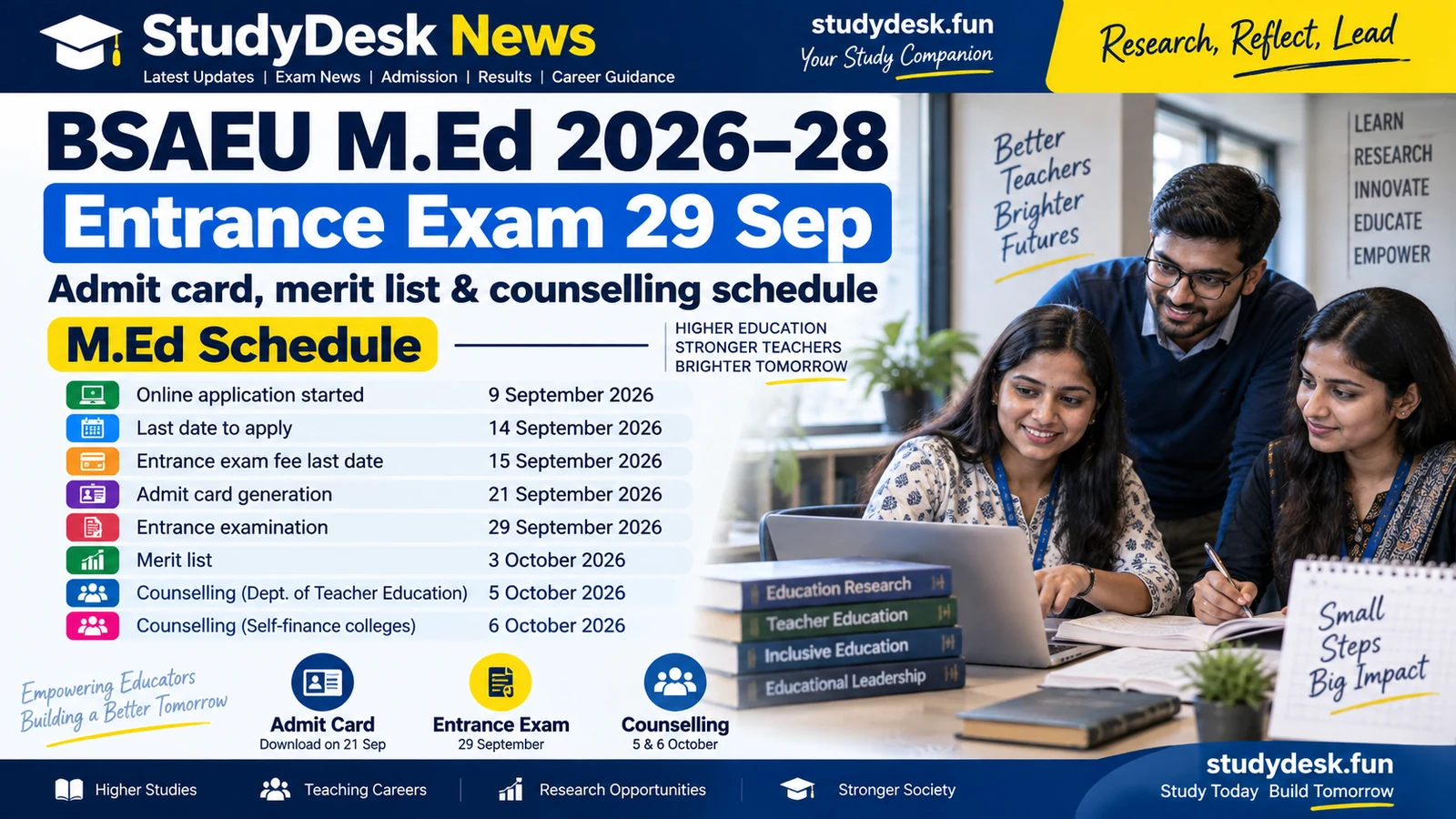
BSAEU M.Ed 2026–28 entrance-exam result stage: published merit lists and counselling/admission notices with official sources.

BSAEU September 2026 notice tracker updated with the 17 September change to specified B.Ed fourth-semester examinations and current B.Ed admission notices.

UP Super TET 2026 (UPESSC Advt 05/2026): 12,405 Assistant Teacher vacancies, online applications 16 September-15 October 2026, written exam 3-4 December 2026.
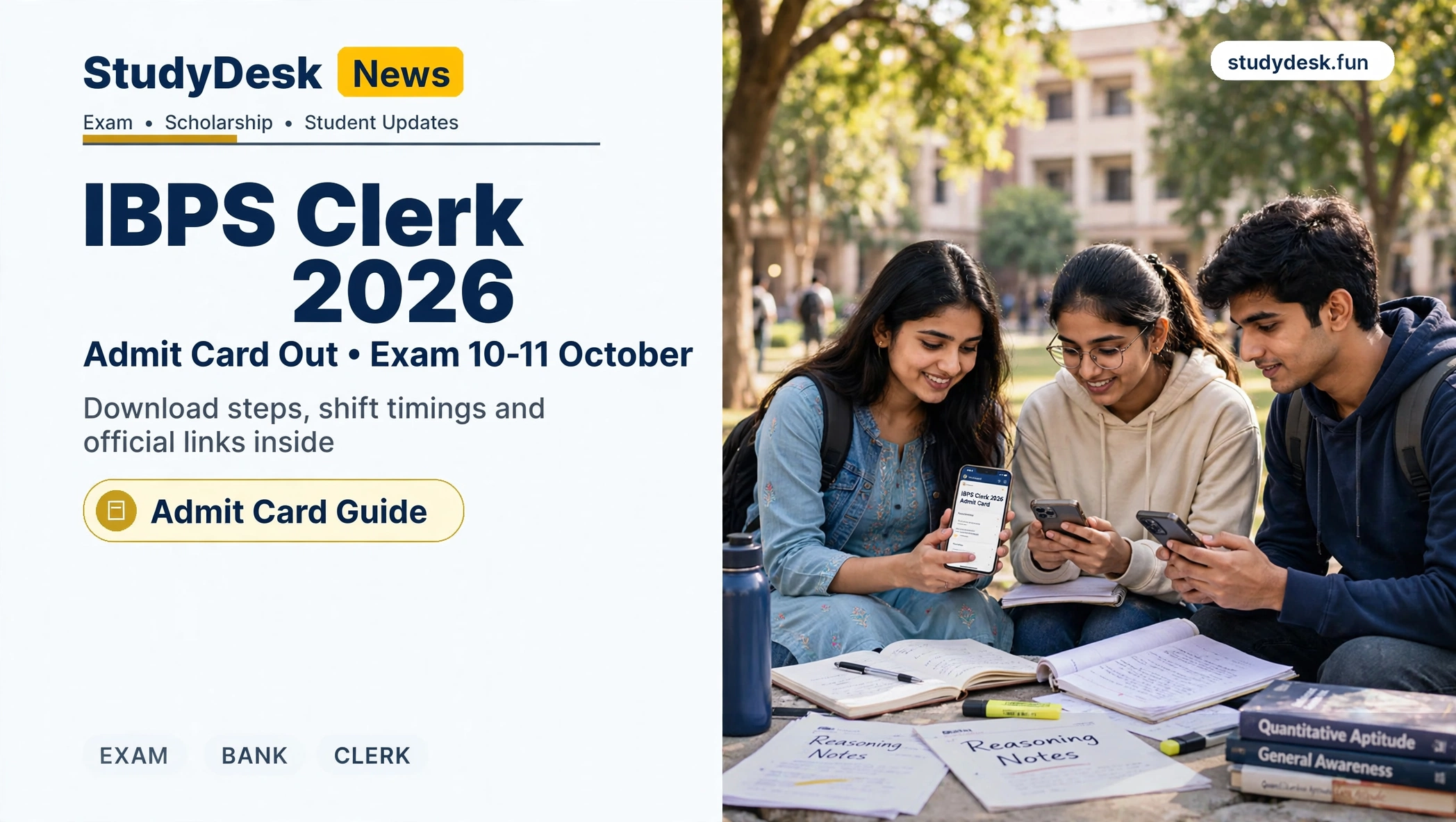
IBPS Clerk 2026 (CRP CSA-XVI): prelims call letter released, exam on 10-11 October 2026, mains on 27 December 2026. Full schedule and download guide.

Complete guide to Siemens Scholarship Program 2026-27 (14th edition): eligibility, benefits for all four years, documents and how to apply on siemens.co.in/scholarship.