 StudyDesk
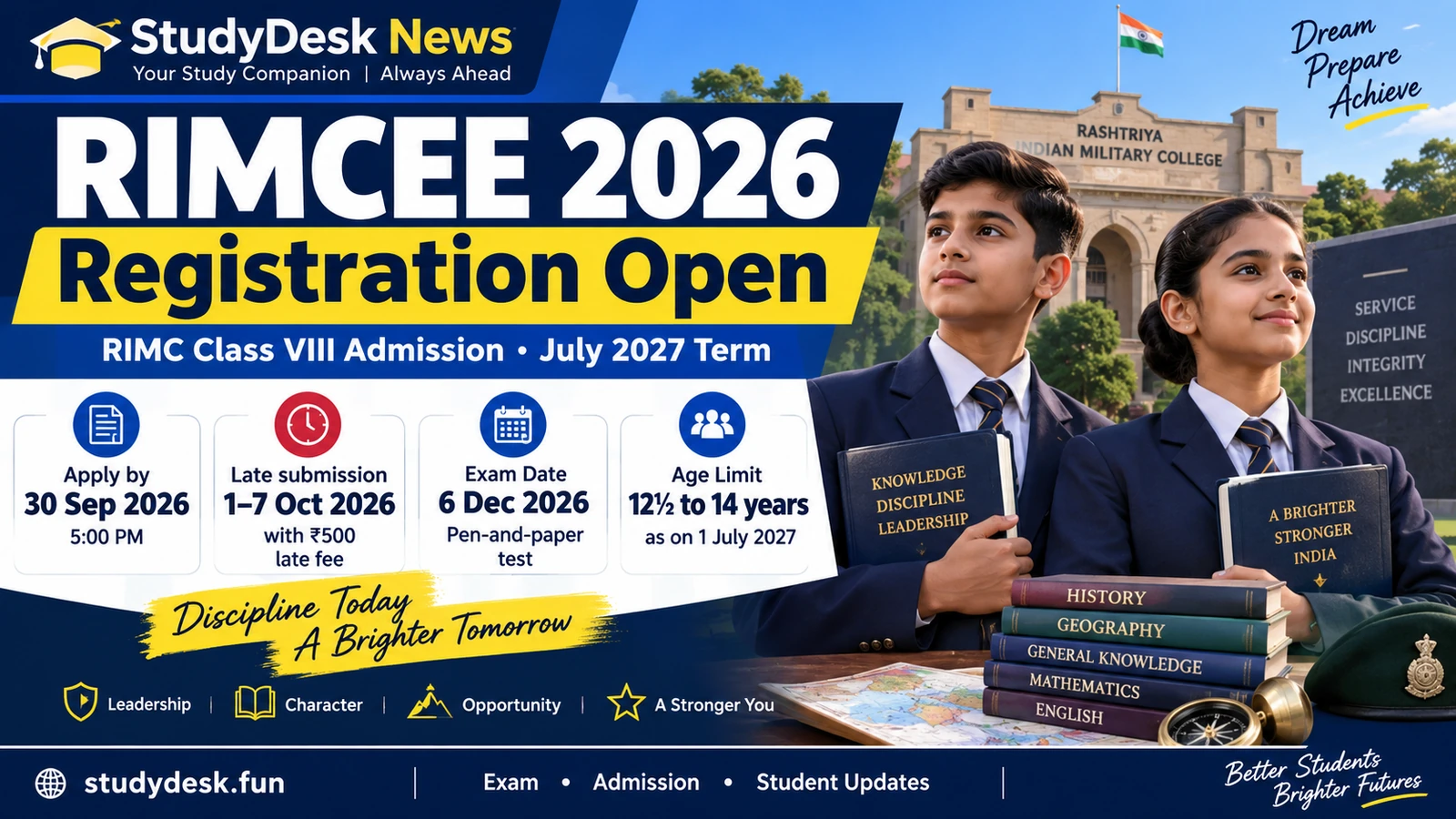
The dates that still matter
| Stage | Date |
|---|---|
| Written examination (Stage I) | 6 December 2026 |
| City intimation slip | 12–15 days before the exam |
| Admit card download | 5–7 days before the exam |
| Declaration of Stage-I result | By 20 February 2027 |
| Stage-II viva voce | Tentatively April 2027, about 4–6 weeks after the Stage-I result |
The exam will be held in pen-and-paper mode at 39 examination cities across India, in the centre printed on your admit card.
Who was eligible for this cycle
The December 2026 examination has its own age rule, stated from the July 2027 term backwards:
- The candidate must be not less than 12½ years and not more than 14 years old as on 1 July 2027 — in date-of-birth terms, born between 2 July 2013 and 1 January 2015, both dates inclusive.
- The candidate should be studying in Class VII, or should have passed Class VII, from a recognised school at the time of admission.
- Both boys and girls can apply. The bulletin describes a tentative intake of about 25 vacancies for boy cadets and 10 for girl cadets per term, with admission decided on merit — boys through state-wise merit lists, girls through a national merit list applied zone-wise.
This age window is the single most common reason families discover, too late, that they were never eligible. If you are planning for a future cycle, work backwards from the term date (1 January or 1 July) before you do anything else.
What the application cost
| Category | Exam fee | Late fee (if used) |
|---|---|---|
| General / wards of defence personnel and ex-servicemen / OBC-NCL (central list) | ₹1,000 | + ₹500 |
| SC / ST | ₹750 | + ₹500 |
One warning buried in the bulletin deserves daylight: OBC-NCL means the central list of OBCs. A caste that appears only on a state list does not qualify — such candidates were instructed to apply as Unreserved.
Separately, families weighing RIMC itself should know the college fee is heavily subsidised by the central government. The bulletin puts the total first-year figure at ₹1,48,650 for General candidates and ₹1,31,850 for SC/ST candidates, including a one-time, refundable security deposit of ₹50,000, and notes that state governments offer scholarships to meritorious cadets.
The written examination, paper by paper
Stage I totals 400 marks over 4 hours 30 minutes, in three papers:
| Paper | Pattern | Questions | Marks | Duration |
|---|---|---|---|---|
| English | Descriptive | 45 | 125 | 2 hours |
| General Knowledge | Objective (MCQ) | 75 | 75 | 1 hour |
| Mathematics | Descriptive | 30 | 200 | 1 hour 30 minutes |
Three rules shape preparation more than any syllabus list does. First, the minimum qualifying mark is 50% in each subject — a brilliant Mathematics paper does not compensate for a failed English paper. Second, there is no negative marking. Third, the papers are bilingual (English and Hindi) except the English paper itself, which is in English only. The syllabus is pitched at Class VI–VII level (CBSE/NCERT): Mathematics covers arithmetic, basic algebra, geometry and mensuration in depth; English tests writing, grammar and comprehension; General Knowledge ranges across science, civics, history and current awareness.
What happens after 6 December
Candidates who clear Stage I go forward on merit. Stage II is a viva voce of 50 marks, conducted through the state governments, testing intelligence, personality and communication — and it too must be passed, with 50% marks. Those who qualify in the viva and make the medical call-up list then undergo a medical examination at a selected military hospital; only candidates found medically fit enter the final merit list, subject to vacancy. Parents should read the bulletin's medical standards before assuming a written-exam success ends the process — the visual and general fitness standards are set at a level comparable to NDA entry standards.
What applicants should do between now and the exam
Download the city intimation slip when it appears (roughly the last week of November) and check the city is workable before the admit card follows 5–7 days before the exam. Keep the confirmation page and fee receipt from your application safe — you will need your credentials at every stage. Practise Mathematics descriptively, showing working, because 200 of the 400 marks sit in a written paper that rewards method, not just answers. And spend real time on English writing: at 50%-per-subject qualifying, the paper most families under-prepare is the one most capable of ending the attempt.
Sources & verification
Dates/status are taken from the linked official source. Recheck the issuing authority before payment, application, counselling, document verification or exam-day action because later corrigenda/extensions may supersede this page.
Frequently asked questions
When is the RIMCEE 2026 written exam?
Stage I, the written examination, is on 6 December 2026, in pen-and-paper mode at 39 examination cities across India. The Stage-I result is due by 20 February 2027.
What is RIMCEE 2026 for?
It is the entrance test for admission to Class VIII at Rashtriya Indian Military College (RIMC), Dehradun, for the July 2027 term. For the first time, the written examination is being conducted by the National Testing Agency (NTA).
Who was eligible for RIMCEE 2026?
Candidates not less than 12½ years and not more than 14 years old as on 1 July 2027 — born between 2 July 2013 and 1 January 2015, both dates inclusive — who are studying in Class VII, or have passed Class VII, from a recognised school. Both boys and girls could apply.
What was the application fee?
₹1,000 for General candidates, wards of defence personnel and ex-servicemen, and OBC-NCL (central list), and ₹750 for SC/ST candidates, with a further ₹500 late fee if the late window was used.
What is the exam pattern?
Stage I totals 400 marks over three papers: English (descriptive, 45 questions, 125 marks), General Knowledge (objective MCQ, 75 questions, 75 marks) and Mathematics (descriptive, 30 questions, 200 marks). The minimum qualifying mark is 50% in each subject, and there is no negative marking.
Is registration still open for RIMCEE 2026?
No. The regular window ran from 1 to 30 September 2026, and the late window — with a ₹500 surcharge — closed on 7 October 2026. There is no further route into this cycle.
AISSEE 2027 tracker updated with the tentative 31 January 2027 date from NTA’s official examination calendar.

UP Super TET 2026 (UPESSC Advt 05/2026): 12,405 Assistant Teacher vacancies, online applications 16 September-15 October 2026, written exam 3-4 December 2026.
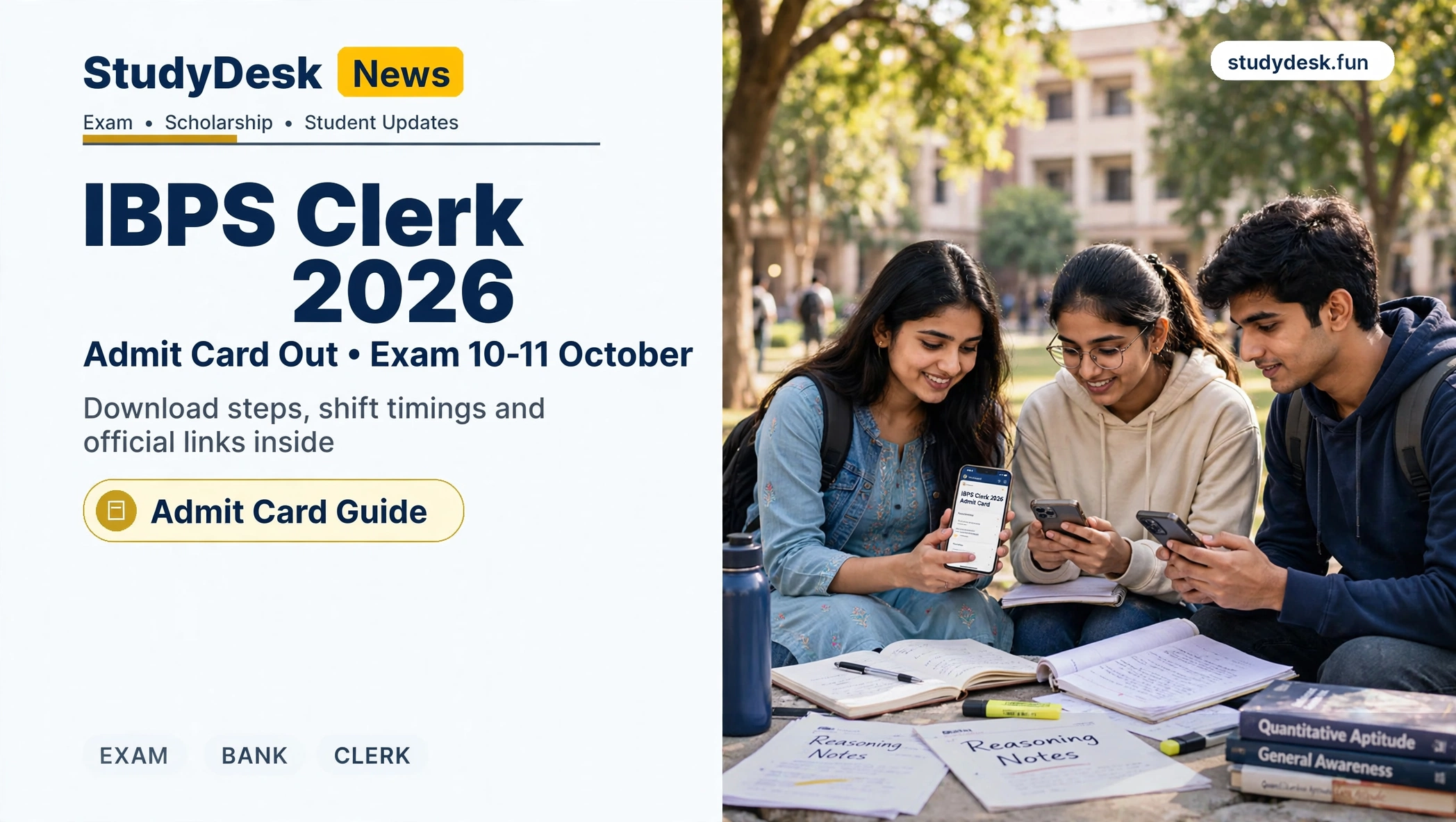
IBPS Clerk 2026 (CRP CSA-XVI): prelims call letter released, exam on 10-11 October 2026, mains on 27 December 2026. Full schedule and download guide.
Complete guide to Siemens Scholarship Program 2026-27 (14th edition): eligibility, benefits for all four years, documents and how to apply on siemens.co.in/scholarship.
Bank of Baroda Wealth Management Services recruitment tracker for 1,000 regular-basis vacancies and the extended 1 October deadline.