 StudyDesk
The headline change: Class 10 now has two board examinations
From the 2026 examinations onwards, CBSE's two board examination system applies to Class 10. It works like this:
- The first board examination is compulsory for every Class 10 student. It is the main examination, held in the usual February–March window, covering the full year's syllabus.
- A second board examination follows in May, in the same academic year. It is optional and exists primarily so a student can improve performance in subjects they have already passed, or clear a subject under the categories CBSE permits.
- Where a student appears in both examinations in a subject, the better of the two scores is what counts in the final result — subject by subject. A weak second attempt cannot drag down a good first one.
- Practicals and internal assessment are not repeated for the second examination; the second attempt is a re-sit of the theory papers on the same full syllabus.
The logic comes straight from the National Education Policy 2020 and the National Curriculum Framework: one examination day should not decide a student's year. For a student, the practical consequence is a change in strategy as much as in stress — the February paper is now the attempt that matters most (it also feeds provisional admission to Class 11), with May as a genuine, score-protected second chance rather than a punishment compartment exam.
Class 12 is not part of this system. Class 12 students in 2026–27 still face a single board examination in the February–April window, with the usual supplementary examination route after results for those who need it. Families who have read that "CBSE boards are now twice a year" and assumed it covers Class 12 should correct that assumption now.
Dates: what is known, and what is not
CBSE has not yet published the subject-wise date sheet for the 2027 examinations as of this writing, and any day-by-day timetable you may have seen shared as an image is a prediction, not a release. The Board historically publishes the final date sheet between late November and mid-December on cbse.gov.in.
What can be said from the Board's established calendar and the first two-exam cycle:
- In the 2026 cycle, the first Class 10 examination began on 17 February 2026, and the second examination began on 15 May 2026. Expect the 2027 cycle to follow the same shape: theory examinations for both Class 10 (first examination) and Class 12 starting in mid-February 2027, Class 12 running into early April, and the Class 10 second examination in May 2027.
- List of Candidates (LOC) submission by schools — the step that locks in who is appearing and in which subjects — runs through September–October for the 2027 examinations (normal window to 21 October 2026, late window to 30 October, correction window 2–4 November). If you are a student, your school is handling this now; if subjects look wrong on any school communication, raise it immediately, because LOC data drives admit cards.
- Practical examinations and internal assessments for regular (non-winter-bound) schools are conducted from 1 January 2027 onwards; winter-bound schools run theirs in November–December 2026.
- Results follow the new rhythm too: with a May second examination, the final Class 10 picture completes later than the old single-result May announcement — another reason the February attempt deserves full effort.
The paper itself: competency questions are the pattern now
CBSE's sample question papers and marking schemes for 2026–27, published on the academic website (cbseacademic.nic.in), continue the assessment design of recent years: at least 50% of the marks in Class 10 and 12 question papers are competency-focused — case-based and source-based questions, assertion-reasoning items, and other questions that test whether you can use a concept on unfamiliar material, rather than reproduce a memorised paragraph. Constructed-response (short and long answer) questions make up roughly 30% of the paper. The remaining share is objective questions beyond the competency set.
The study implication is concrete: NCERT text, exemplars and the Board's own sample papers are the preparation core, and reading a chapter without practising its application-based questions is now only half preparation. Download the 2026–27 sample paper and marking scheme for every subject you are taking — the marking scheme, in particular, shows you exactly what an examiner is instructed to reward.
The standing rules students forget
- Attendance: a minimum of 75% attendance is required to be eligible to appear, with condonation only in defined cases such as medical grounds or participation in recognised national-level sports. Shortfalls discovered in January are rarely recoverable.
- Passing standard: you need 33% to pass — in Class 12, 33% separately in theory and in practical/internal assessment; check your subject's exact scheme where a subject mixes the two.
- Admit cards come through your school. CBSE does not operate a student self-download for regular candidates; your roll number slip is issued by the school, and errors on it (name, subjects, photograph) must be corrected through the school the moment you see the card, not at the exam centre.
What to do this term
Class 10 students: plan for February as the real examination, complete the syllabus once by December, and use CBSE's sample papers under timed conditions from January. Keep May in reserve as insurance, not as the plan. Class 12 students: nothing about your single-examination structure has changed, so the only 2026–27-specific task is to track the official date sheet when it appears on cbse.gov.in — and to ignore every version of it that arrives earlier from anywhere else.
Sources & verification
Checked against official Central Board of Secondary Education (CBSE) academic circulars and public notifications.
Frequently asked questions
Does the two board examination system apply to Class 12?
No. The two board examination system applies to Class 10; Class 12 students in 2026–27 still face a single board examination in the February–April window.
Is the second Class 10 board examination compulsory?
No. The first board examination is compulsory for every Class 10 student and the second examination, following in May, is optional; where a student appears in both in a subject, the better of the two scores counts.
Has CBSE published the 2027 subject-wise date sheet?
No. CBSE has not yet published the subject-wise date sheet for the 2027 examinations as of this writing, and the Board historically publishes the final date sheet between late November and mid-December on cbse.gov.in.
How much attendance is required to appear in CBSE board exams?
A minimum of 75% attendance is required to be eligible to appear, with condonation only in defined cases such as medical grounds or participation in recognised national-level sports.
What is the passing standard for CBSE board exams?
You need 33% to pass — in Class 12, 33% separately in theory and in practical/internal assessment.
When are practical examinations held?
Practical examinations and internal assessments for regular (non-winter-bound) schools are conducted from 1 January 2027 onwards; winter-bound schools run theirs in November–December 2026.
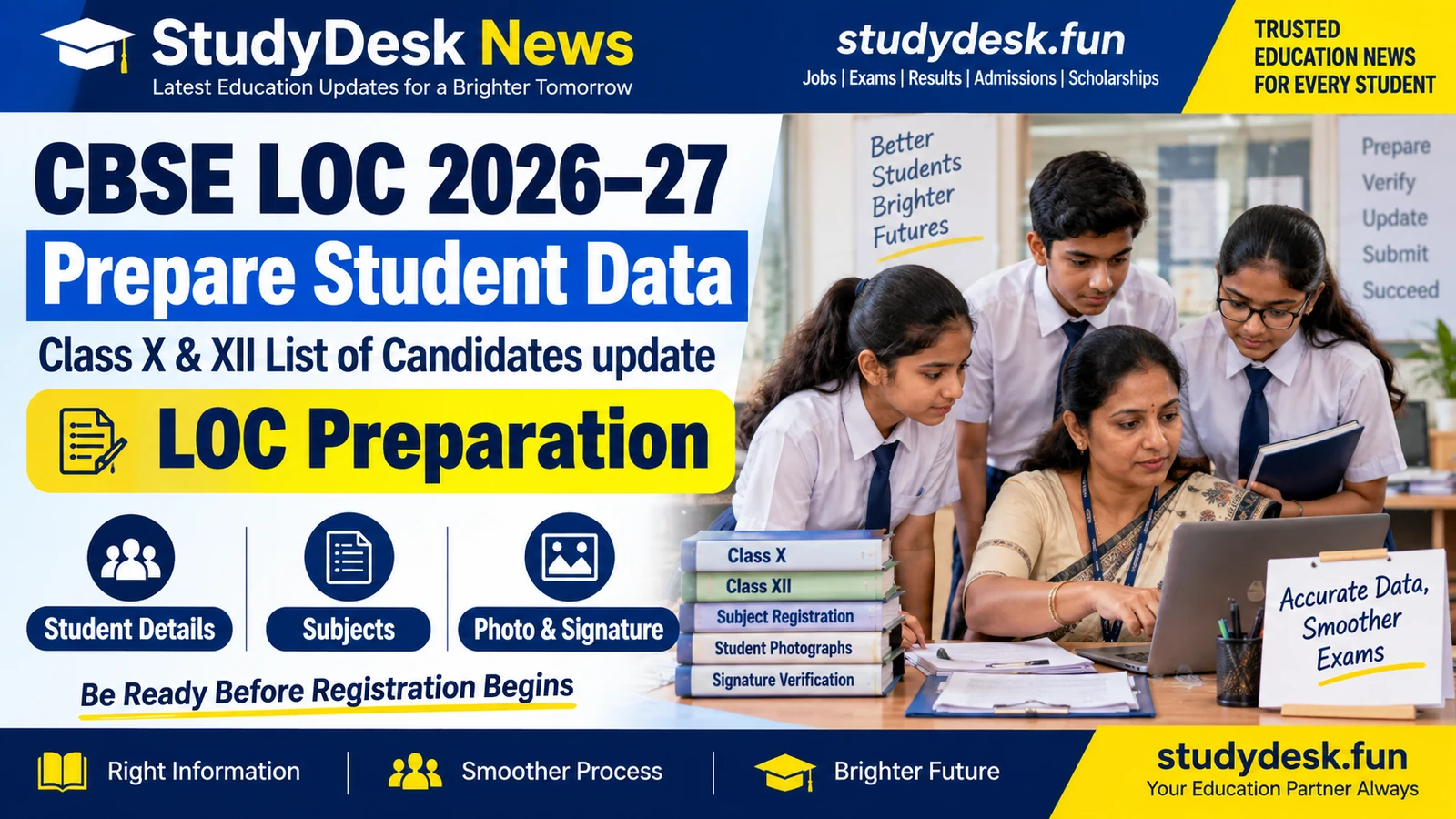
CBSE prior intimation for the 2026–27 examination cycle on preparing accurate student data before Class X/XII LOC submission.
CBSE Class 12 date sheet 2027 tracker with official timetable status, practical/project context and clear separation from the completed 2026 cycle.
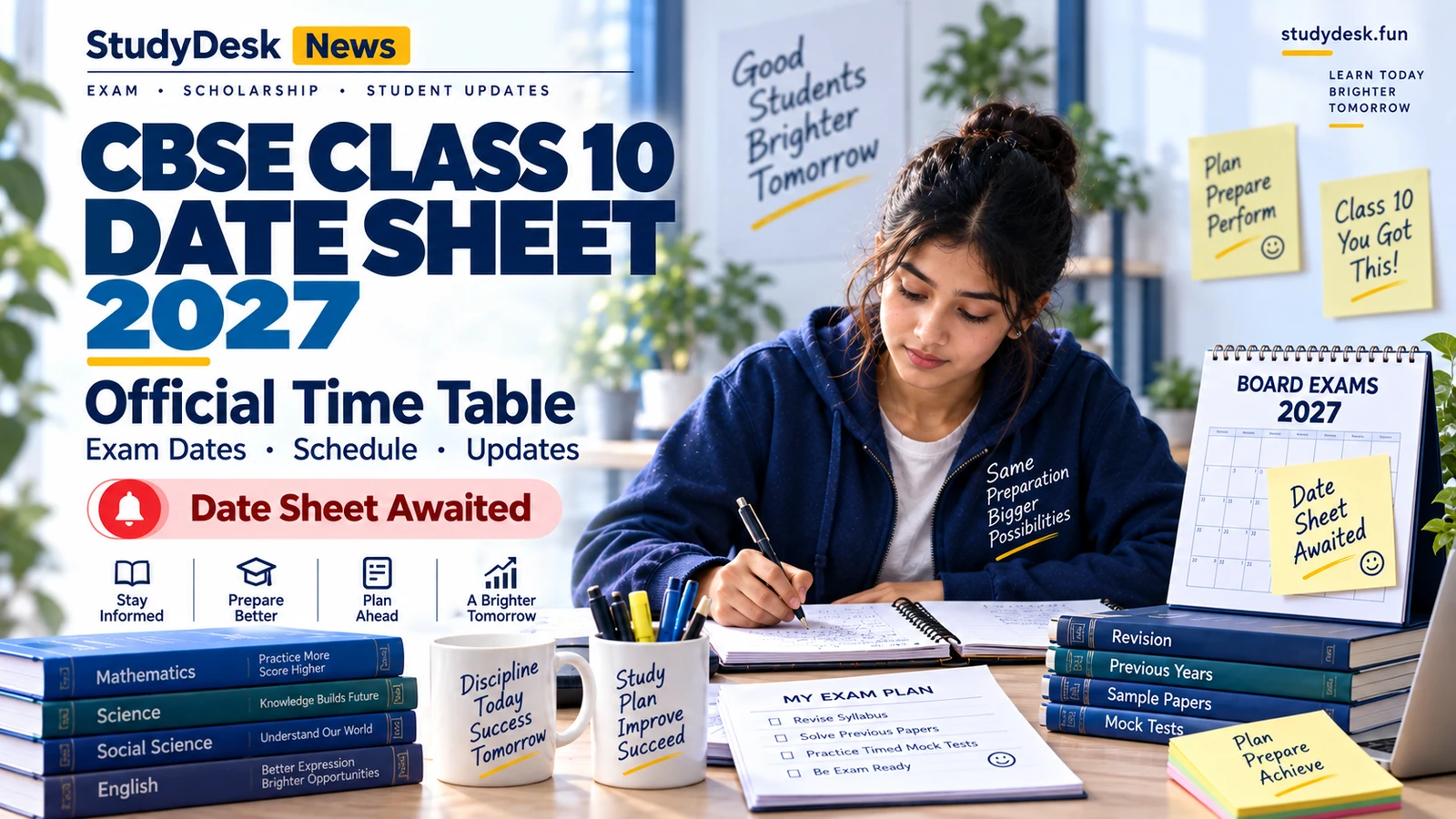
CBSE Class 10 date sheet 2027 tracker with the final timetable status, official circular source and clear separation from the 2026 board/second-board schedule.
A direct guide to official CBSE sample question papers and marking schemes for the 2026–27 academic session.
Complete CBSE 2027 board-exam hub connecting Class 10/12 date sheets, sample papers, Class 10 second-board updates, results and official circulars.