 StudyDesk
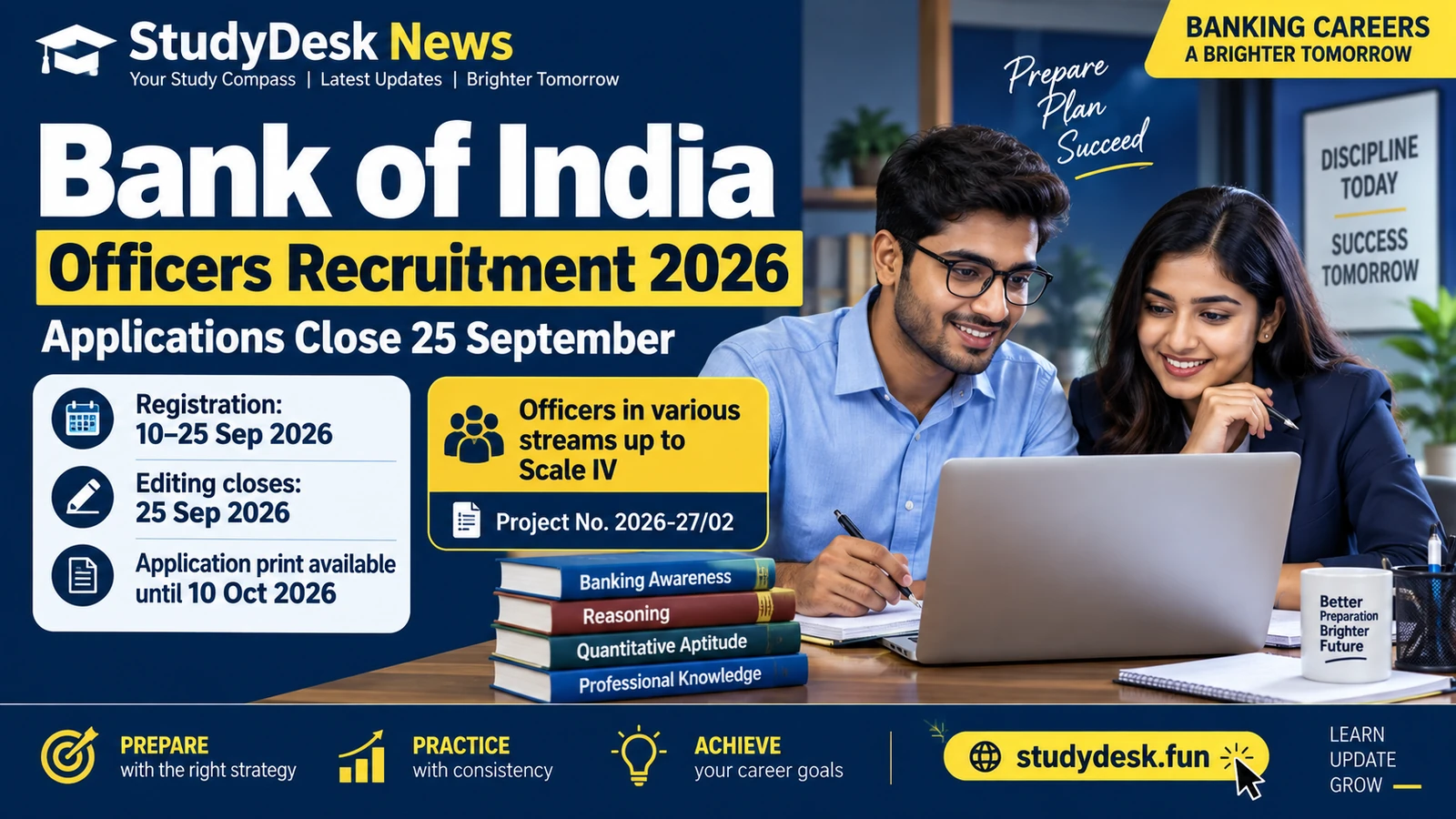
Bank of India Officers Recruitment 2026: 205 Specialist Posts, Registration Closed — What Happens Next
Bank of India closed online registration on 5 October 2026 for one of the larger specialist-officer intakes of this banking season: 205 officer vacancies in specialist streams up to Scale IV, under Project No. 2026-27/02 (Notice dated 1 August 2026). If you applied, your next action is narrow and time-sensitive — the last date for printing your submitted application is 20 October 2026. If you missed the window, this guide explains exactly what was on offer and how the selection will run, so you can judge whether the next cycle is worth preparing for.
What was recruited, and at what pay
All 205 posts are Specialist Officer (SPL) positions, concentrated heavily in technology, digital banking and information security, with smaller numbers in law, fire, security and civil engineering:
- Scale IV (Chief Manager): 10 posts — full-stack engineering, digital platforms, supply-chain/trade-finance technology, digital banking operations, IT procurement and information security. Age 28–40 for most posts; the Information Security Chief Manager post runs 32–42, and the CISA/CISM/CISSP IT Officer post 28–42.
- Scale III (Senior Manager): 49 posts — dominated by engineering, data, Finacle support, infrastructure, architecture and information security roles. Age 28–37 for most; the CISA/CISM/CISSP Senior Manager post runs 28–40.
- Scale II (Manager): 118 posts — the biggest block: full-stack and decisioning engineering, digital platforms, application support, infrastructure, testing, data analytics, UI/UX, information security, plus 10 Law Officer posts (age 25–30), 2 Fire Officer posts and 10 Security Officer posts. Most Scale II posts are 25–35; Manager–Information Security is 25–32 and the CISA/CISM/CISSP Manager post is 27–35.
- Scale I (Officer): 28 posts — entry-level engineering, application support, data analytics and engineering, QA, information security (most posts age 21–30; Information Security posts 22–30) and 10 Civil Engineer posts (age 25–30).
Basic pay runs from ₹48,480–85,920 for JMGS-I, ₹64,820–93,960 for MMGS-II, ₹85,920–1,05,280 for MMGS-III and ₹1,02,300–1,20,940 for SMGS-IV, plus applicable allowances and perquisites. Vacancy numbers are provisional and include backlog; the bank states it may vary them against actual requirements. Posting is anywhere in India — the notification is blunt that only candidates ready to work anywhere should have applied.
Every post, counted: the full 205-vacancy table
Scale totals hide where the competition actually is. The post-wise split (all 48 specialist posts) is:
Scale IV — Chief Manager (10): Full-Stack Engineering 2 · Digital Platforms 1 · Supply Chain, Trade Finance Technology 1 · Digital Banking Operations 2 · IT Procurement, Contracts & SLA Management 1 · IT Officer with CISA/CISM/CISSP 1 · Information Security 2
Scale III — Senior Manager (49): Full-Stack Engineering 12 · Digital Platforms 2 · Finacle Application Support 3 · Infrastructure Operations 3 · Solution & Technology Architecture 3 · Data Engineering 4 · API Governance & Security 4 · DevSecOps Engineering 3 · IT Procurement Specialist 2 · Database Administration 2 · Information Security 6 · IT Officer with CISA/CISM/CISSP 5
Scale II — Manager and officers (118): Full-Stack Engineering 18 · BRE/LOS/Decisioning Engineering 4 · Digital Platforms 5 · Application Support & Operations 11 · Infrastructure Operations 12 · IT System Administrator 2 · Performance Testing 2 · Automation Testing 3 · IT Procurement Specialist 4 · IT Project Manager 3 · Business Analysis 2 · Data Analytics 5 · DevSecOps Engineering 3 · UI/UX Design 2 · Emerging Technology & Innovation 2 · Solution & Technology Architecture 2 · Database Administration 1 · Information Security 8 · IT Officer with CISA/CISM/CISSP 7 · Law Officer 10 · Fire Officer 2 · Security Officer 10
Scale I — Officer (28): Full-Stack Engineering 6 · Application Support & Operations 4 · Data Analytics 2 · Data Engineering 2 · QA & Test Engineering 2 · Information Security 2 · Civil Engineer 10
Read the table strategically: at a 1:3 interview ratio, a 1-vacancy post (Manager–Database Administration, several Scale IV posts) calls roughly three candidates — your real contest is document shortlisting, not the test. Conversely, Full-Stack Engineering (38 posts across scales) and Information Security (26 posts across scales) are where volume gives a well-qualified candidate the most room.
Who was eligible
Age, qualification and experience were all reckoned as on 1 August 2026. Candidates had to be citizens of India (or subjects of Nepal/Bhutan, pre-1962 Tibetan refugees, or persons of Indian origin in the listed categories holding a Government of India eligibility certificate). Detailed post-wise qualifications and experience are in Annexure-I of the notification. Where a minimum of 60% marks was stipulated, reserved-category candidates applying against reserved vacancies got a 5% relaxation to 55% — and the fraction rule is unforgiving: 59.99% counts as less than 60%. Upper-age relaxations: 5 years for SC/ST, 3 years for OBC (non-creamy layer), 10 years for PwBD, plus the standard provisions for ex-servicemen and persons affected by the 1984 riots. Two hard rules caught people out every cycle: you could apply for only one post (multiple applications meant only the latest valid one was kept and the other fees were forfeited), and anyone who previously held the same post in Bank of India was not eligible at all.
The application fee, non-refundable and paid online, was ₹1,180 (application fee plus intimation charges, GST included) for General/EWS/OBC candidates and ₹175 (intimation charges only) for SC/ST/PwBD candidates.
How the application ran — and why the print date matters
Applications opened on 10 September 2026 through the bank's website (bankofindia.bank.in → CAREER → the Project No. 2026-27/02 link → APPLY ONLINE). The original closing date of 25 September was extended: registration, editing and fee payment finally closed on 5 October 2026, and the application-print facility, originally ending 10 October, runs until 20 October 2026. That print is not a courtesy copy. At interview, candidates must produce the interview call letter, the system-generated printout of the online application form, proof of date of birth, photo ID, mark sheets and certificates (with a document showing the result was declared on or before 1 August 2026), category certificates (OBC non-creamy-layer certificates must be issued on or after 1 April 2026; EWS income and asset certificates must be based on FY 2025–26 income), disability certificates where applicable, and a No Objection Certificate if you work in government, a PSU or a nationalised bank. If you applied and have not yet saved the print and the fee e-receipt, do it by 20 October — there is no later reprint stage promised in the notice.
Uploads at registration were scanned photograph (20–50 KB, JPG/JPEG, plus a live photo capture), signature in black ink (10–20 KB, not in capital letters), left thumb impression (20–50 KB) and a handwritten declaration in English (50–100 KB), along with degree certificates, mandatory professional certifications and experience proofs. Shortlisting itself was done from those uploaded documents — the notification states no later request to submit eligibility documents will be entertained.
The declaration had to be this exact text, in your own handwriting, in English, in black ink on white paper, not in capital letters (image 50–100 KB, preferably 800 × 400 pixels): "I, _______ (name of the candidate), hereby declare that all the information submitted by me in the application form is correct, true and valid. I will present the supporting documents as and when required." A typed, capital-letter or differently worded declaration is a standard rejection ground in bank SO recruitments — if you are preparing for the next cycle, practise producing this file cleanly rather than improvising it on registration day.
The cost nobody budgets for: the refundable security deposit
Selected candidates must deposit a refundable security amount, returned only after three years of satisfactory service and liable to be forfeited if you leave the bank before completing those three years: ₹1,00,000 for JMGS-I (Scale I), ₹2,00,000 for MMGS-II (Scale II), and ₹3,00,000 for MMGS-III and above (Scales III–IV). This is a genuine decision factor, not a footnote: a Scale III appointee needs ₹3 lakh available at joining, on top of relocation to an anywhere-in-India posting. Factor it in before you celebrate an interview call — and treat any "agent" offering to arrange the deposit as a fraud signal; the bank takes it directly under the appointment terms.
How selection will work
Selection is through an online test and/or personal interview, depending on the number of applicants. The bank expressly reserves the option to skip the online test and interview shortlisted candidates directly on qualification, experience and suitability. If the online test is held, its structure is:
- English Language — 25 marks, qualifying only; these marks are not added to the merit list
- Professional Knowledge relevant to the post — 100 marks
Both papers run in a composite 100 minutes; everything except English is bilingual (English and Hindi). The minimum qualifying mark in each test is 35% for General/EWS, with a 5% relaxation for SC/ST/OBC/PwBD candidates against reserved vacancies. Wrong answers cost one-fourth of the question's marks; blank answers cost nothing.
The interview carries 100 marks, with qualifying marks of 50% for General/EWS and 45% for SC/ST/OBC/PwBD. Candidates are called at a 1:3 ratio to vacancies, which the bank may vary. When both stages are held, the final merit combines them at 60:40 (online test : interview), using the Professional Knowledge score for the test component; ties are broken first by the online-test score, then by seniority of age. If the test is dropped, merit is on interview marks alone, ties broken by age.
Worked example — how the 60:40 merit is actually built: suppose you score 70/100 in Professional Knowledge and 60/100 in the interview. Your merit score is (70 × 0.6) + (60 × 0.4) = 42 + 24 = 66. English does not enter this number at all — it only gates you. Two practical consequences: a 10-mark interview gain is worth 4 merit marks, while a 10-mark test gain is worth 6 — so if both stages are held, test preparation has the higher payoff per mark; and because interview qualifying (50%/45%) is a floor rather than the contest, the contest is won in Professional Knowledge. Note that some aggregator pages still print an 80:20 ratio for this recruitment — the notification's ratio is 60:40, and it is the notification that governs.
Exam date status, stated plainly: the notification lists the online examination date only as "will be advised separately." No exam date, admit-card window or result schedule had been announced when this was written. Expect the call letter and an Information Handout to appear on the bank's website; anyone quoting you a specific exam date today is guessing. Keep your registered email and mobile active — the bank communicates call letters through them — and keep the application print and e-receipt safe until the process closes.
Sources & verification
Re-checked the official IBPS application portal today. Registration, editing and fee payment closure dates were extended from 25 September to 5 October 2026 and have now passed; the last date for printing the application was extended from 10 October to 20 October 2026.
Frequently asked questions
When is the Bank of India SO exam 2026?
Not announced. The notification says the date "will be advised separately"; the call letter and Information Handout will appear on bankofindia.bank.in. Any specific date circulating now is a guess.
Can the bank really skip the online test?
Yes — the notification expressly reserves selection by interview alone, with shortlisting on qualification, experience and the documents you uploaded at registration. That is why the upload stage mattered: there may be no later chance to produce a missing certificate.
I applied for two posts by mistake. What happens?
Only your latest valid application is retained; the fee for the other registration is forfeited. There is no clubbing or transfer of applications.
Is the security deposit really refundable?
Yes, after three years of satisfactory service. Leave earlier and it can be forfeited. Amounts: ₹1 lakh (Scale I), ₹2 lakh (Scale II), ₹3 lakh (Scales III–IV).
What if I miss the 20 October application-print deadline?
The notification promises no later reprint facility. The printout is a required interview document, so if you have not saved it, do so today — and save the fee e-receipt with it.
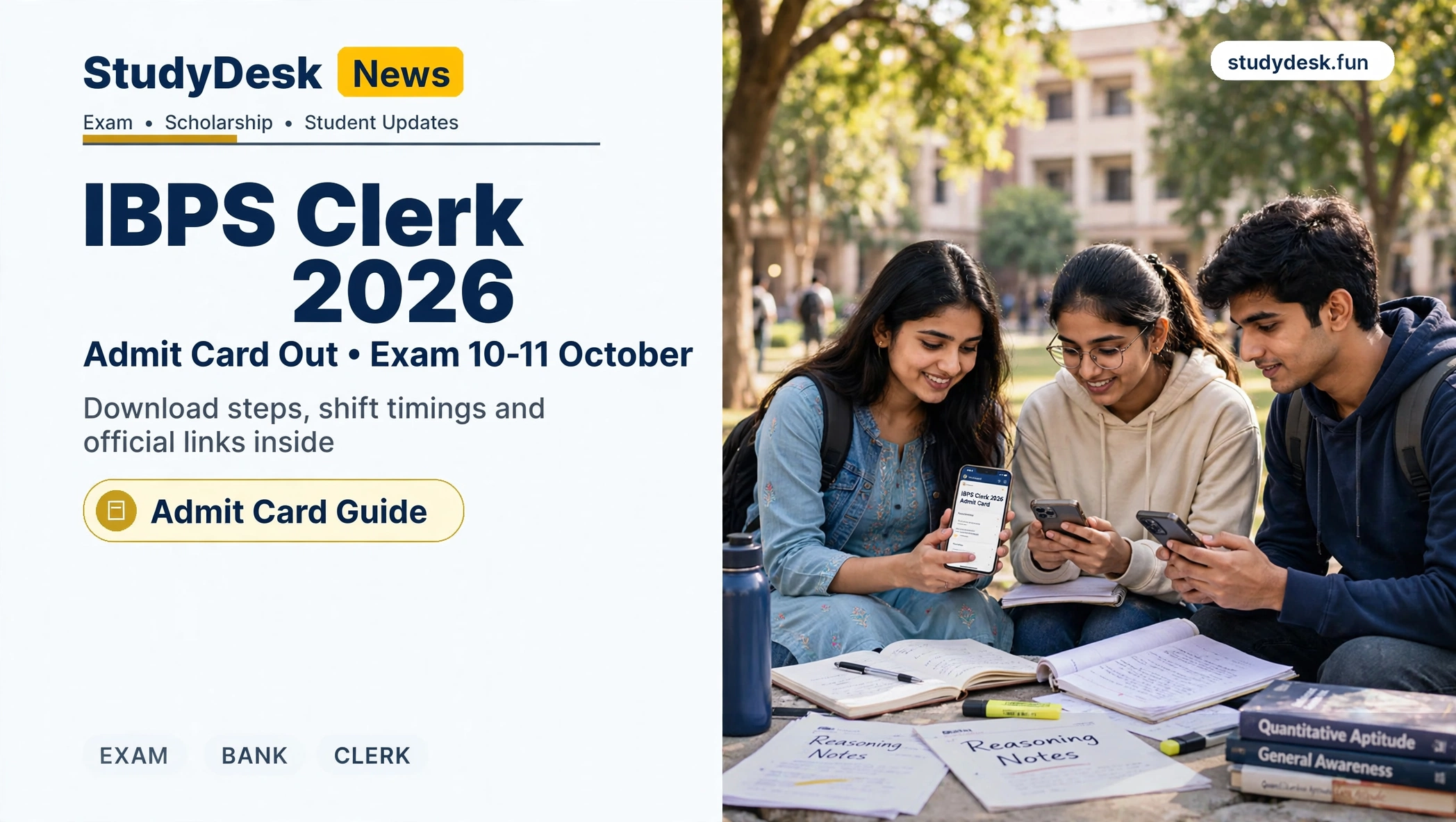
IBPS Clerk 2026 (CRP CSA-XVI): prelims call letter released, exam on 10-11 October 2026, mains on 27 December 2026. Full schedule and download guide.
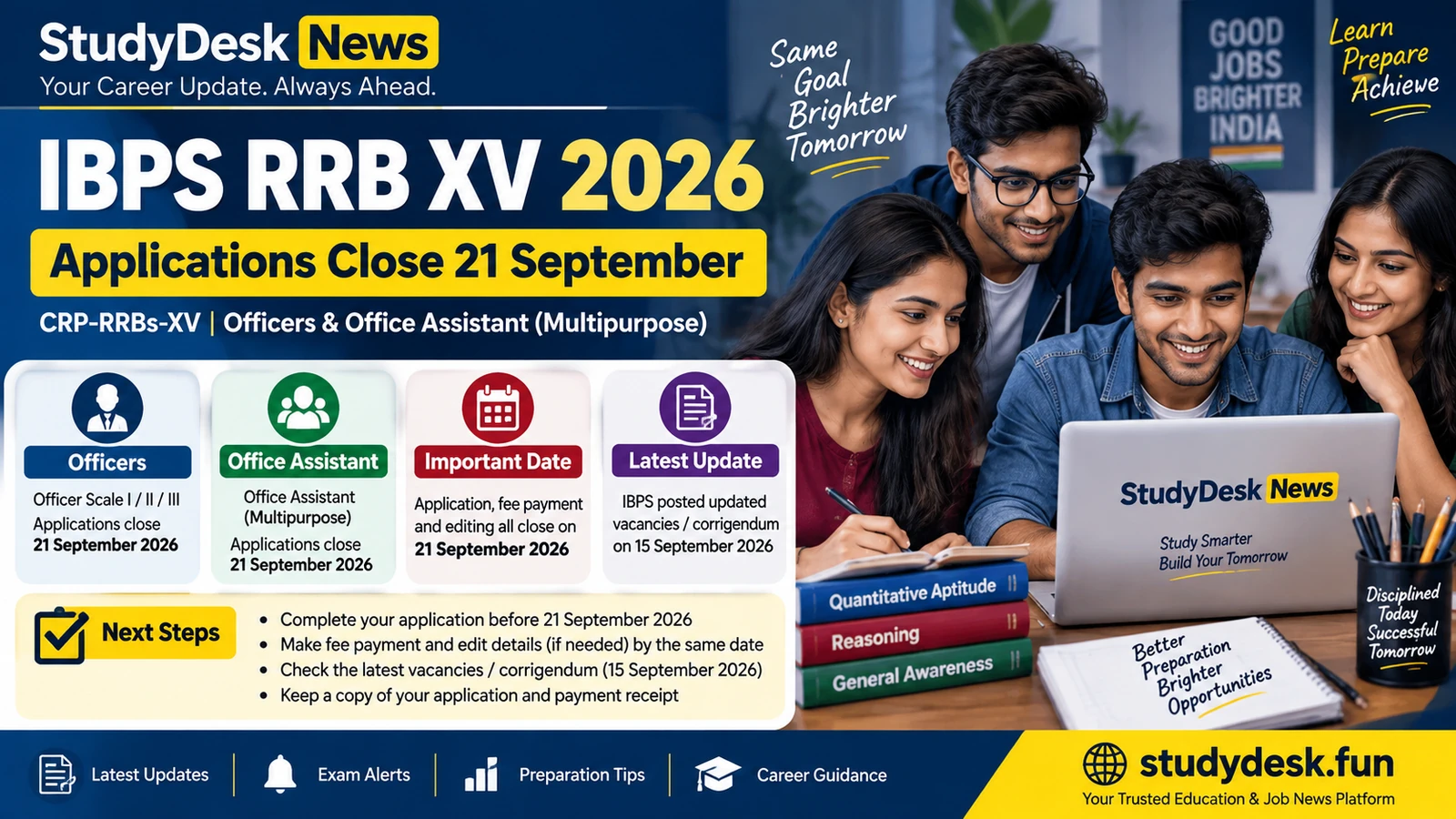
IBPS RRB XV 2026 application closure status, extended deadline, updated-vacancy status and next steps.
SBI PO 2026 recruitment: mains exam held 12 September, result awaited, Phase 3 (psychometric test, group exercise, interview) next.
SBI Clerk 2026 (Junior Associate) recruitment: 9,766 vacancies, prelims held 26-27 September 2026, mains tentatively in November 2026.
Complete guide to IBPS PO 2026 (CRP PO/MT-XVI): mains exam held, result expected in November 2026, interview and allotment schedule.