 StudyDesk
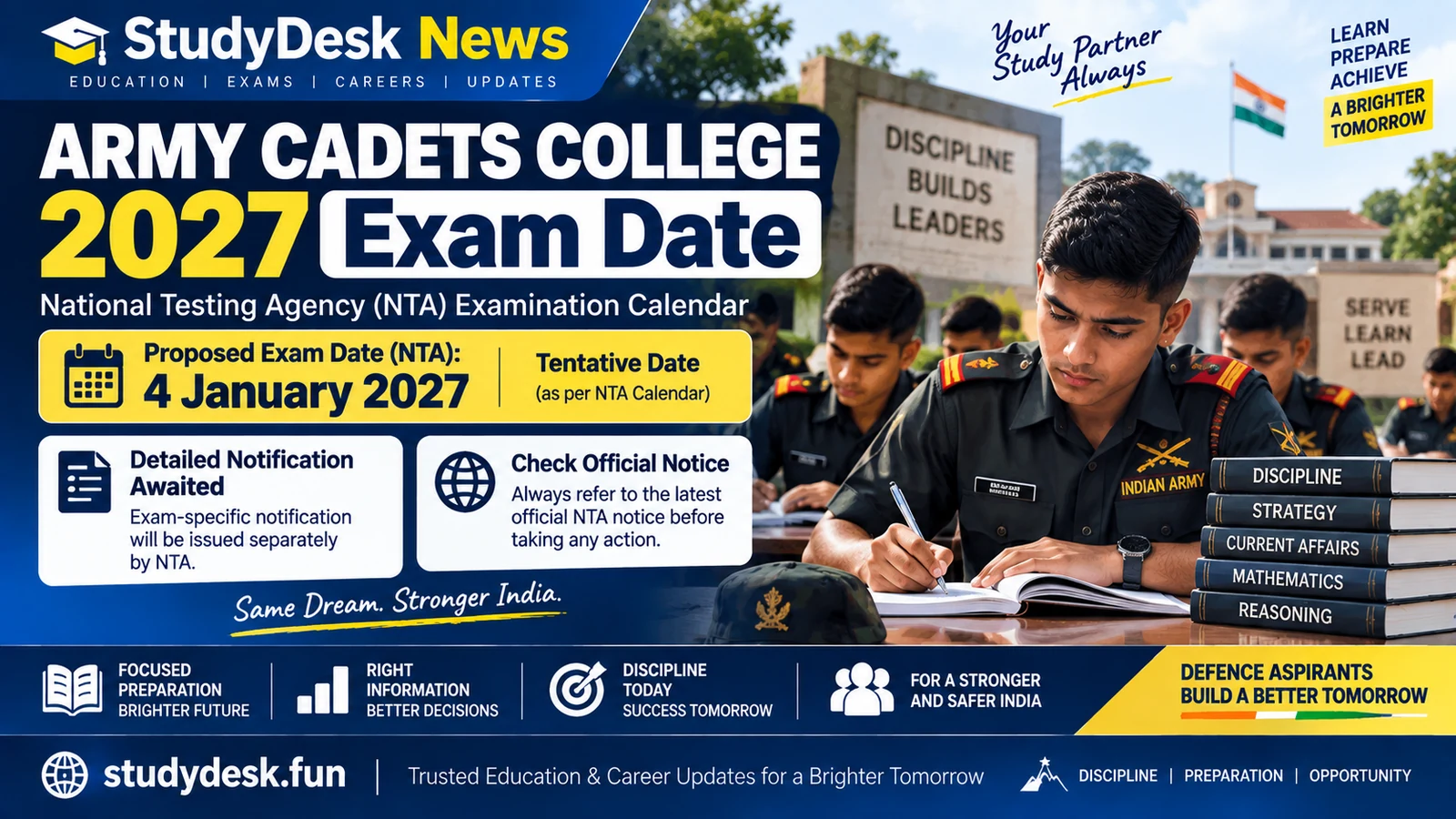
Army Cadets College 2027: NTA's calendar proposes 4 January — but this is not the notification
The Army Cadet College entry is unlike almost every other examination on India's calendar, because the people who sit it are already soldiers. The Army Cadet College (ACC) Wing at the Indian Military Academy, Dehradun, exists to take serving personnel — soldiers, and personnel from the other services — and train them for a commission as officers in the Indian Army. It is a lateral, in-service route: there is no civilian application, no public coaching funnel that ends in a form any school-leaver can fill. If you are not in uniform, this examination is not for you; if you are, it is one of the most significant career doors the services offer.
For the 2027 cycle, the only firm public fact so far is a date on a calendar. The National Testing Agency's examination calendar up to March 2027, issued on 16 September 2026, lists the Army Cadets College examination on 4 January 2027, as a one-day examination. NTA is explicit that this calendar is tentative — it is a planning document covering 14 examinations from December 2026 to March 2027, and the agency states the dates are subject to change owing to administrative, academic, statutory, logistical or other unforeseen circumstances. The calendar does not constitute the detailed notification for the ACC examination: it carries no eligibility rules, no application window, no syllabus and no centre list. Treat 4 January as the date to plan preparation and leave around, not as a guarantee. For scale, ACC sits in the same calendar as JEE (Main) Session 1 (22–30 January 2027) and CUET (PG) in March 2027 — it is one line in a national schedule, not a recruitment notice.
How the ACC entry normally works
Because the detailed 2027 notification is still awaited, the honest way to describe this entry is by its established structure — the pattern the Army has used for this entry across cycles — while being clear that the binding details for 2027 will be those in the official circular.
ACC selection runs in stages. Eligible serving personnel apply through service channels — applications move through the candidate's unit and records office rather than through a public portal open to civilians, typically after unit-level screening by the commanding officer. Shortlisted candidates then sit a written examination, and those who qualify in the written test go before the Services Selection Board (SSB) for the five-day personality and leadership assessment used for officer selection, followed by a medical examination to officer standards and a final merit list.
The long-standing eligibility conditions reported for this entry are: the candidate must be serving personnel (Personnel Below Officer Rank from the Army, Navy or Air Force); a minimum of two years of service is required on most published accounts; the educational floor is 10+2 or an equivalent qualification; the age band is most commonly reported as 20 to 27 years, with no caste/community relaxation on age; and both married and unmarried personnel have been eligible. A clean service record — good annual confidential reports and no recent red-ink entry — and the commanding officer's recommendation matter in practice: this is a selection that reads your record, not just your answer sheet. Every one of these figures must be confirmed against the 2027 circular when it reaches your unit, because in-service entries are governed by that circular, not by articles like this one. Note the one genuine disagreement in published sources: the age/service floor at course commencement is stated differently in some references (see Flags), which is exactly why the circular, when it arrives, outranks everything written here.
The written test, as it has historically been structured
Recent ACC written examinations have comprised four papers, each of two hours and 300 marks on the accounts that break the pattern down in detail:
| Paper | Subject | Structure reported |
|---|---|---|
| I | General Mental Ability Test (GMAT) | Verbal reasoning, non-verbal reasoning and numerical ability — objective |
| II | Current & General Awareness Test (CGAT) | 150 objective questions, 300 marks |
| III | Interactive Communicative English (ICE) | Part I objective (120 questions) + Part II descriptive, 300 marks combined |
| IV | Academic Content Test (ACT) | Mathematics, general science and humanities at 10+2 level — objective |
Two qualifications belong with this table. First, some coaching sources describe a newer single-paper format of six 50-mark sections, which does not match the four-paper accounts — another reason to wait for the bulletin rather than build a study plan on any one source. Second, the ACC Wing's own description states the written syllabus is the same as the Combined Defence Services (CDS) written examination, so CDS-level material is the safest preparation base while the 2027 bulletin is awaited. What is not in doubt is the sequence after the written test: SSB, medical board, merit list.
ACC is not NDA, and it is not CDS
| Route | Who enters | Entry point | Training |
|---|---|---|---|
| NDA | Civilians after Class 12 | UPSC written + SSB | 3 years at NDA, Pune, then service academy |
| CDS | Graduates (civilian) | UPSC written + SSB | Direct to IMA/OTA and other academies |
| ACC | Serving PBOR only | Unit screening + written + SSB | 3 years at ACC Wing, Dehradun (degree course), then 1 year at IMA |
The ACC distinction matters practically: your competitors are experienced soldiers, your application is a service document, and your service record is part of your candidature in a way no civilian examination replicates.
Training, for those finally selected, is a substantial commitment: three years at the ACC Wing in Dehradun on a degree course (B.Sc./B.A., affiliated to Jawaharlal Nehru University) followed by one year of pre-commission training at the Indian Military Academy before commissioning as a Lieutenant — four years in total. That length is precisely why the age ceiling exists and why candidates should think through family and service implications before applying, not after selection.
What serving aspirants should do now
Working backwards from 4 January 2027, you have roughly eleven weeks from late October. First, register the date correctly: 4 January 2027 is NTA's proposed written-examination date. Second, watch the right channels — the detailed notification and the Army's internal circular through your unit, company office and records office. In-service examinations do not always surface on public websites with the fanfare of civilian recruitments, and missing an internal deadline because you were waiting for a news alert is the most common and most avoidable failure in this entry. Third, start preparation on the established footing of the written test — reasoning and numerical ability, current and general awareness, communicative English (including descriptive writing, which most serving candidates neglect), and mathematics/science/humanities at 10+2 level. Fourth, keep your service documents in order.
Document and record checklist (prepare before the circular lands):
- Service record / service book extract showing date of enrolment and years of service
- 10+2 certificate and mark sheet, plus any higher qualification certificates — names and dates of birth must match your service record exactly
- Annual confidential reports in order; know your last red-ink position before your commanding officer does the screening
- Service identity card and unit recommendation paperwork as your formation requires
Two warnings bear repeating. Do not pay any agent or unofficial portal in connection with this entry — ACC applications do not work that way, and any website asking a civilian to "apply online for ACC 2027" for a fee is not an official channel. And do not treat the tentative calendar date as final: NTA itself reserves the right to move it. The sequence to wait for is detailed notification first, unit circular second, application third — in that order.
Sources & verification
StudyDesk separates tentative calendar dates from final exam-specific notices. Recheck the issuing authority before application, payment, counselling, recruitment or exam-day action because later notices may supersede this page.
Frequently asked questions
When is the Army Cadets College exam in 2027?
The National Testing Agency's examination calendar up to March 2027, issued on 16 September 2026, lists the Army Cadets College examination on 4 January 2027 as a one-day examination. NTA states the calendar is tentative and dates are subject to change.
Can civilians apply for Army Cadets College?
No. There is no civilian application — ACC is a lateral, in-service route for serving personnel, and eligible serving personnel apply through service channels via their unit and records office.
Has the detailed ACC 2027 notification been published?
No. The calendar carries no eligibility rules, application window, syllabus or centre list, and the detailed notification for this cycle had not been published in the official sources checked for this page.
What happens after the ACC written test?
Candidates who qualify in the written test go before the Services Selection Board (SSB) for its five-day personality and leadership assessment, followed by a medical examination to officer standards and a final merit list.
How long is ACC training?
Training is three years at the ACC Wing in Dehradun on a degree course affiliated to Jawaharlal Nehru University, followed by one year of pre-commission training at the Indian Military Academy — four years in total before commissioning as a Lieutenant.
What should I prepare for the ACC written test?
The ACC Wing's own description states the written syllabus is the same as the Combined Defence Services (CDS) written examination, so CDS-level material is the safest preparation base while the 2027 bulletin is awaited.

Official NTA examination calendar published 16 September 2026 with tentative dates through March 2027.

JEE Main 2027 exam-date tracker for Session 1 and Session 2 with expected planning windows kept separate from official NTA announcements.

Current SSC CGL 2026 Tier-I exam-window, admit-card and city-information tracker.

NTA’s examination calendar up to March 2027 places the UGC NET December 2026 cycle in mid-December with buffer dates reserved.

A Bihar-first current exam hub refreshed from BCECEB, BSEB, BPSC and STET sources on 19 September 2026.